

Commentary
Michael Young
{
  "authors": [
    "Michael Young"
  ],
  "type": "commentary",
  "blog": "Diwan",
  "centerAffiliationAll": "",
  "centers": [
    "Carnegie Endowment for International Peace",
    "Malcolm H. Kerr Carnegie Middle East Center"
  ],
  "englishNewsletterAll": "",
  "nonEnglishNewsletterAll": "",
  "primaryCenter": "Malcolm H. Kerr Carnegie Middle East Center",
  "programAffiliation": "",
  "programs": [],
  "projects": [],
  "regions": [
    "Yemen",
    "Gulf"
  ],
  "topics": []
}
Source: Getty
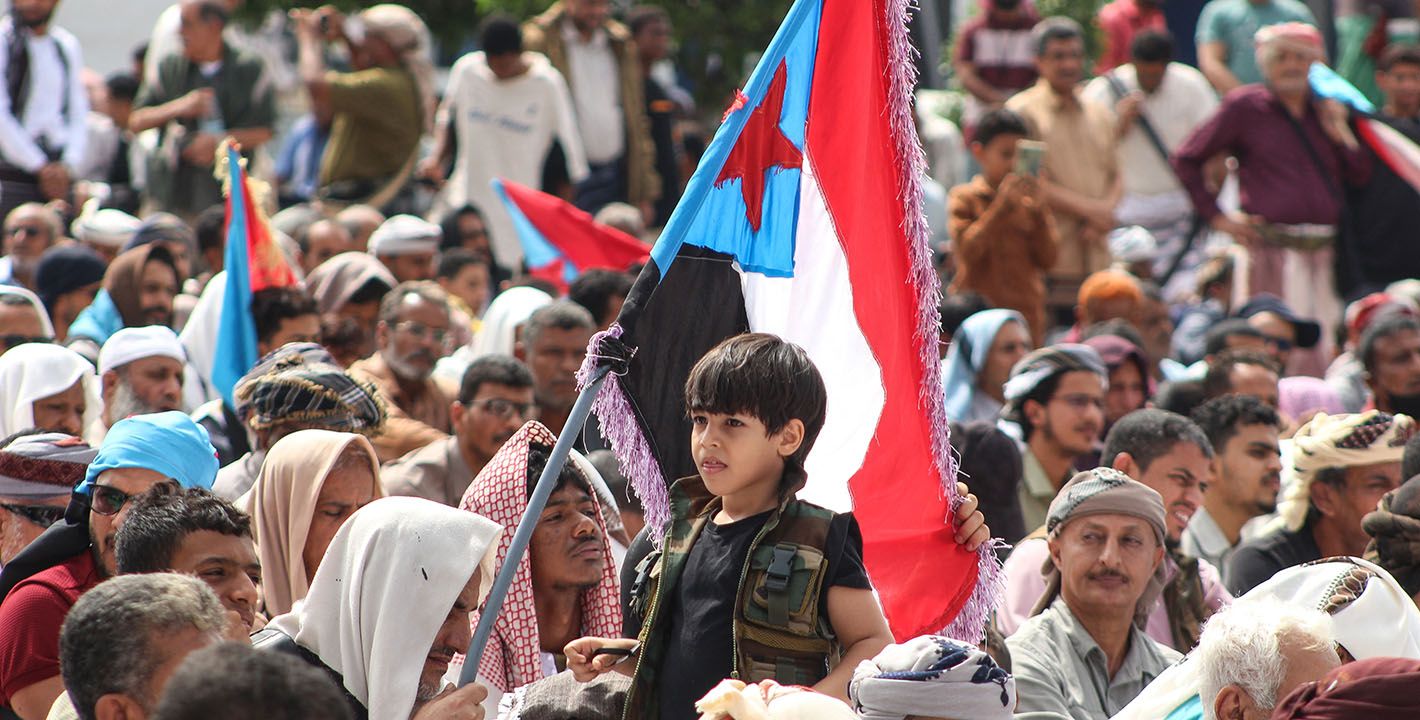
In an interview, Ibrahim Jalal discusses the Southern Transitional Council’s recent takeover of Hadhramawt and Mahra.
Ibrahim Jalal was previously a nonresident scholar at the Malcolm H. Kerr Carnegie Middle East Center, where he specialized on Yemen as well as on the evolving regional security architecture in the Middle East and North Africa. He has worked with the United Nations, the Middle East Institute, the Yemen Policy Center, the Overseas Development Institute, and Sussex University’s Institute of Development Studies. Diwan interviewed Jalal in mid-December, in order for him to explain recent developments in Hadhramawt and Mahra, in which the Southern Transitional Council took control of both governorates. In December 2024, he had written an article that provides a very useful backdrop to the developing situation today in Yemen.
Michael Young: What are the implications of the recent takeover of most of southern Yemen by the Southern Transitional Council (STC)? In what way does it represent a new phase in the Yemeni conflict?
Ibrahim Jalal: The STC’s recent takeover of Hadhramawt and Mahra, albeit uncontested and regionally orchestrated, has far-reaching implications. It exposes new fault lines in Saudi-Emirati relations, crosses the red lines of Yemen’s neighbors, threatens to shatter Yemen’s Presidential Leadership Council (PLC), and risks direct military confrontation between the Saudi-backed Nation Shield Forces and the UAE-backed, STC-aligned paramilitary groups. The new situation risks leading to the further destabilization of Hadhramawt and Mahra, especially undermining Hadhramawt’s social cohesion, relative stability, and tranquility since the expulsion of Al-Qaeda in the Arabian Peninsula in 2016. It also curtails the influence of Islah, diverts attention from Ansar Allah, better known as the Houthis, and increases intra-southern polarization.
Regionally, the takeover expands Emirati influence, and as increased military deployments near border crossings in Shinn, Surfeet, and Wadiaa show, adds to national security threat perceptions in Saudi Arabia and Oman. This can be seen as the UAE pushes back against growing Saudi pressure on the Sudan file, which was visible during Crown Prince Mohammed bin Salman’s meeting with President Donald Trump in November. The takeover also introduces new war narratives, weaponizes the counterterrorism card, creates openings for the Houthis and extremist organizations to exploit the potential vacuum, and complicates peacebuilding efforts.
Overall, the new map of control and influence characterizing this phase, which has not yet been consolidated, marks a qualitative shift, one that is far from representing a decisive endgame. The STC’s eastern push is an attempt at territorial and political reordering, eroding the authority of the recognized government of Yemen, in which regions long treated as buffer zones and typified by cross-border trade flows, energy resources, and relative peace, are becoming central battlegrounds.
MY: Is this the final stage in the years-long developments in the south? In other words, are we heading toward southern secession and a return to two Yemens, or are there forces powerful enough in the south to prevent such an outcome?
IJ: This is not the final stage of developments in the south, and is far from a fait accompli for Riyadh, Muscat, and PLC chief Rashad al-Alimi. The latest developments may soon face concerted pressure and rollback. Given the national security calculations of Yemen’s bordering states, this moment highlights the delusion of finality. It, instead, raises the political, social, diplomatic, and military costs for the STC and Hadhramawt. While an internationally-recognized secession [of the south] is complex—as the cases of Somaliland and Iraqi Kurdistan have shown—the withdrawal of STC-aligned forces from Hadhramawt and Mahra would expose the STC in its strongholds. The UAE-backed STC’s eastern push, while impressive, is strategically reversible, and much remains unfinished, especially if Riyadh leverages its geopolitical clout.
Southern secession, increasingly sought from 2007 on, does not enjoy universal support in the south. For instance, Hadhramawt and Mahra have long demanded autonomy or federalism within a Yemeni state, not secession. Bordering states with varying historical experiences with North and South Yemen favor a friendly regime in Yemen, not another undisciplined actor supported by a geographically non-bordering regional patron. They also seek predictable border security arrangements. Hence, the conflicts in the Red Sea and Gulf of Aden, such as those in Sudan and Somalia, coupled with the absence of a successful service delivery model in STC-held areas, have pushed the international community to ask whether secession will lead to a more stable state, or a failed one? How would secession contribute to strategic stability, including maritime security and containment of Houthi cross-border threats?
The multiplicity of actors and the distribution of territorial control in Yemen beyond the north-south divide suggest the ultimate outcome could be the emergence of more than just two entities—except if remaining pockets in the northwest were handed over to the Houthis. For now, the biggest challenges for the STC are three: whether it can deliver a viable governance model; whether it can introduce self-administration; and whether it can withstand regional pushback.
MY: Does the STC have the capacity to march on Sanaa, where Ansar Allah is based, and defeat the group? STC leader Aydarous al-Zubaydi has indicated that this is the intention, but it is unclear in that case whether the STC seeks secession or control of all of Yemen. What is your reading of this?
IJ: No, the STC alone does not have the capacity to march on Sanaa and defeat the Houthis, given the logistical, military, manpower, and command conditions that would be required to do so. However, it could be part of a broader coalition to achieve such an outcome. Therefore, Zubaydi’s statement can be seen as strategic signaling to speak on behalf of the PLC, despite disagreements within the institution. It could also have been aimed at discrediting Alimi and reassuring Saudi Arabia and the international community of Zubaydi’s commitment to countering Houthi cross-border threats, in the hope of normalizing the STC’s territorial gains. The STC seeks the consolidation of its power in the south, not control over all of Yemen.
MY: Where do you see Saudi-Emirati relations heading, insofar as Riyadh has supported the Yemeni Presidential Council, in which, paradoxically, the STC was represented, and preferred a negotiated solution to the Yemen conflict? Neither Saudi Arabia nor the UAE has an interest in entering into a confrontation with each other, but also, neither is willing to surrender its strategic priorities.
IJ: Recent Saudi-Emirati divergences in Yemen are unprecedented, reaching the most sensitive juncture yet. Particularly, they have gone beyond managed rivalry to become force projection near the Saudi borders and they signal a recalibration of engagement rules. This goes far beyond the competition taking place in the Gulf of Aden and the Red Sea basin, most visibly in Sudan and Eritrea. While the two allies had managed their differences through direct coordination channels, this may have reached a deadlock, considering the UAE’s transfer of the confrontation from Sudan into areas near the Saudi borders. The threat to Saudi and Omani national security interests has, as a result, deepened mistrust among Gulf states. Because neither the Saudis nor the Emiratis seeks a direct clash, both need to engage in candid high-level talks and agree over regional trade-offs—new understandings on spheres of influence or more collaborative efforts in Sudan and Yemen. The alternative is a further erosion of each side’s red lines, escalation, and the increased risk of miscalculation.
MY: How will Iran react to the latest developments, in light of the STC’s takeover of the south?
IJ: Iran views the recent developments as an opportunity to discredit the coherence of the anti-Houthi camp, the Saudi-led coalition, and the West in general. On December 14, the spokesman of the Foreign Ministry, Esmail Baghaei, said the situation in Yemen destabilized regional security and accused Western powers of trying to “fragment Middle Eastern countries” in line with “Israeli policies.” Iran and the Houthis benefit from the latest territorial reordering.

Editor, Diwan, Senior Editor, Malcolm H. Kerr Carnegie Middle East Center
Michael Young is the editor of Diwan and a senior editor at the Malcolm H. Kerr Carnegie Middle East Center.
Recent Work
Michael Young
Michael Young

Middle Eastern states should welcome an accelerated U.S. disengagement from their region.
Michael Young

The accord represents a pivotal moment in the region to avert a security vacuum in the Gulf.


Azeema Cheema, Mohanad Hage Ali
In an interview, Marc Lynch discusses his new book decrying the post-1990 U.S.-dominated order in the Middle East.
Michael Young

Because perpetual conflict enhances control, offers economic benefits, and allows leaders to ignore popular preferences.

Angie Omar
The community already suffers social discrimination, so addressing inequalities requires sustained interventions.
Musaed Aklan , Mohammad Al-Saidi