• Research
  • Diwan
  • About
  • Experts
Carnegie Middle East logoCarnegie lettermark logo
LebanonIran
{
  "authors": [
    "Karim Sadjadpour"
  ],
  "type": "legacyinthemedia",
  "centerAffiliationAll": "dc",
  "centers": [
    "Carnegie Endowment for International Peace"
  ],
  "collections": [],
  "englishNewsletterAll": "menaTransitions",
  "nonEnglishNewsletterAll": "",
  "primaryCenter": "Carnegie Endowment for International Peace",
  "programAffiliation": "MEP",
  "programs": [
    "Middle East"
  ],
  "projects": [],
  "regions": [
    "Middle East",
    "Iran"
  ],
  "topics": [
    "Foreign Policy"
  ]
}
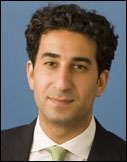
Source: Getty

In The Media

U.S.-Iran Confrontation in Strait of Hormuz

Link Copied
By Karim Sadjadpour
Published on Jan 8, 2008

Source: BBC Radio 4’s The World Tonight

Carnegie’s Karim Sadjadpour appeared on BBC Radio 4’s The World Tonight to discuss the January 7 confrontation between Iranian speedboats and U.S. Navy warships in the Strait of Hormuz. “There’s been a period of relative de-escalation with this National Intelligence Estimate released in Washington, with statements from U.S. officials in Iraq that Iran is beginning to play a more constructive role there. And whenever there is a potential for confidence- building, there are entrenched actors in the Iranian system, and they’re a minority within the Iranian government, but they really have an incentive to keep the crisis going, to remain in isolation.  They thrive both economically and politically as long as Iran is in isolation.” 

mp3
Podcast - Download mp3 audio of the broadcast.

Related: Sadjadpour on BBC World Service's The World Today:

mp3
Podcast - Download mp3 audio of the broadcast.

About the Author

Karim Sadjadpour

Senior Fellow, Middle East Program

Karim Sadjadpour is a senior fellow at the Carnegie Endowment for International Peace, where he focuses on Iran and U.S. foreign policy toward the Middle East.

    Recent Work

  • Q&A
    What’s Keeping the Iranian Regime in Power—for Now

      Aaron David Miller, Karim Sadjadpour, Robin Wright

  • Q&A
    How Washington and Tehran Are Assessing Their Next Steps

      Aaron David Miller, David Petraeus, Karim Sadjadpour

Karim Sadjadpour
Senior Fellow, Middle East Program
Karim Sadjadpour
Foreign PolicyMiddle EastIran

Carnegie does not take institutional positions on public policy issues; the views represented herein are those of the author(s) and do not necessarily reflect the views of Carnegie, its staff, or its trustees.

More Work from Malcolm H. Kerr Carnegie Middle East Center

  • Commentary
    Diwan
    Hezbollah’s Wartime Strategy

    The party’s objectives involve tying together the Lebanese and Iranian fronts, while surviving militarily and politically at home. 

      Mohamad Fawaz

  • Commentary
    Diwan
    Iran Rewrites Its War Strategy

    In an interview, Hamidreza Azizi discusses how Tehran has adapted in real time to the conflict with the United States and Israel.

      Michael Young

  • Commentary
    Diwan
    What Does the Strait of Hormuz’s Closure Mean?

    In an interview, Roger Diwan discusses where the global economy may be going in the third week of the U.S.-Israeli war with Iran.

      Nur Arafeh

  • Commentary
    Diwan
    Tehran’s Easy Targets

    In an interview, Andrew Leber discusses the impact the U.S. and Israeli war against Iran is having on Arab Gulf states.

      Michael Young

  • Commentary
    Diwan
    The Gulf Conflict and the South Caucasus

    In an interview, Sergei Melkonian discusses Armenia’s and Azerbaijan’s careful balancing act among the United States, Israel, and Iran.

      Armenak Tokmajyan

Get more news and analysis from
Malcolm H. Kerr Carnegie Middle East Center
Carnegie Middle East logo, white
  • Research
  • Diwan
  • About
  • Experts
  • Projects
  • Events
  • Contact
  • Careers
  • Privacy
  • For Media
Get more news and analysis from
Malcolm H. Kerr Carnegie Middle East Center
© 2026 Carnegie Endowment for International Peace. All rights reserved.









