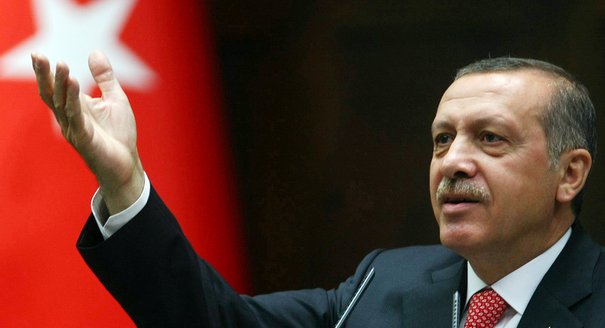
Issues surrounding Afghanistan and Iran will likely lead the agenda during Turkish Prime Minister Erdogan’s meeting with President Obama, but the two leaders should also focus on addressing the growing gap between Turkish and U.S. public rhetoric which threatens to create a rift between Turkey and the West.
Talking to TurkeyTurkish Prime Minister Recep Tayyip Erdogan comes calling on President Obama at a particularly delicate time. While the two leaders have major issues to advance at their first White House meeting, beginning today, they also need to address the growing gap between their public rhetoric, if not their actual positions. A growing view in the United States—more outside than inside the government—holds that Turkey is drifting away from the West. In Turkey, the United States remains very unpopular and Erdogan sees little political benefit in trying to change that.
Mr. Erdogan’s increasingly independent foreign-policy discourse in the Middle East and his attacks on Israel’s behavior in Gaza have increased his popularity at home and abroad. Turkey has improved relations with neighboring Middle Eastern states and concluded numerous deals with Russia. Erdogan has personally worked hard to expand Turkish trade and investment with the intention not only of benefiting politically in Turkey but also with the ambition of becoming an influential player in global politics. In view of early successes, however, he and many Turks may have convinced themselves that the EU and the United States need Turkey more than Turkey needs them. These are dangerous perspectives. They are also wrong, and they hinder Turkey’s chances of being accepted into the EU, however low they already are.
Nevertheless, the fear that Turkey is parting with the West for the Muslim world or Putin’s Russia is inflated and misguided. It is prudent and appropriate to move from cold relations to profitable friendship. Ending years of enmity makes sense. One can be both a reliable NATO ally and maintain good relations with Russia or the Muslim world. Moreover, Erdogan’s ambitious agenda and desire to build on Turkey’s geostrategic location, economic prowess and alliances may be also helpful to the West, especially in areas where Western efforts have failed.
Most important for Turkey’s future, Erdogan has been an impressive leader, producing a livelier and more dynamic Turkey, although many Turks worry that this is for the worst. Erdogan completely dominates the political scene. He has taken on huge domestic political challenges, including a dramatic opening to Turkey’s Kurdish minority, and he has a long way to go in advancing this deeply divisive political issue. He could well stumble along the way. While progressing, now much more slowly, on a democratic-reform package, Erdogan has created the impression that he brooks no dissent. Indeed he cannot tolerate much criticism, and he is using the tax authorities to subdue an opposition press baron. However odious the behavior of Turkey’s media elites has been, he is misusing his powers.
Just as Erdogan deserves credit for his genuinely visionary moves, he also deserves blame for the perceptions he has created about himself and Turkey. First among them is the belief that he is pursuing a foreign policy that values Islam over alliance concerns. He has doggedly defended the Iranian nuclear program as peaceful and the Iranian elections as democratic. He has embraced President Bashir of Sudan, an indicted war criminal, and supports Hamas to the consternation of both the Israelis and the Palestinian Authority.
In many areas, the United States and Turkey have made much progress. The most contentious issue has long been Iraq, but differences have been significantly reduced. Turkish fears of an independent Iraqi Kurdistan have diminished, and the Erdogan government has become a source of stability rather than division in Iraq. This, in turn is facilitating the U.S. decision to withdraw from the country.
Yet Erdogan comes to Washington with a surprisingly small agenda. First and foremost, he is looking for Washington’s validation of Turkey’s new international role, diplomatic forays into Syrian-Israeli negotiations, enhanced stature in the Middle East in general, and role in the G-20 and UN Security Council.
Erdogan would particularly welcome American support in helping secure a settlement over Cyprus—an issue now headed toward disaster and dangerous to Turkey’s EU aspirations—and resolving his difficulties in opening the Turkish border with Armenia. Obama will push the Turks to ignore Azeri manipulations with oil and gas routes and act more resolutely in opening the border with Armenia.
For the most part, Obama wants more Turkish troops in Afghanistan. Erdogan is unlikely to agree to deploy more combat troops, but he could supply more trainers. On Iran, the president will have to be particularly forceful in making the point that Turkish diplomacy is providing the Iranian regime with a way out and, therefore, makes it difficult for the international process to advance. Most recently, the Turks abstained at an IAEA vote on Iran at a time when even China and Russia joined the United States to build a consensus.
Obama will have to recognize that he is dealing with a confident—sometimes far too self-confident—Turkey. Erdogan will probably not grant the White House much more cooperation in dealing with Iran. And Obama should not shy away from disagreeing with Erdogan on other Middle Eastern questions, or freedom of the press in Turkey.
But Obama must not allow the differences to overshadow the greater goal of restoring confidence in Turkey’s alliance with the West. In order for Turkey to meet accession requirements to the EU, it must enact greater domestic political and economic reforms. That remains a fundamental goal of both Turkey and the United States, and Obama and Erdogan should state it loud and clear.
Barkey served as a member of the U.S. State Department Policy Planning Staff, working primarily on issues related to the Middle East, the Eastern Mediterranean, and intelligence from 1998 to 2000.
Carnegie does not take institutional positions on public policy issues; the views represented herein are those of the author(s) and do not necessarily reflect the views of Carnegie, its staff, or its trustees.
More Work from Malcolm H. Kerr Carnegie Middle East Center