

Article
- +1
Toby Dalton, Mark Hibbs, Nicole Grajewski, …
{
  "authors": [
    "Mark Hibbs"
  ],
  "type": "questionAnswer",
  "centerAffiliationAll": "dc",
  "centers": [
    "Carnegie Endowment for International Peace"
  ],
  "collections": [],
  "englishNewsletterAll": "ctw",
  "nonEnglishNewsletterAll": "",
  "primaryCenter": "Carnegie Endowment for International Peace",
  "programAffiliation": "NPP",
  "programs": [
    "Nuclear Policy"
  ],
  "projects": [],
  "regions": [],
  "topics": [
    "Nuclear Policy",
    "Nuclear Energy"
  ]
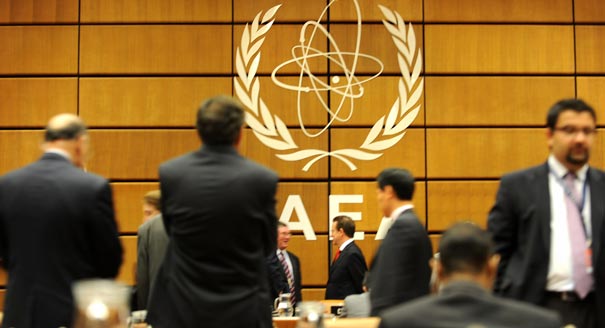
}
Source: Getty
The IAEA's expected inability to move forward on the nuclear programs of Iran, Syria, and Israel and the goal of a nuclear-free Middle East demonstrates the dysfunctional relationship between advanced, largely Western, nuclear countries and the developing and non-aligned states that constitute the majority of the IAEA's membership.
This month, the two decision-making bodies of the International Atomic Energy Agency (IAEA)—the board of governors and the general conference—will convene in Vienna for their annual fall meetings. On the agenda will be the nuclear programs of Iran, Syria, and Israel, and the goal of a nuclear-free Middle East. Following on the heels of two new IAEA reports criticizing Iran and Syria for continued lack of cooperation with the IAEA—including allegations of covert nuclear work—the two countries’ nuclear programs will remain in the spotlight.
In a Q&A, Mark Hibbs explains that the lack of action expected on these major issues underscores the dysfunctional relationship between advanced, largely Western, nuclear countries, and the developing and non-aligned states that constitute the majority of the IAEA’s membership.
The meetings will be held for two consecutive weeks beginning with the board meeting opening on September 13, followed by the general conference that starts on September 20. The agendas for both events are complementary, as the board will deal with a number of topics that follow from resolutions taken at the 2009 general conference—nuclear safety, nuclear security, technical cooperation, and safeguards. A great deal of time at the board meeting will be consumed by attempts to reach consensus on these carried-over agenda items. If consensus by the board of governors can be reached, issues will then be put before the IAEA’s 151 member states at the general conference.
The board is not expected to make significant decisions on the more controversial items on its agenda—which include Iran, Syria, Israel, and safeguards in the Middle East. Week-long board meetings routinely deal with least-contentious issues first, meaning that it is likely that just a couple of days will remain for the board to discuss the most complex and politically sensitive issues. Because these issues are flashpoints for deep-rooted divisions between the United States and most advanced nuclear states, on the one hand, and most developing countries, on the other, board members will be reluctant to press hard for agreement on any consensus resolutions in a short period of time.
For decades and until the last several years, the board’s 35 members have made nearly all decisions by consensus. But during the last decade, consensus among the board members has unraveled and meetings have been marred by bitter divisions between advanced states and members of the Non-Aligned Movement (NAM), which represents 118 developing countries.
Previously, the NAM’s attention to United Nations diplomacy was exclusively focused on activities happening in New York and Geneva. But the NAM opened a chapter in Vienna in 2003 and it is now advocating a greater voice for its members in both IAEA decision-making bodies. Many advanced nuclear states on the board, including the United States, are uncomfortable with the NAM’s agenda and appear off balance and unprepared to meet its challenges. The result is often minimalist diplomatic outcomes.
In particular, NAM states include both Iran and Syria, both of which are in noncompliance with previous IAEA board resolutions calling for them to cooperate fully to resolve outstanding doubts about the peaceful nature of their nuclear activities. During IAEA board meetings the last several years, including in 2010, the NAM formally supported Iran’s right to engage in peaceful nuclear activities. Iran’s right, however, is not being challenged by the UN Security Council. The issue is whether Tehran is or should be cooperating fully to build international confidence that, notwithstanding its past violations of safeguard obligations, Iran’s nuclear activities are exclusively peaceful. During the IAEA’s seven-year probe into Iran’s program, Tehran has asserted that all its activities are peaceful. The NAM’s reiterations of Iran’s right to peaceful nuclear energy therefore seem to buttress Iran’s position while ignoring the core of the IAEA board’s resolutions on Iran.
As has been the case for every quarterly board meeting since early 2003, the IAEA secretariat this month submitted an update on an ongoing investigation by the Department of Safeguards into Iran’s nuclear activities. The new report attests that—in violation of previous resolutions from both the IAEA board and the UN Security Council—Iran is adding to its inventory of low-enriched uranium produced at two centrifuge enrichment plants under IAEA inspection; the output from these plants is consistent with Iran’s declarations about how the plants are operated; and Iran is not fully cooperating with the IAEA investigation.
Notably, the report contains stern language objecting to Tehran’s recent refusal to permit experienced IAEA inspectors to work in the country and details how Iran has failed to give the IAEA facility design information as required by the terms of its safeguards agreement.
The report underscores that, without Tehran’s cooperation, the IAEA has no recourse to compel Iran to comply with its safeguards obligations. This prompts the conclusion that significant change in Tehran’s behavior vis-à-vis the IAEA can be brought about only by a broader political agreement between Iran and its adversaries.
No. In the view of the IAEA’s legal experts, the terms of Syria’s safeguards agreement would legally permit IAEA Director General Yukiya Amano to request a special inspection based on the information about Syrian nuclear activities obtained from the United States and other IAEA member states. But so far Amano is not willing to make the request given the perceived political risks involved.
The last time the IAEA made a special inspection request was for North Korea in 1993. U.S. spy satellite photos conclusively demonstrated that North Korea was concealing reprocessing waste from what appeared to be a facility separating plutonium and the IAEA board reached a consensus that a special inspection was “urgent and essential,” as legitimated by the terms of North Korea’s safeguards agreement.
As it’s widely believed that the 2007 Israeli air attack decapitated Syria’s clandestine nuclear activities, there will not be a consensus that a special inspection in Syria is “urgent” today. And board members who are wary of a special inspection request point out that the request made for North Korea in 1993 led Pyongyang one month later to quit the Non-Proliferation Treaty (NPT).
Furthermore, if Syria complies with a request for a special inspection and the IAEA fails to confirm alleged clandestine nuclear activities—a concern some Vienna experts say is justified given evidence indicating that Damascus has covered its tracks in the three years since Israel bombed the suspected reactor site in Syria—that would profoundly damage the IAEA’s credibility. Syria, Arab states, and other NAM members have expressed concern that should a special inspection be requested on the basis of U.S.-supplied information, the IAEA would be acting on behalf of U.S. intelligence agencies that supposedly aim to use the IAEA to obtain access to military activities in Syria even though they are not necessarily nuclear.
On the other hand, a few IAEA verification officials have argued that there is little to lose in requesting a special inspection in the light of Syria’s lack of cooperation. Regardless of the political risks, they think the request would establish an important benchmark and bring the matter to the attention of the UN Security Council. But this is not the view expressed internally and in bilateral meetings with member states by Amano and his senior aides and, given their reluctance, and Amano’s apparent desire to accommodate NAM concerns on the board, it’s unlikely board members will force the matter during this month’s meeting.
An agreement like this is highly unlikely. During and after a recent visit by Amano to the country, Israel underscored that it will not make any major concessions on its nuclear program.
At the 2009 general conference, Arab states, led by Egypt, succeeded in getting a resolution passed urging Israel to join the NPT and put all its nuclear activities under IAEA safeguards. A similar resolution will be floated during the 2010 conference. Still, it’s likely that action on Israel’s nuclear program—both in the boardroom and especially at the general conference—will be dominated by rhetoric, but not result in any decisions of substance.
At the 2010 NPT Review Conference in May, the NAM was able to extract from the United States and other Western states an endorsement of the proposal to hold a conference of all states in the Middle East in 2012 to establish a regional zone free of nuclear weapons and other weapons of mass destruction. Out of a fear that the NPT could collapse if two consecutive review conferences failed to reach a consensus conclusion, the United States and Western states agreed. Israeli officials have since warned that Israel may not attend the 2012 conference—Israel is not obligated to take part because it is not a party to the NPT.
The IAEA safeguards a limited amount of declared nuclear activity in Israel, but now and in the future the Vienna agency will have no leverage to significantly influence decision making by Israel about the future of its overall strategic nuclear policy.

Nonresident Senior Fellow, Nuclear Policy Program
Hibbs is a Germany-based nonresident senior fellow in Carnegie’s Nuclear Policy Program. His areas of expertise are nuclear verification and safeguards, multilateral nuclear trade policy, international nuclear cooperation, and nonproliferation arrangements.
Recent Work


Toby Dalton, Mark Hibbs, Nicole Grajewski, …
Mark Hibbs
Carnegie does not take institutional positions on public policy issues; the views represented herein are those of the author(s) and do not necessarily reflect the views of Carnegie, its staff, or its trustees.
In an interview, Marc Lynch discusses his new book decrying the post-1990 U.S.-dominated order in the Middle East.

Michael Young

Both events also could force Washington to rethink or revive its Middle East partnerships.

Karim Sadjadpour
Disagreement between the United States and Iran over a revived nuclear accord may anchor volatile competition.

George Perkovich
A regular survey of experts on matters relating to Middle Eastern and North African politics and security.
Michael Young
The British, French, and German foreign ministers have formally accused Iran of breaking the terms of the 2015 Iran nuclear deal, a step that could lead to sanctions. Are the Europeans preparing to pull the plug?

Jarrett Blanc