

In The Media
David Rothkopf
{
  "authors": [
    "David Rothkopf"
  ],
  "type": "legacyinthemedia",
  "centerAffiliationAll": "",
  "centers": [
    "Carnegie Endowment for International Peace"
  ],
  "collections": [],
  "englishNewsletterAll": "",
  "nonEnglishNewsletterAll": "",
  "primaryCenter": "Carnegie Endowment for International Peace",
  "programAffiliation": "",
  "programs": [],
  "projects": [],
  "regions": [
    "North America",
    "United States",
    "South Asia",
    "East Asia",
    "Southeast Asia"
  ],
  "topics": [
    "Foreign Policy"
  ]
}
Source: Getty
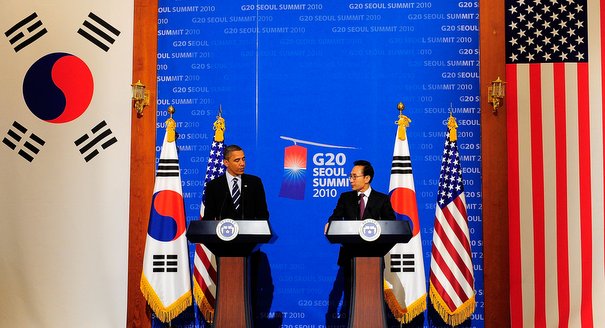
The faltering U.S. economy and an increasingly confident and powerful Asia are challenging efforts by President Obama to orient U.S. foreign policy more toward transpacific issues.
Source: Financial Times

Titillating but absurd debates about his birthplace aside, no one can dispute that a president raised in the mid-Pacific also came into office seeking a foreign policy more oriented toward transpacific issues than that of his predecessors. Bill Clinton and George W. Bush sought to rebalance policies in that direction but were largely distracted. So it has fallen to Mr Obama to usher in this era and address the challenges it brings.
Some are historical. America has had two major prior eras of foreign policy. During its first century, it turned inward. During the 20th century it ascended globally, with the core of that ascendancy built on transatlantic issues, alliances and conflicts. Over time, its relatively large economic and military size, and its cultural and linguistic ties, provided advantages over principal allies. It did not always get what it wanted but, as the 20th century progressed, there was no doubt who was first among the equals.
On this most recent trip to Asia, Mr Obama discovered just how different the next century is going to be. The US will still be the most powerful country but it is faltering economically. With the wind of history no longer at its back, others – rivals and allies alike – flex their muscles. They are doing so in ways that confounded the president’s aspirations for this visit, and are quickly derailing other important policy initiatives too.
Mr Obama’s first goal in Asia was to produce some kind of meaningful deal at the G20 meeting to control global economic imbalances. Not only did he not manage this but he also discovered that Asia’s most important power, China, felt comfortable confronting the US on the perceived hypocrisy of browbeating Beijing on undervaluing its currency while manipulating the dollar downward. The Chinese were pointed and unswayable, and other nations – including once-loyal European allies and other emerging powers – fell into line.
Thus were revealed important elements of the nature of a Pacific century, in which power and momentum is located on the Asian side of the ocean, and the most important Asian player is also America’s most important rival. As a consequence, the president’s desire to focus on how to stimulate global growth and rein in China was rebuffed by a world coalescing around the Sino-European world view that the focus ought to be on fiscal responsibility, and that this should start with the profligate, flagging US.
Elsewhere Mr Obama sought a trade deal with South Korea. But when the US side pushed too hard on access to beef markets, the Koreans – who also have growing economic clout and are now much less US-centric in their orientation than in the past – felt comfortable walking away. His embrace of India, meanwhile, produced inevitable bristling in Pakistan. It also made the Chinese distinctly uncomfortable, illustrating again that the geopolitics of the coming era will require a degree of balance of power diplomatic finesse not demanded of the US in more than a half century.
No doubt the political climate is tough for Mr Obama at home. But after this trip and the upcoming visit to Europe that will include a focus on Afghanistan – America’s thorniest foreign policy problem – he may find returning to the dissonance and name-calling of Washington a relief. He may also realise the best way to regain momentum on his ground-breaking efforts in the Pacific will be to redouble work to engineer a breakthrough on controlling the US deficit and restoring competitiveness. As America’s first Pacific president is learning, foreign policy is always easier if you are negotiating from a position of strength.
Former Visiting Scholar
David Rothkopf was a visiting scholar at the Carnegie Endowment as well as the former CEO and editor in chief of the FP Group.
Recent Work
David Rothkopf
David Rothkopf
Carnegie does not take institutional positions on public policy issues; the views represented herein are those of the author(s) and do not necessarily reflect the views of Carnegie, its staff, or its trustees.

In an interview, Ian Lustick and Eli Clifton discuss their new book on why a prominent ally has so much influence in America.

Michael Young

As the U.S. stumbles in its war with Iran, we are likely to see an acceleration of its disengagement from the region.
Michael Young

Middle Eastern states should welcome an accelerated U.S. disengagement from their region.
Michael Young

In an interview, former ambassador Charles Freeman assesses the Trump administration’s war against Iran.
Michael Young

By failing to address Palestinian representation, the current process is bound to lead to just another temporary arrangement.

Nathan J. Brown