

Commentary
Several Carnegie experts from different offices discuss the significance of Putin’s address to the future of Russia and its role in the international community.
- +1
Lina Khatib, Shi Han, Ulrich Speck, …
{
  "authors": [
    "Dmitri Trenin",
    "Feng Shaolei"
  ],
  "type": "legacyinthemedia",
  "centerAffiliationAll": "",
  "centers": [
    "Carnegie Endowment for International Peace",
    "Carnegie China",
    "Carnegie Russia Eurasia Center"
  ],
  "collections": [
    "China’s Foreign Relations"
  ],
  "englishNewsletterAll": "",
  "nonEnglishNewsletterAll": "",
  "primaryCenter": "Carnegie Russia Eurasia Center",
  "programAffiliation": "",
  "programs": [],
  "projects": [
    "Eurasia in Transition"
  ],
  "regions": [],
  "topics": []
}
Source: Getty
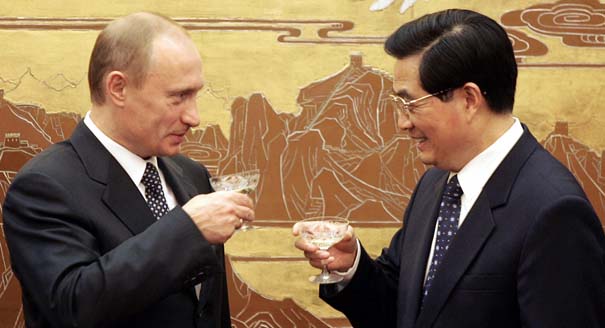
Putin’s visit to China is important for both China and Russia, but if the two countries wish to strengthen their bilateral relations, Moscow and Beijing need to work to enhance trust and build a long-term strategy of mutual cooperation.
Source: China Radio International's People In the Know

China and Russia have enjoyed good momentum in the development of their bilateral relations and President Putin's visit is widely expected to take Sino-Russian relations to a new level.
On the China Radio International, Carnegie Moscow Center’s Dmitri Trenin spoke about Putin’s trip to China. He was joined by Feng Shaolei, director of the Center for Russian Studies at East China Normal University. Trenin said that Putin’s visit to China is important for both China and Russia, as the two countries face a number of shared problems. The two countries can cooperate in different spheres because the Chinese and Russian leaderships have the same political philosophy based on the principles of sovereignty and non-interference. However, Trenin added, Russia and China shouldn't be seen as an opposition to the West, as the relations with the European Union and the United States are among top priorities of the both countries. Trenin stressed that to strengthen bilateral relations, the Russian and Chinese authorities need to enhance trust and build up a long-term strategy of cooperation between the two countries.
Former Director, Carnegie Moscow Center
Trenin was director of the Carnegie Moscow Center from 2008 to early 2022.
Feng Shaolei
Carnegie does not take institutional positions on public policy issues; the views represented herein are those of the author(s) and do not necessarily reflect the views of Carnegie, its staff, or its trustees.
Several Carnegie experts from different offices discuss the significance of Putin’s address to the future of Russia and its role in the international community.
Lina Khatib, Shi Han, Ulrich Speck, …
The world can be an awfully dangerous and unpredictable place.


Thomas Carothers, Lina Khatib, Marwan Muasher, …
China is unusually secure in its policy of nonintervention in the Syrian conflict. But will strong rhetoric and vetoes be enough?

Paul Haenle

Turkey’s planned new canal and a missile defense system both send the message that Turkey will go its own way, swiftly and irrespective of the country’s international environment and commitments.

Marc Pierini

China’s misreading of the likelihood of U.S. intervention in Syria cost Beijing an opportunity to position itself as a global power.
Paul Haenle