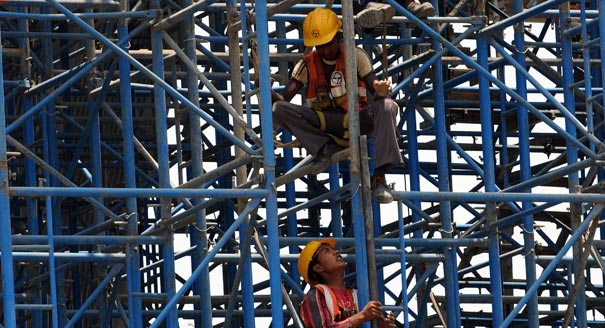
India’s struggles with cronyism and land deals are not new, but they will be hard to fix, since the glue that connects builders and politicians is election finance.
The current uproar regarding the land and real estate shenanigans of Indian politicians, their progeny and sons-in-law is reminiscent of the scene from the classic film Casablanca in which Captain Renault barges into Rick’s Bar to pronounce that he was shocked – shocked! – to discover that patrons in the bar were gambling (and then proceeded to pick up his winnings).
According to the World Bank, India ranks 181 out of 183 countries in terms of ease of obtaining a construction permit. A 2011 survey of Indian firms conducted by KPMG found that real estate and construction was perceived to be the most corrupt sector of the economy by a wide margin.
Why should we be so shocked, then, at L’affaire Vadra, merely the latest in a long, long line of examples of an endemic Indian affliction, the builder-politician nexus? Robert Vadra may not be a politician, but he is the very definition of “politically connected”. In any event, regardless of labels – “politicians”, “mafias”, “nexuses” – there is no question that in India the use and abuse of regulation on issues related to land is rotten to the core, with beneficiaries ranging from businessmen to bureaucrats, journalists to judges, and politicians irrespective of political party, ideology or region.
In the south, the Comptroller and Auditor General’s blistering report of the Y S Rajasekhara Reddy regime, in which land concessions in Andhra Pradesh were doled out “on an ad hoc, arbitrary and discretionary basis”, said the gains being allegedly reaped by private companies linked to his son Jaganmohan Reddy. The Bharatiya Janata Party has been neck and neck with the Congress if the ambitious land scams of the B S Yeddyurappa government are any indication. The Nationalist Congress Party’s role in Lavasa and Mumbai, the Samajwadi Party and the Bahujan Samaj Party in Noida, the Dravida Munnetra Kazhagam in Tamil Nadu, all demonstrate that at least when it comes to grand larceny, there is unity as well as consensus across all political parties. Even for the Left, for which land rights were a bread-and-butter issue; after more than three decades of Communist Party of India (Marxist) rule in West Bengal “land scams have replaced land reforms”, as Gayathri Nivas of Deccan Herald pithily put it.
Cosy links between builders and politicians have long been – and continue to be – a global phenomenon. The historical record, ranging from America’s “Gilded Age” to the post-World War II rebuilding of southern Italy, is replete with examples of politicians trading their regulatory leverage for political support from builders. Fast-forward to today, and these problems continue to fester. A recent study of 166 corporate bribery cases worldwide uncovered that construction was the single most bribe-laden industry. The reason, supported by a large body of research, is that regulatory intensity correlates highly with rent extraction potential, and land is a classic “rent-thick” sector. The heavy-hand of the state, lack of transparency and temptation to trade on inside information pave the way for transactions marked by malfeasance.
India’s struggles with cronyism and land deals are not new, but they will be hard to fix since the glue that connects builders and politicians is election finance. Those involved in real estate are among the leading financiers of elections. Politicians have discretion over permits, clearances and land conversion; and builders have liquidity. Furthermore, real estate is a cash-intensive sector riding the wave of Indian middle class growth. Indeed, in a forthcoming paper*, we examine patterns in Indian states’ consumption of cement – the indispensable ingredient for construction – and find that it declines during the month of elections. Why? Because as elections approach, builders are cash-strapped since they channel funds out of their operations and into political campaigns.
What makes the problem so intractable, though, is that it is not just a simple illicit quid pro quo: land concessions in return for campaign cash. And this brings us back to L’affaire Vadra. What if, in fact, there was no illegality at all, as pointed out in an earlier column by Mihir S Sharma in this newspaper? Builders merely grant influential, politically connected friends a slice of their profitable pie in return for regulatory forbearance. When a businessman makes a deal with a powerful politician, it sends a strong signal to regulators: enter at your own risk. No direct requests need to be made, nor does money have to be exchanged; the survival instincts of most government officials will ensure that acts of regulatory omission prevail. The rare official who does not toe the line is quickly brought to heel, as attested by the immediate transfer of IAS officer Ashok Khemka, who had the temerity to probe the Vadra-DLF deals.
The past two years have unveiled spectacularly corrupt deals across a host of India’s heavily regulated sectors. It’s not surprising that political parties seize upon the latest scandal to score points — as well they should. But let’s be frank: L’affaire Vadra is as entirely predictable as it is shameful. And as history shows, it will take a lot more than handwringing to change the trajectory India is on. Ongoing efforts on reforming the colonial-era land acquisition Bill are just a start. Parallel initiatives on transparency and taxation are critical if this cancer is to be curbed.
The major stock market scams in the early 1990s led to a realisation that the old paper-based settlement of trades inevitably led to flaws in delivery and delays in transfers of title, which were an invitation to scam. This led to the Depositories Act in 1996 and the creation of the National Securities Depository Limited, resulting in securities being held and settled in dematerialised form and much more efficient Indian capital markets.
India needs to urgently create a similar institution to register properties, beginning with the 35 cities above one million population (where high values considerably amplify the incentives to cheat). By making the records publicly available at a nominal fee, the urban land and property registration system will be taken out of the discretionary and non-transparent – and frankly utterly corrupted current systems – and reduce the risks and transaction costs of buying property, thereby supporting buyers, builders and urban planners. The transparency will also allow civil society and, when needed, investigators, to swiftly track ownership changes.
Once the systems are in place, stamp duties on sales/purchases of property in urban areas should be slashed to incentivise registering the real value of a property sale and instead replaced by a property tax. This would not only more than make up for the revenue losses (a one per cent property tax should yield annual revenues exceeding Rs 5,000 crore in Delhi and Mumbai), but also make tycoons with billion-dollar homes pay annually for their extravagances.
* Devesh Kapur and Milan Vaishnav. ‘Quid Pro Quo: Builders, Politicians and Election Finance in India.’ Available at: //www.cgdev.org/files/1425795_file_Kapur_Vaishnav_election _finance_India_FINAL.pdf Devesh Kapur is director of the Centre for the Advanced Study of India at the University of Pennsylvania. Milan Vaishnav is a South Asia associate at the Carnegie Endowment for International Peace
Milan Vaishnav is a senior fellow and director of the South Asia Program and the host of the Grand Tamasha podcast at the Carnegie Endowment for International Peace. His primary research focus is the political economy of India, and he examines issues such as corruption and governance, state capacity, federalism, and electoral behavior. He also conducts research on the Indian diaspora.
Devesh Kapur
Starr Foundation Professor, Johns Hopkins (SAIS)
Devesh Kapur is the Starr Foundation Professor of South Asian studies at the Johns Hopkins School of Advanced International Studies (SAIS). He is the author of three books on migration, including The Other One Percent: Indians in America (with Sanjoy Chakravorty and Nirvikar Singh).
Carnegie does not take institutional positions on public policy issues; the views represented herein are those of the author(s) and do not necessarily reflect the views of Carnegie, its staff, or its trustees.
More Work from Malcolm H. Kerr Carnegie Middle East Center
A humanitarian crisis in Lebanon deepens, and Syrian refugees face a perilous choice: remain in a war-torn environment or return to Syria where they risk encountering significant dangers and discrimination. There are significant challenges and risks to their search for safety in Syria.
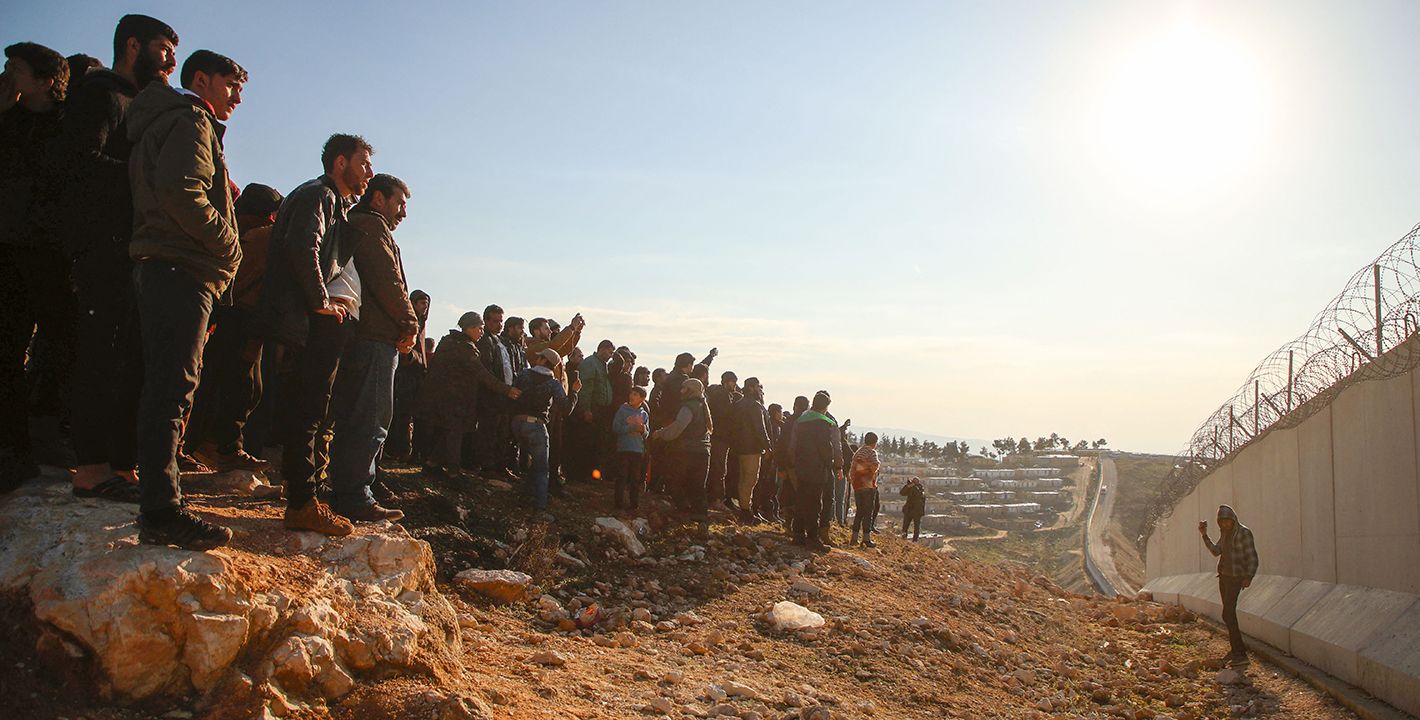
In Syria’s border regions, changes in demographics, economics, and security mean that an inter-Syrian peace process will require consensus among main regional powers that Syria must remain united, that no one side can be victorious, and that perennial instability threatens the region.
The interaction of national armed forces and private business sectors offers a useful lens for viewing the politics of numerous countries of the so-called Global South. A rising trend of military political activism—often accompanied by military commercial activity—underlines the importance of drivers and outcomes in these relationships.