

Commentary
Richard Youngs
{
  "authors": [
    "Richard Youngs"
  ],
  "type": "legacyinthemedia",
  "centerAffiliationAll": "dc",
  "centers": [
    "Carnegie Endowment for International Peace",
    "Carnegie Europe"
  ],
  "collections": [
    "Turkey’s Transformation",
    "Democracy and Governance"
  ],
  "englishNewsletterAll": "democracy",
  "nonEnglishNewsletterAll": "",
  "primaryCenter": "Carnegie Europe",
  "programAffiliation": "DCG",
  "programs": [
    "Democracy, Conflict, and Governance"
  ],
  "projects": [],
  "regions": [
    "Middle East",
    "Russia",
    "Europe",
    "Türkiye",
    "Eastern Europe",
    "Ukraine"
  ],
  "topics": [
    "Foreign Policy",
    "Democracy"
  ]
}
Source: Getty
The rise of civic protests revolves around more transient forms of political organization. If anything, it has widened the disconnect between the civil and political spheres.
Source: Bloomberg
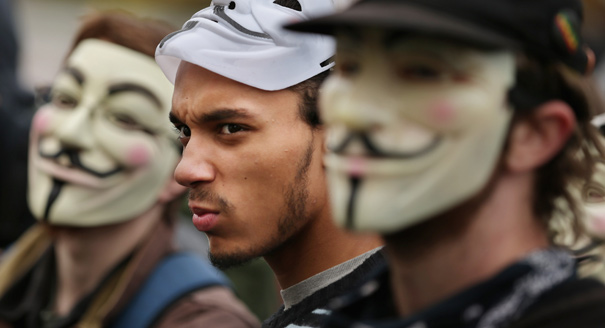
This year has been one of vibrant and daring social protest, closing with the tumult in Ukraine and Thailand. Disturbances have taken place even in ultra-stable Singapore. Protests have rumbled on intermittently in several austerity-afflicted European countries, and during the summer mass demonstrations in Turkey and Brazil filled the media. Citizens across the world, it seems, are bravely taking up W.H. Auden’s famous injunction “to undo the folded lie ... the lie of Authority/Whose buildings grope the sky.”
The occurrence of so many protests within such a short space of time invites the thought that a new international wave of citizen-led democracy is upon us. Analysts have long talked about the incipient emergence of a cosmopolitan civil society. Many academics and activists see global civic mobilization as the social counterpart to economic globalization: An internationalization of protest and citizen power can, they insist, mitigate the disenfranchising effects of financial globalism. The protests seem to counter-balance notions of cultural relativism, as pictures capture Brazilians, Turks, Ukrainians, Italians, Russians, Egyptians and Thais engaged in similar street battles. No wonder hopes are high for what might be termed a new “democratic cosmopolitanism.”
There are clearly similarities between the different movements: the use of communication technology; heightened citizen expectations; frustration with opaque decision-making in democracies, infant quasi-democracies and autocracies; and a healthy loss of deference, even in some very conservative and socially hierarchical societies.Yet look more closely, and it becomes clear we are still far from witnessing any unstoppable spirit of democratic cosmopolitanism. Some protests have been stirred by big, system-changing aims; others are directed at very prosaic policy changes. Most commonly, they have been triggered by locally specific grievances or discrete corruption scandals.
The results have been very different, too. Not all the protests have been successful, even in achieving minimalist versions of their objectives. In Turkey, for example, Prime Minister Recep Tayyip Erdogan has consolidated his power after the protests. Turkey has been left with the combustible mixture of a highly majoritarian shade of democracy and simmering social discontent. Ukrainian protesters may yet force their government to sign an agreement with the European Union, but the country’s democratization is far from ensured.
Moreover, the linkages between different protest movements have been relatively limited. Most of today’s protests aren’t especially cosmopolitan in outlook. Indeed, most contain at least a pinch of nationalist flavoring. Activists in Russia and Egypt are still prickly about outside linkages and engagement. Anti-austerity mobilizations in European countries have been strikingly national in their discourses and organizational structure: Pan-European solidarity is in short, even diminishing supply.
Protesters today often cloak themselves in the progressive values of an ostensible liberalism, but then reject some of the core tenets of liberal-internationalist cooperation. Moreover, the lesson from the last year is that the step from protest to deeper democracy is a large and uncertain one. Indeed, unmarshaled protest can be problematic for other necessary parts of the democratic equation. Almost all protests have failed to create new political parties as a permanent legacy; India’s anti-corruption Common Man party is a rare exception.
The rise of civic protests revolves around more transient forms of political organization. It has, if anything, widened the disconnect between the civil and political spheres. Mass mobilization co-exists with the near-death of mass membership organizations such as labor unions and political parties. This may risk pushing citizens away from compromise and careful deliberation to instinctive and maximalist claims.
Edmund Burke was, of course, eerily perceptive in warning that popularly driven revolutions tend to be captured by “ignoble oligarchy.” Two hundred years on, his analysis still provides clues to explaining the many tragic deviations of today’s democratic breakthroughs.
A number of things can be done to nurture a genuinely cosmopolitan, citizen-led impulse to improving global democracy.
Civic activism needs to be married to a re-energized response from political parties, both nationally and through international groupings. More needs to be done not just to strengthen civil society in individual countries but also to encourage links between activists across borders.
Support for civil society movements must be linked to strategies for democratizing the United Nations, World Bank and other multilateral institutions. Western governments need to open greater spaces for civil society movements within international institutions -- in ways that give the latter real influence and an incentive to develop a less parochial outlook. Global institutions need to appreciate how some of their economic recipes might spark not just democratic protest but also a fearful, inward-looking nationalism –- of a kind that sits uneasily with these institutions’ own mandates.
None of this is to cast aspersion on the positive value of 2013’s citizen-led protests. Today’s activism is a healthy corrective to increasingly unresponsive government within and beyond the West. An optimist might detect a half vindication of Karl Marx: not workers so much as citizens of the world uniting to break their chains. Even as these citizens are angrier and more fearless, however, their emancipation and empowerment depend on forging greater global links.

Senior Fellow, Democracy, Conflict, and Governance Program
Richard Youngs is a senior fellow in the Democracy, Conflict, and Governance Program, based at Carnegie Europe. He works on EU foreign policy and on issues of international democracy.
Recent Work
Richard Youngs
Richard Youngs
Carnegie does not take institutional positions on public policy issues; the views represented herein are those of the author(s) and do not necessarily reflect the views of Carnegie, its staff, or its trustees.

In an interview, Ian Lustick and Eli Clifton discuss their new book on why a prominent ally has so much influence in America.

Michael Young

As the U.S. stumbles in its war with Iran, we are likely to see an acceleration of its disengagement from the region.
Michael Young

The accord represents a pivotal moment in the region to avert a security vacuum in the Gulf.


Azeema Cheema, Mohanad Hage Ali

In an interview, Jason Burke discusses his sweeping account of the “revolutionists” who so shaped the 1970s and early 1980s.
Michael Young

By failing to address Palestinian representation, the current process is bound to lead to just another temporary arrangement.

Nathan J. Brown