

Commentary
Sarah Chayes
{
  "authors": [
    "Sarah Chayes"
  ],
  "type": "legacyinthemedia",
  "centerAffiliationAll": "",
  "centers": [
    "Carnegie Endowment for International Peace"
  ],
  "collections": [],
  "englishNewsletterAll": "",
  "nonEnglishNewsletterAll": "",
  "primaryCenter": "Carnegie Endowment for International Peace",
  "programAffiliation": "",
  "programs": [],
  "projects": [],
  "regions": [
    "Southern, Eastern, and Western Africa"
  ],
  "topics": [
    "Political Reform",
    "Security"
  ]
}
Source: Getty
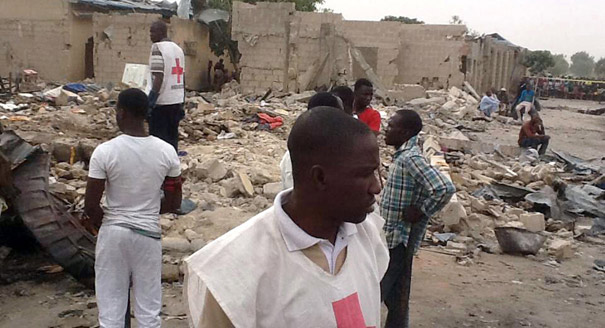
In recent weeks, a Nigerian official went on record alleging that some $20 billion of his country’s oil revenue had gone missing in just the past 18 months.
Source: Public Radio International
In recent weeks, a Nigerian official went on record alleging that some $20 billion of his country's oil revenue had gone missing in just the past 18 months.
That official — Central Bank Governor Lamidu Sanusi — was about to do some serious asset-tracking to find out what had happened to the cash.
But the country's President Goodluck Jonathan fired Sanusi.Sarah Chayes, a senior associate at the Carnegie Endowment for International Peace says western officials have told her the $20 billion has been laundered and is at the disposal of President Jonathan.
Chayes has been looking at several acutely corrupt countries, including Nigeria, and she sees a pattern.
"Rather then seeing them as, fundamentally, governments who ... are trying to govern and see after the welfare of their people with a degree greater or less of corruption around the edges, we need to really think of them as criminal organizations that are posing as governments — are essentially using their government activity to pursue their primary objective, which is not governing, but extracting resources," Chayes argues.
Chayes links Nigeria's corruption to the other big story there, the extremist militant group Boko Haram. The name means "western education is forbidden," or is "ritually unclean."
"Westerners have a tendency to see that in cultural terms, like 'Oh, they don't like tolerance and scientific inquiry and critical thinking,'" Chayes says. "But if you think of it in the context of this massive civil service-driven theft of national resources, it looks like something different. So to get a job in the civil service or in a hospital or in schools — which also steal people's money — you have to have a degree. You have to have gone to school and gotten what in the north is seen as a western education. And that's what Boko Haram was kicking about, originally."
Chayes argues that foreign donors and aid agencies are providing "wiggle room" for corrupt governments like Nigeria, by performing the functions that the government ought to be performing.
"We just had, for example, Secretary of State [John] Kerry condemning Boko Haram and promising counter-terrorism support for Nigeria, but when the government of Nigeria is stealing $20 billion from its own people over an 18-month period, somehow that doesn't seem to be rising to the level of something that US foreign policy needs to grapple with," she says.
Some of the factors that might have made Washington reticient to push for transparency in Nigeria are now changing. The US need for Nigeria's oil is down. And Nigeria's role as a power broker in Africa could be waning, according to Chayes.
"So that gives the US some room to really look at putting more pressure on a country like Nigeria," she says. "It also means that our banks, and our oil companies, and our consumers need to think twice about how their actions enable a system like this."
This interview was originally published by Public Radio International.
Former Senior Fellow, Democracy, Conflict, and Governance Program
Sarah Chayes is internationally recognized for her innovative thinking on corruption and its implications. Her work explores how severe corruption can help prompt such crises as terrorism, revolutions and their violent aftermaths, and environmental degradation.
Recent Work
Sarah Chayes
Carnegie does not take institutional positions on public policy issues; the views represented herein are those of the author(s) and do not necessarily reflect the views of Carnegie, its staff, or its trustees.

Just look at Iraq in 1991.

Marwan Muasher

Baku may allow radical nationalists to publicly discuss “reunification” with Azeri Iranians, but the president and key officials prefer not to comment publicly on the protests in Iran.

Bashir Kitachaev
The Moroccan-Algerian rivalry is playing itself out in ties with Burkina Faso, Niger, and Mali.

Yasmine Zarhloule
In addressing Hezbollah’s disarmament, the Lebanese state must start by increasing its own leverage.

Michael Young
The country’s political and military establishment is still debating how to interpret the recent war’s outcome.
Nicole Grajewski