

Paper
Christopher S. Chivvis, Rohan Mukherjee, Milan Vaishnav
{
  "authors": [
    "Milan Vaishnav"
  ],
  "type": "legacyinthemedia",
  "centerAffiliationAll": "dc",
  "centers": [
    "Carnegie Endowment for International Peace"
  ],
  "collections": [],
  "englishNewsletterAll": "ctw",
  "nonEnglishNewsletterAll": "",
  "primaryCenter": "Carnegie Endowment for International Peace",
  "programAffiliation": "SAP",
  "programs": [
    "South Asia"
  ],
  "projects": [
    "India Decides 2014"
  ],
  "regions": [
    "South Asia",
    "India"
  ],
  "topics": [
    "Political Reform",
    "Democracy"
  ]
}
Source: Getty
The results of India’s sixteenth general election challenge the common understanding of contemporary Indian electoral politics in at least four ways.
Source: Times of India
The 2014 elections have only just ended but analysts are already struggling to comprehend how the BJP's stunning electoral success, deemed unlikely just one year ago, came to pass. The results of India's sixteenth general election challenge our common understanding of contemporary Indian electoral politics in at least four ways.
A second assumption that was upturned in this election was that Congress, not the BJP, had the advantage in alliance formation. Despite all the talk about its off-key "India Shining" mantra sinking the BJP in 2004, their loss was more about the BJP's inability to forge the right alliances. This fed doubts about whether the BJP could construct effective alliances in 2014, especially with Modi at the helm. Yet it was a Modi-led BJP that struck key deals over the past several months while the Congress, in contrast, was viewed as a sinking ship. Many observers dismissed the BJP's alliance with the Lok Jan Shakti Party in Bihar, the Telugu Desam Party in Andhra Pradesh, and the Haryana Janhit Congress as trivial. But such criticism overlooked the importance of small shifts in vote share in a fragmented, first-past-the-post electoral system.
A third assumption underpinning Indian elections since 1989 has been the growth of regional parties. Between 1996 and 2009, the non-Congress, non-BJP share of the vote has hovered around 50%, rising to a record 53% in 2009. The 2014 election, though, saw a decline in regional party support; their nation-wide vote share dipped to roughly 47%, reversing the prevailing trend. Two players merit special attention here. The first is the evisceration of the BSP. Mayawati may draw a blank in Uttar Pradesh while the hard-fought inroads she made in other Hindi heartland states simply evaporated. The second is the weakening of the Left. At a time of rising inequality and concerns over crony capitalism, the conditions would seem propitious for a Leftist revival; instead we are witnessing their collapse.
A fourth assumption has been that national elections are best understood as an aggregation of state verdicts. The 2014 election outcome, however, is a partial reversal of "derivative" national elections. Not only was this election marked by presidential overtones, but the animating issues—namely, the slumping economy—have also been pan-Indian. Despite this apparent shift, there are two caveats to the "nationalization" thesis.
First, states still remain the most important tier of government for ordinary Indians. This is reflected in the fact that, notwithstanding the record voter turnout in these Lok Sabha polls, turnout for state elections is still 4.5% higher, on average, in any given state. Second, much of the south remained resistant to the BJP's charms. Although the BJP picked up new seats in Andhra Pradesh, Karnataka, and Tamil Nadu, its advances were limited and much smaller than in the north.
These facts suggest a far-reaching realignment of Indian politics. Whether this is ephemeral or enduring will depend on what a Modi-led BJP chooses to do with its historic mandate.
This article was originally published by the Times of India.

Director and Senior Fellow, South Asia Program
Milan Vaishnav is a senior fellow and director of the South Asia Program and the host of the Grand Tamasha podcast at the Carnegie Endowment for International Peace. His primary research focus is the political economy of India, and he examines issues such as corruption and governance, state capacity, federalism, and electoral behavior. He also conducts research on the Indian diaspora.
Recent Work


Christopher S. Chivvis, Rohan Mukherjee, Milan Vaishnav



Sophia Besch, Eric Ciaramella, Steve Feldstein, …
Carnegie does not take institutional positions on public policy issues; the views represented herein are those of the author(s) and do not necessarily reflect the views of Carnegie, its staff, or its trustees.
To address the deepening climate crisis, climate activism is employing a wider variety of tactics and aiming at a broader set of goals. In response, the movement faces stronger repression and civic backlash against climate action.


Erin Jones, Richard Youngs
A humanitarian crisis in Lebanon deepens, and Syrian refugees face a perilous choice: remain in a war-torn environment or return to Syria where they risk encountering significant dangers and discrimination. There are significant challenges and risks to their search for safety in Syria.
Haid Haid
In an interview, Abhinav Pandya discusses the multiple facets of India’s ties with the Middle East.

Armenak Tokmajyan
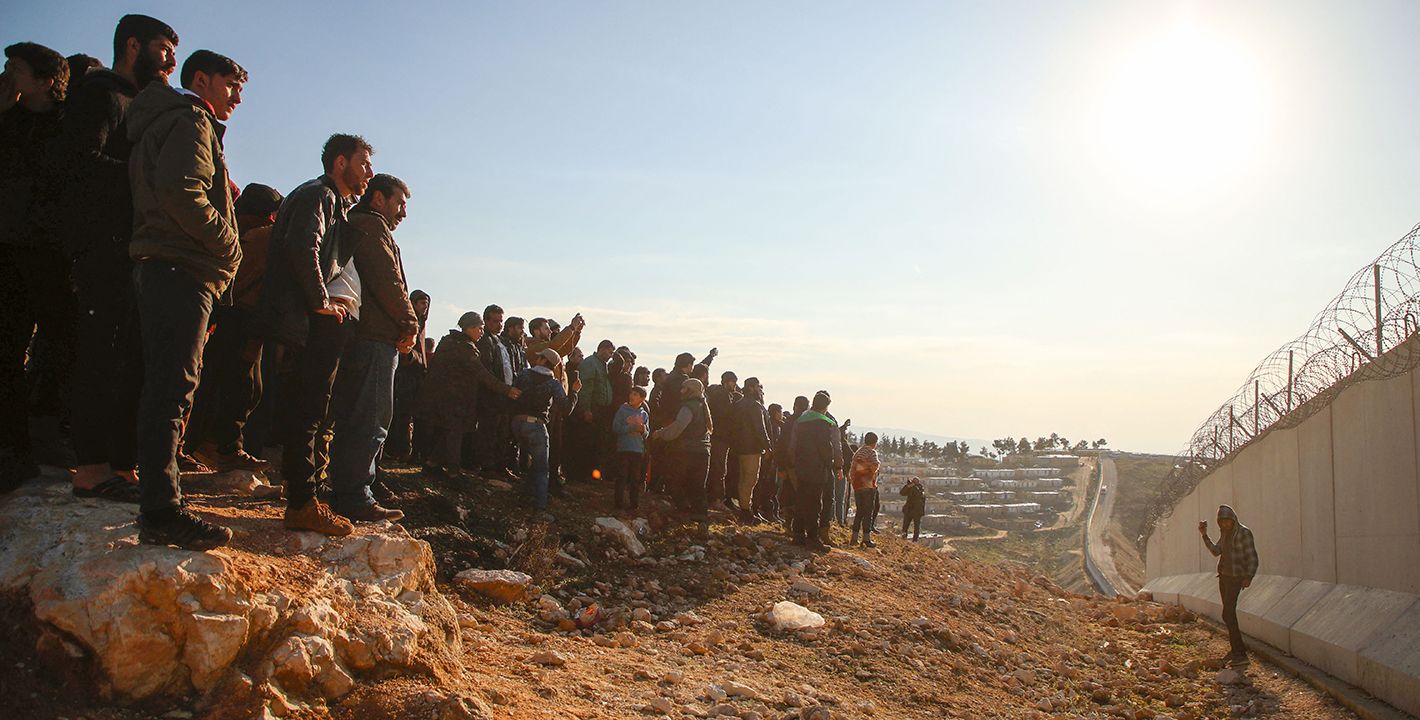
In Syria’s border regions, changes in demographics, economics, and security mean that an inter-Syrian peace process will require consensus among main regional powers that Syria must remain united, that no one side can be victorious, and that perennial instability threatens the region.

Kheder Khaddour, Armenak Tokmajyan
The interaction of national armed forces and private business sectors offers a useful lens for viewing the politics of numerous countries of the so-called Global South. A rising trend of military political activism—often accompanied by military commercial activity—underlines the importance of drivers and outcomes in these relationships.


Yezid Sayigh, Hamza Meddeb