

Q&A
Suzanne Maloney, Aaron David Miller, Karim Sadjadpour
{
  "authors": [
    "Karim Sadjadpour"
  ],
  "type": "legacyinthemedia",
  "centerAffiliationAll": "dc",
  "centers": [
    "Carnegie Endowment for International Peace",
    "Malcolm H. Kerr Carnegie Middle East Center"
  ],
  "collections": [
    "Iranian Proliferation"
  ],
  "englishNewsletterAll": "ctw",
  "nonEnglishNewsletterAll": "",
  "primaryCenter": "Carnegie Endowment for International Peace",
  "programAffiliation": "NPP",
  "programs": [
    "Nuclear Policy",
    "Middle East"
  ],
  "projects": [],
  "regions": [
    "Middle East",
    "Iran"
  ],
  "topics": [
    "Political Reform",
    "Foreign Policy",
    "Nuclear Policy"
  ]
}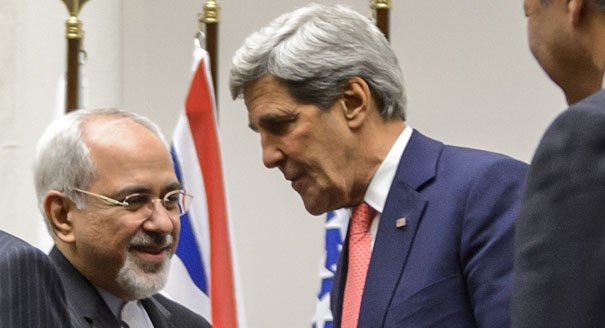
Source: Getty
The intent of U.S. policy should be to deter Iran’s nuclear advancement, not provoke it.
Source: Wall Street Journal
Nuclear negotiations with Iran failed, as expected, to produce a comprehensive resolution. Talks are to be extended until June 2015. Congress now faces a critical decision: As lawmakers deliberate, two broad principles are important:
One: A pause in Iran’s nuclear program–though imperfect–must not be measured against a utopian ideal (the total dismantlement of Iran’s nuclear program) but realistic alternatives.
Two: The intent of U.S. policy should be to deter Iran’s nuclear advancement, not provoke it.
As I testified before the House Foreign Affairs Committee last week, the widespread assessment that economic pressure forced Tehran to negotiate seriously is likely to tempt Congress to enact additional sanctions in an effort to coerce an Iranian compromise. But premature unilateral U.S. sanctions could threaten the unity among Washington’s negotiating partners (the other four permanent members of the U.N. Security Council and Germany). They also risk tainting U.S. standing among the Iranian people and precipitating an escalation that could result in military conflict.
Iranian calculations are driven in part by the view that President Barack Obama is averse to conflict and that Washington, not Tehran, would be blamed for abrogating the joint agreement reached last November. Additional U.S. sanctions are less likely to produce greater concessions than they are to encourage Tehran to recommence its nuclear activities and curtail its already limited cooperation with the International Atomic Energy Association.
So far, the global embargo on Iran’s economy has remained largely intact. But it’s unclear whether the European Union, Russia, and Asia would continue to forsake commercial and strategic ties with Iran to placate the U.S. in the event of a diplomatic breakdown. The bombastic Mahmoud Ahmadinejad is no longer president. Today, China, Russia, and even many European allies believe that Iran is too critical to regional stability to be shunned and that President Hasan Rouhani and Foreign Minister Mohammad Javad Zarif are reasonable leaders who should be engaged and strengthened, not sanctioned and weakened.
The worst scenario for U.S. interests is one in which Congress overwhelmingly passes new sanctions, Iran resumes its nuclear activities, and international unity unravels. Such an outcome would force the United States to revisit the possibility of another military conflict in the Middle East.
A more effective path is likely to come from legislation that seeks to lock in Iran’s current compromises, deters nuclear advancement, and incentivizes greater compromises. Iran should have strong disincentives to proceed with its nuclear activities coupled with strong incentives to compromise. Simply put, congressional sanctions should be conceived to deter Iran’s nuclear ambitions, not provoke them. This is important to maintaining international unity.
Congress should also think more creatively about how to align with the economic and democratic aspirations of the Iranian people, not merely against the government’s nuclear aspirations. U.S. policies necessary to counter Iran’s nuclear program and the policies needed to facilitate political transformation in Iran are at loggerheads. The economic pressure and political isolation that have proven necessary to force Tehran to reassess its nuclear ambitions are hurtful to Iranian civil society and the private sector, which require political and economic engagement.
This article was originally published on the Wall Street Journal.

Senior Fellow, Middle East Program
Karim Sadjadpour is a senior fellow at the Carnegie Endowment for International Peace, where he focuses on Iran and U.S. foreign policy toward the Middle East.
Recent Work


Suzanne Maloney, Aaron David Miller, Karim Sadjadpour

Aaron David Miller, Karim Sadjadpour, Robin Wright
Carnegie does not take institutional positions on public policy issues; the views represented herein are those of the author(s) and do not necessarily reflect the views of Carnegie, its staff, or its trustees.

Huawei pushed hard to enter the Egyptian data centers market, until the Americans made a better offer.

Angie Omar

Middle Eastern states should welcome an accelerated U.S. disengagement from their region.

Michael Young

In an interview, former ambassador Charles Freeman assesses the Trump administration’s war against Iran.
Michael Young

The accord represents a pivotal moment in the region to avert a security vacuum in the Gulf.


Azeema Cheema, Mohanad Hage Ali

In an interview, Jason Burke discusses his sweeping account of the “revolutionists” who so shaped the 1970s and early 1980s.
Michael Young