

Commentary
Huawei pushed hard to enter the Egyptian data centers market, until the Americans made a better offer.
Angie Omar
{
  "authors": [
    "Farea Al-Muslimi",
    "Laura Kasinof"
  ],
  "type": "legacyinthemedia",
  "centerAffiliationAll": "",
  "centers": [
    "Carnegie Endowment for International Peace",
    "Malcolm H. Kerr Carnegie Middle East Center"
  ],
  "collections": [],
  "englishNewsletterAll": "",
  "nonEnglishNewsletterAll": "",
  "primaryCenter": "Malcolm H. Kerr Carnegie Middle East Center",
  "programAffiliation": "",
  "programs": [],
  "projects": [],
  "regions": [
    "Gulf",
    "Yemen",
    "Middle East"
  ],
  "topics": [
    "Political Reform",
    "Security"
  ]
}
Source: Getty
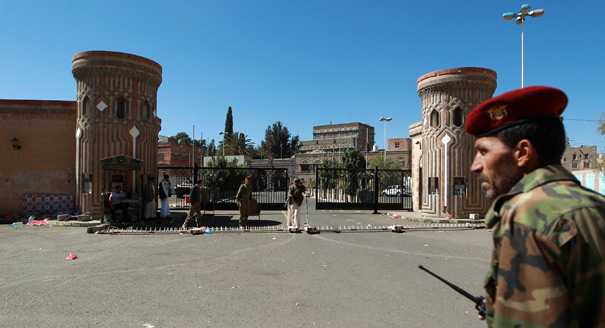
The violence in Sanaa has pushed the Yemeni government to the brink, and what is happening inside will almost certainly reverberate across the globe.
Source: CBC Radio The Current
This week, rebel fighters of Yemen—the Houthis—attacked the president's residence. It seems President Abed Rabbu Mansour Hadi barely had much power anyway. Yemen is a patchwork quilt of militias from Al Qaeda to the Houthis, whose support comes from Iran. All of which sets the stage for a confrontation that will make Western leaders sit up and notice ... nervously.
The violence in Sanaa, the capital of Yemen, has pushed the government to the brink, and what's happening inside the small country on the southern tip of the Arabian peninsula, will almost certainly reverberate across the globe.
Its neighbor, Saudi Arabia, is wary of Houthi rebels with Iranian backing gaining the upper hand.
And as for the rest of the world, there was a vivid reminder in Paris this month that Yemen remains home to one of the most vicious terror cells on the globe—Al Qaeda in the Arabian Peninsula—or AQAP—having claimed responsibility for the deadly attack on Charlie Hebdo.
Farea al-Muslimi is a visiting scholar at the Carnegie Middle East Center and an expert on Yemen and Gulf state politics. He was in Sanaa, Yemen.
Politics in Yemen can be complicated and fluid at the best of times. And it's not a country with a strong international media presence. That all adds up to make the country a rather opaque place to the rest of the world.
Laura Kasinof is a freelance journalist who has lived in and reported extensively from Yemen. She is also the author of "Don't Be Afraid of the Bullets: An Accidental War Correspondent in Yemen." Laura Kasinof was in Washington, DC.
This segment was produced by CBC Radio The Current's Howard Goldenthal and Naheed Mustafa.
Research fellow at Chatham House’s Middle East and North Africa Programme
Farea Al-Muslimi is a research fellow at Chatham House’s Middle East and North Africa Programme.
Laura Kasinof
Carnegie does not take institutional positions on public policy issues; the views represented herein are those of the author(s) and do not necessarily reflect the views of Carnegie, its staff, or its trustees.

Huawei pushed hard to enter the Egyptian data centers market, until the Americans made a better offer.

Angie Omar

Middle Eastern states should welcome an accelerated U.S. disengagement from their region.

Michael Young

The accord represents a pivotal moment in the region to avert a security vacuum in the Gulf.


Azeema Cheema, Mohanad Hage Ali
In an interview, Jason Burke discusses his sweeping account of the “revolutionists” who so shaped the 1970s and early 1980s.
Michael Young

Morocco and Algeria, each in its own way, are having to navigate the global economic fallout of the U.S.-Israeli military campaign against Iran.

Yasmine Zarhloule