

Commentary
Judy Dempsey
{
  "authors": [
    "Judy Dempsey"
  ],
  "type": "legacyinthemedia",
  "centerAffiliationAll": "dc",
  "centers": [
    "Carnegie Endowment for International Peace",
    "Carnegie Europe"
  ],
  "collections": [
    "Turkey’s Transformation"
  ],
  "englishNewsletterAll": "ctw",
  "nonEnglishNewsletterAll": "",
  "primaryCenter": "Carnegie Europe",
  "programAffiliation": "EP",
  "programs": [
    "Europe"
  ],
  "projects": [],
  "regions": [
    "Middle East",
    "Europe",
    "Türkiye",
    "Iran"
  ],
  "topics": []
}
Source: Getty
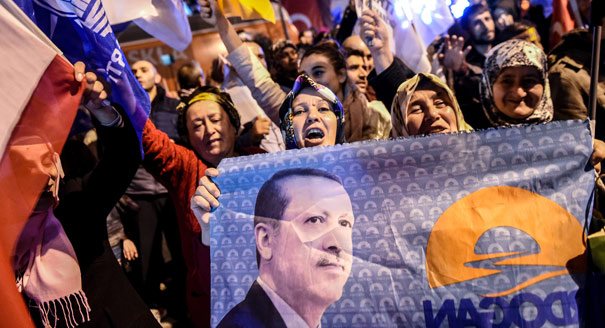
Pollsters did not predict the scale of the AKP’s victory in Turkey’s November parliamentary election. But was the contest’s real winner the country’s president?
Source: Deutsche Welle
A clear victory for Turkish President Recep Tayyip Erdoğan’s Justice and Development Party (AKP) in the November parliamentary election was not what the pollsters had predicted. In a climate of insecurity, have Turkish voters indirectly given more power to the president?
Speaking to Deutsche Welle’s Quadriga, Judy Dempsey was asked to comment on the outcome of the Turkish election and the future of the country. She was joined by Alan Posener, political author at Die Welt, and Dilek Kurban, research fellow at the Hertie School of Governance.
This broadcast was originally aired on Deutsche Welle’s Quadriga.

Nonresident Senior Fellow, Carnegie Europe
Judy Dempsey is a nonresident senior fellow at Carnegie Europe
Recent Work
Judy Dempsey
Judy Dempsey
Carnegie does not take institutional positions on public policy issues; the views represented herein are those of the author(s) and do not necessarily reflect the views of Carnegie, its staff, or its trustees.

As the U.S. stumbles in its war with Iran, we are likely to see an acceleration of its disengagement from the region.

Michael Young

Middle Eastern states should welcome an accelerated U.S. disengagement from their region.
Michael Young

In an interview, former ambassador Charles Freeman assesses the Trump administration’s war against Iran.
Michael Young

The accord represents a pivotal moment in the region to avert a security vacuum in the Gulf.


Azeema Cheema, Mohanad Hage Ali

In an interview, Jason Burke discusses his sweeping account of the “revolutionists” who so shaped the 1970s and early 1980s.
Michael Young