

Research
- +4
Milan Vaishnav, Rahul Verma, Rukmini S., …
{
  "authors": [
    "Christophe Jaffrelot"
  ],
  "type": "legacyinthemedia",
  "centerAffiliationAll": "dc",
  "centers": [
    "Carnegie Endowment for International Peace"
  ],
  "collections": [],
  "englishNewsletterAll": "ctw",
  "nonEnglishNewsletterAll": "",
  "primaryCenter": "Carnegie Endowment for International Peace",
  "programAffiliation": "SAP",
  "programs": [
    "South Asia"
  ],
  "projects": [],
  "regions": [
    "South Asia",
    "India"
  ],
  "topics": [
    "Political Reform"
  ]
}
Source: Getty
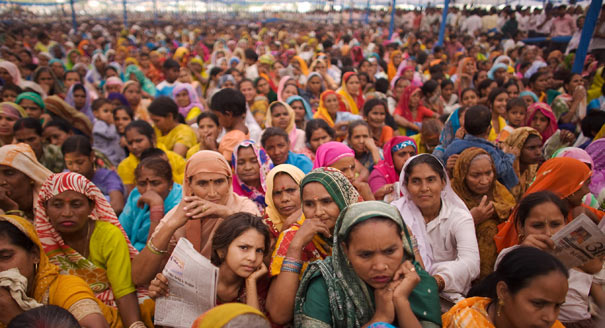
Dominant castes in India resent reservations, while official Other Backward Classes feel that they haven’t fully benefited from the system. Despite its flaws, though, there is no visible alternative.
Source: Indian Express
Marathas, Patels, Jats, Kapus and others are asking for reservations today, preferably through their recognition as Other Backward Classes. This demand reflects the challenges they are facing on the job market. Not only is the Indian economy not creating as many jobs as before (the number has declined from 7 lakh to 1.55 lakh from 2011-12 to 2014-15 in the eight sectors reviewed by the Labour Bureau), but wages in the private sector are much lower than in the public sector. On average, in 2011-12 daily earnings were almost 2.5 times higher in the public sector at Rs 945 against Rs 388 in the private sector. The gap will increase after the recommendations of the 7th Pay Commission are implemented. Certainly, this assessment needs to be qualified because salaries of government jobs are mostly attractive at entry-level. But they are also perceived as less demanding, more stable and as providing many social benefits.
However, one may wonder whether the inclusion of dominant castes in the OBC list is such a panacea. The first problem is that the public sector is shrinking: Government jobs which were 19.5 million in 1996-97 are about 17.6 million today. Certainly, the percentage of public jobs is higher in some states than in others — 16 per cent in Kerala to 1.2 per cent in Gujarat — but the national average is rather low at 4.5 per cent. It is also true that among government workers, groups A and B have continued to grow (24.1 and 27 per cent respectively between 2001-02 and 2011-12), but groups C and D have declined by 8.4 per cent over the same period, and these are the most numerous. According to the 7th pay commission, only slightly more than 1 lakh jobs were added every year in departments and ministries of the central government between 2006 and 2014. The stock of jobs of the state governments being 1.6 times that of the Centre in 2006, if they have recruited at the same rate, by and large, the public sector has been hiring 3 lakh people a year in 2006-14 — when about 8 lakh young Indians were entering the job market annually.Secondly, government jobs may not be the right solution for the dominant castes listed above because an increasingly large percentage of these jobs are occupied by contract workers who earn at least twice less than the directly employed ones. In 2014, a report prepared by the Indian Staffing Federation showed that at least 44 per cent of the government employees are now temporary — and their number is on the rise. Not only are their wages almost as low as those of the contract workers of the private sector, but they are deprived of social security benefits.
If we return to the Patels, Marathas, Jats and Kapus, this state of things is particularly resented by such caste groups which used to enjoy a prestigious status in the village and whose expectations are still high. In fact, some studies show that their job problem has much to do with the hiatus between their expectations and their skills: They want good jobs but are not very qualified. In a way, their problem is one of employability — which explains that joblessness is particularly pervasive among those who have degrees, but no real skill. According to the Employment and Unemployment Survey 2013-2014 of the ministry of labour and employment, the unemployment rate was above 15 per cent among the graduates and 2.5 per cent among the “not literates” of India — partly because some families can’t afford not to work.
If reservations are not a solution for the dominant castes, they still see them as a problem because of the advantages they give to OBCs who, according to some dominant caste leaders, do not deserve them. Many Patels, Marathas, Jats and Kapus would prefer reservations to be abolished — if they cannot benefit from them. Their argument needs also to be revisited.
First, OBCs have not taken away as many jobs as is suggested by the quota of 27 per cent that is supposed to go to them at the Centre and in most states. In fact, a quarter of a century after the upholding of the Mandal Commission recommendations by the Supreme Court, this quota remains less than half filled at the Centre. According to the response a Chennai-based scientist, E. Muralidharan got from the government under the Right to Information Act, less than 8 per cent of employees of government ministries, departments and statutory bodies were from the OBCs in 2008 and about 12 per cent in 2015 — that is, only 9,040 people out of 79,483 posts. To paraphrase Arjun Appadurai, the anti-reservation movement truly reflects the “Fear of Small Numbers”.
Interestingly, 12 per cent of Central government jobs was exactly the proportion the OBCs already represented in the national bureaucracy in 1980 according to the Mandal Commission Report (Report of the Backward Classes (Mandal) Commission, 1980, Vol II, p. 92). Certainly, the data collected by Muralidharan are incomplete since many ministries and departments held back the information. But the only other available (and reliable) figure is not terribly different: It comes from the reply of minister of state, V. Narayanasamy, in Parliament in 2011, when OBCs formed 12.9 per cent of the IAS officers.
It is not only that quotas are not fulfilled, but in some places they are put into question. On June 3, a UGC directive indicated that the Central Universities (CUs) would have to implement the OBC quota only for assistant professors and not for professors or even assistant professors. This directive was all the more surprising as the number of OBCs among faculty members was still minuscule in the CUs: In 2011, according to Arun Kumar, a young researcher who has compiled the relevant data, they were only 245 out of 13,514 (including 4 professors and 4 readers). The situation was such that the Committee on welfare of the OBCs of the Lok Sabha had proposed a set of measures in December 2015. On June 14, the National Commission for Backward Classes (NCBC) rejected the UGC’s directive.
Others have raised their voice in favour of more positive discrimination for the OBCs. In April 2016, Union minister Upendra Kushwaha demanded reservation for OBCs in the judiciary and in February the NCBC had asked for legislation making it mandatory for private entities, including cooperatives, to reserve 27 per cent of all hiring to OBCs. These moves are understandable if one admits that positive discrimination was intended to help the OBCs catch up in socio-economic terms — as V.P. Singh explained in 1990 — simply because these groups continue to lag behind. For instance, according to the NSS, there are still only 4.7 per cent graduates among them, against 11.20 per cent in the “general” population.
With dominant castes resenting reservations (or asking to benefit from them) and OBCs claiming that they have not achieved their mission yet (and are not prepared to share their quota), tensions are bound to increase. But no party may dare to open this pandora’s box without an alternative solution that could be agreeable to all the parties and this is not an easy task. After all, the judiciary has rejected the inclusion of the Jats in the OBC list by the government of Haryana and the Patel leaders have rejected the Economically Backward Classes formula of the Gujarat government.
Former Nonresident Scholar, South Asia Program
Jaffrelot’s core research focuses on theories of nationalism and democracy, mobilization of the lower castes and Dalits (ex-untouchables) in India, the Hindu nationalist movement, and ethnic conflicts in Pakistan.
Recent Work

Milan Vaishnav, Rahul Verma, Rukmini S., …
Christophe Jaffrelot
Carnegie does not take institutional positions on public policy issues; the views represented herein are those of the author(s) and do not necessarily reflect the views of Carnegie, its staff, or its trustees.
A humanitarian crisis in Lebanon deepens, and Syrian refugees face a perilous choice: remain in a war-torn environment or return to Syria where they risk encountering significant dangers and discrimination. There are significant challenges and risks to their search for safety in Syria.
Haid Haid
In an interview, Abhinav Pandya discusses the multiple facets of India’s ties with the Middle East.

Armenak Tokmajyan
In Syria’s border regions, changes in demographics, economics, and security mean that an inter-Syrian peace process will require consensus among main regional powers that Syria must remain united, that no one side can be victorious, and that perennial instability threatens the region.
Kheder Khaddour, Armenak Tokmajyan
The interaction of national armed forces and private business sectors offers a useful lens for viewing the politics of numerous countries of the so-called Global South. A rising trend of military political activism—often accompanied by military commercial activity—underlines the importance of drivers and outcomes in these relationships.

Yezid Sayigh, Hamza Meddeb

For many in the society, the post-Ben Ali years were mainly about successive economic crises and political instability.
Jasmine Khelil