

Commentary
The GCC states’ use of Artificial Intelligence will generate much leverage over the global digital infrastructure and climate talks.
Camille Ammoun
{
  "authors": [
    "R. Shashank Reddy"
  ],
  "type": "legacyinthemedia",
  "centerAffiliationAll": "",
  "centers": [
    "Carnegie Endowment for International Peace",
    "Carnegie India"
  ],
  "collections": [],
  "englishNewsletterAll": "",
  "nonEnglishNewsletterAll": "",
  "primaryCenter": "Carnegie India",
  "programAffiliation": "",
  "programs": [],
  "projects": [],
  "regions": [
    "South Asia",
    "India"
  ],
  "topics": [
    "Technology"
  ]
}
Source: Getty
India’s draft circular on the regulation of drones stifles innovation, raises operational risks, and creates substantial uncertainty for organizations, individuals, and enforcement agencies.
Source: Hindu Business Line
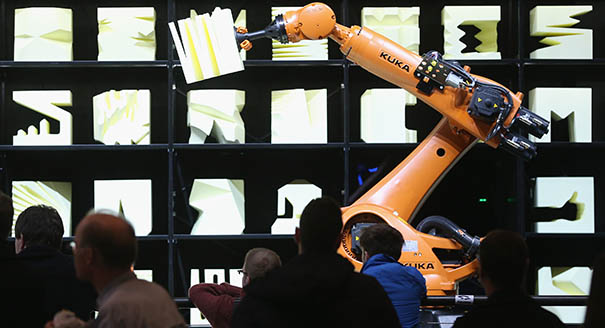
Some 11 million by 2036 in the UK alone; 5 million worldwide by 2020. These apocalypse-sounding figures are the estimated number of jobs that will be lost to automation in the very near future.
Automation lies at the forefront of the so-called ‘fourth industrial revolution’, a process whereby the interaction of cyber and physical systems will profoundly change established economic and social structures. And this will happen on a scale, size and speed unseen as of now.
The fourth industrial revolution is upon us, and the big question that everybody from the World Economic Forum to Raghuram Rajan is asking is about its effect on employment. Are our policymakers listening?
The Prime Minister’s flagship Skill India mission is a laudable programme. A skilled and trained population is the basis for sustainable long-term growth, and at present there exists a massive gap between the demands of industry and skill level of the populace. But what if the skills become redundant within a few years? Welding. Automobile repair. Basic programming. Entry level management. Even driving. All jobs that can easily be turned over to robots.
Nasscom predicts that by 2025, 50 per cent of all IT jobs in India will be lost to automation, and the downward trend that has already started. To be trained in redundant skills is to have no skills at all.
We are preparing our populace for 20th-century jobs. What we need to do is prepare them for 21st-century jobs. The fourth industrial revolution will make most current entry and mid-level jobs, in almost every single sector, irrelevant. The loss of these jobs, however, will be balanced by the creation of a variety of new jobs, mostly in the high technology, creative or service sectors.
While at this point it might be too early to forecast all the various kinds of jobs that may be created in the future, the first step is to acknowledge the fact that we are behind the times.
A detailed study is needed to understand the current and projected levels of automation in various sectors of the economy and the consequent effect on employment opportunities. While international studies of this nature do exist, there is no specific study yet for India.
The conclusions of the studies that do exist can be reduced to two major thoughts.
First, the job markets of the future will be more volatile and uncertain. Jobs will be created and destroyed at an exponential rate and any worker would need skills to cope. Second, an increasing number of jobs will be created in areas such as services , creatives and high technology, where automation would have a considerably less impact.
To adequately prepare for this scenario, multiple steps need to be taken. The most important would be rethinking and restructuring our education systems. The future being unpredictable, we need to inculcate cognitive flexibility among our children. The idea is not to train them for a particular job but to enable them to deal with the ever-changing nature of jobs. Adopting design-thinking principles may help students better cope.
Here one can take guidance from the Partnership for 21st Century Learning, which has outlined ‘21st Century Student Outcomes’ — evaluating skills that students would need. While some outcomes are related to traditional subjects such as science, mathematics and languages, and inter-disciplinary themes, others focus on learning and innovation skills such as creativity, critical thinking, communication and collaboration; ICT and media literacy; and life and career skills such as flexibility and adaptability. Taken together, these are skills that do not necessarily train students for a particular kind of job, especially given the fact that the very nature of jobs would change through their years of schooling. India’s education system, needs to be overhauled to reflect these outcomes.
The old cliché that change is the only constant has never been truer than now. While the Government is taking welcome strides in addressing current skills issues, it must also prepare the populace to cope with constant change.
This article was originally published in the Hindu Business Line.
R. Shashank Reddy
Former Research Analyst
R. Shashank Reddy was a research analyst at Carnegie India. His research focuses on the implications of emerging technologies and their governance for international and Indian security.
Carnegie does not take institutional positions on public policy issues; the views represented herein are those of the author(s) and do not necessarily reflect the views of Carnegie, its staff, or its trustees.
The GCC states’ use of Artificial Intelligence will generate much leverage over the global digital infrastructure and climate talks.

Camille Ammoun
Uneven investment in the technology will widen regional inequalities in the Middle East and North Africa.

Nur Arafeh
The GCC states are, to varying degrees, opening up to digital finance. This is part of an effort to diversify their economies and wean themselves off U.S.-dominated monetary systems.
Ala’a Kolkaila

In an interview, Abhinav Pandya discusses the multiple facets of India’s ties with the Middle East.

Armenak Tokmajyan

The interaction of national armed forces and private business sectors offers a useful lens for viewing the politics of numerous countries of the so-called Global South. A rising trend of military political activism—often accompanied by military commercial activity—underlines the importance of drivers and outcomes in these relationships.

Yezid Sayigh, Hamza Meddeb