Source: Indian Express
While the 2017 elections in Uttar Pradesh are approaching, the BSP — which has not won a single Lok Sabha seat in 2014 — has two tactical decisions to make, regarding its attitude vis-à-vis the Muslims and the Congress.
The cow protection campaign orchestrated this year by the Sangh Parivar has almost equally alienated the Dalits (BSP’s traditional vote bank) and the Muslims. Both groups, in states like Gujarat, have started to look at the upper caste Hindu-dominated BJP as their common enemy. This development may prepare the ground for a Dalit-Muslim rapprochement which, in UP, could represent a formidable coalition weighing potentially 40 per cent of the votes.
The BSP is best placed to cash in on such a convergence. First, this combination is not unprecedented. The RPI benefited from such a configuration when, in the 1962 and 1967 elections, UP gave more seats to Dr Ambedkar’s party than even Maharashtra. The main slogan of 1962, articulated by B.P. Maurya, a Jatav leader converted to Buddhism, was “Jatav Muslim bhai bhai, Hindu kaum kahan se aayi?” In the wake of the 1961 Aligarh riots that turned the Muslims away from the Congress in West UP, the RPI won eight Vidhan Sabha seats in India’s largest state.
Second, Kanshi Ram always thought that Dalits had to join hands with minorities in general and Muslims in particular. As Badri Narayan points out in his biography of Kanshi Ram, he not only “warned Dalits that they were being used by communal forces” against Muslims, he was “also concerned about the role of other minorities in nation building” (other than the Dalits). In the BAMCEF, the union he founded in the early 1970s, “B” stood for backward and “M” for minorities. Among its five vice presidents, one was Muslim, the other Christian.
Third, the BSP has followed the same policy vis-à-vis its party apparatus: Muslims have been well represented among office-bearers and it has systematically nominated Muslim candidates in elections — and they have done well: In 1996, 17.5 per cent of the BSP candidates in UP were Muslims and Muslims were 17 per cent among its 66 MLAs. In 2012, Muslims represented 22 per cent of the BSP candidates and 19 per cent of the victorious ones. Never before has the proportion of Muslims among BSP MLAs been so high.
Fourth, Muslims form the category whose support to the BSP has increased the most over the last three elections, according to CSDS data: Only 9.7 per cent of the UP Muslims supported the party in 2002, 17.60 per cent in 2007 and 20.40 per cent in 2012. This increase contrasts with the declining number of non-Jatav Dalits who voted the BSP: From 60.60 per cent in 1996, to 55.10 in 2002, 55 per cent in 2007 and 47.90 per cent in 2012. Incidentally, even the Jatav support base is eroding, from 84.80 per cent in 2007 to 61.90 per cent in 2012. Clearly, the BSP needs more Muslim support to remain a strong candidate in UP.
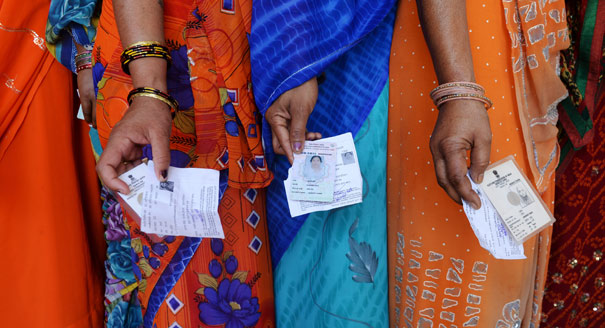
It got some of it, since in 2012, 20 per cent of the Muslims supported the BSP, whereas 39 per cent voted for the SP. This category, however, needs to be disaggregated along class lines to identify the Muslims who voted BSP. The 2014 CSDS National Election Survey (NES) shows that the poorer they were, the more BSP-inclined the Muslims were too, and the richer they were, the more SP-oriented they were: Whereas 48.5 per cent of the poor Muslims voted BSP, 69 per cent of the rich Muslims voted SP. Muslims, like large caste groups, have been differentiated along class lines and their voting behaviour is also much less homogenous than before. Incidentally, this is not true of only one group — Dalits — since in their case, class made almost no difference so far as the BSP vote was concerned in 2014. It remained between 57 and 61 per cent, whatever the economic category, “poor”, “lower”, “middle” or “rich”.
The BSP has everything to win by playing the Dalit-Muslim combine, but another tactical — and related — decision pertains to its attitude vis-à-vis the Congress. Indeed, the Congress retains some Dalit and Muslim support in UP and these limited support bases may supplement those of the BSP in class terms. Secondly, the party-wise average margin of victory of the BSP MLAs was only 5.17 per cent in 2012, smaller than those of the SP, 8.91 per cent, BJP, 8.05 per cent and even Congress, 6.26 per cent. While the Congress has retained only 12 per cent of the valid votes in 2012, added to the 26 per cent of the BSP, a BSP-Congress combine would have been number one in UP in 2012.
The distribution of Muslim voters’ support across parties shows that contrary to popular belief, UP’s largest minority does not vote en bloc. In fact, Muslim representation in the state assembly has recently risen precisely because Muslim voters did not tie their fate to a single party. Muslims acquired in 2012 for the first time since Independence a representation proportionate to their demography. They did so by voting cohesively at the local level, using their constituency-level demographic advantage better than in the past, when they tended to split their votes between parties and candidates.
In 1996, the BJP won 10 seats in constituencies counting above 20 per cent of Muslim voters, including seats like Amroha or Suar Tanda, where Muslims form a majority of the electorate. In 2002, 19 seats were “lost” due to split voting. That number greatly reduced in 2007 and 2012, which indicates that Muslim voters pick their local candidate more strategically.
This is where both the SP and the BSP have a card to play. Their ability to attract support from Muslim voters will be key to this election. Communal tensions have risen ever since the SP came to power in 2012. Akhilesh Yadav’s term has been marked not only by large-scale outbursts of communal violence, as in Muzaffarnagar in 2013, but also by the development of a permanent state of communal tension, marked by regular small incidents that have reinforced polarisation in the state. In many instances, the UP government chose not to act, guided by the thought that a sentiment of fear among Muslims would make them flock towards the SP, as in the past. There is a strong possibility that the BSP could ultimately benefit from the cynicism displayed by its main opponents.
The tactical moves of the BSP, however, will depend upon those of the other parties in the fray. One of these possible tactics may be communal polarisation, that both the BJP and the SP may promote to get, respectively, the Hindu vote (including the Dalits) and the Muslim vote. But in this case, the BSP may benefit from reverse polarisation and some Dalit/Muslim solidarity.
This article was originally published in the Indian Express.