

Commentary
Marc Pierini
{
  "authors": [
    "Marc Pierini"
  ],
  "type": "legacyinthemedia",
  "centerAffiliationAll": "dc",
  "centers": [
    "Carnegie Endowment for International Peace",
    "Carnegie Europe"
  ],
  "collections": [
    "Turkey’s Transformation"
  ],
  "englishNewsletterAll": "ctw",
  "nonEnglishNewsletterAll": "",
  "primaryCenter": "Carnegie Europe",
  "programAffiliation": "EP",
  "programs": [
    "Europe"
  ],
  "projects": [],
  "regions": [
    "Europe",
    "Türkiye",
    "Middle East",
    "Western Europe",
    "Iran"
  ],
  "topics": [
    "Foreign Policy",
    "Political Reform"
  ]
}
Source: Getty
Relations between Brussels and Ankara have not yet passed the point of no return, however they are at an important fork in the road.
Source: Euronews
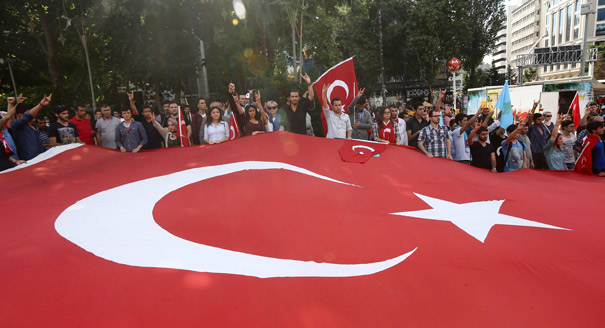
Turkish voters go to the polls this Sunday. Nearly 55 million are eligible to take part in the referendum, on a revision of the constitution.
The referendum campaign provoked a diplomatic crisis between Ankara and the European Union.
Accusations of “Nazi practices” or “fascism” in Europe, uttered by the Turkish president, have deeply affected EU-Turkey relations, which were already tense.
So do the remarks mark a point of no return? Euronews’ Gregoire Lory put that to Marc Pierini, former EU ambassador to Ankara, and researcher at Carnegie Europe.
Marc Pierini: “It is a bridge that was destroyed, but destroyed on a personal level, that is, between the Turkish president and his counterparts in the European Council.
“I don’t think the economic, financial, investment, technological, education relationship with Turkey will suffer, unless Turkey chooses to cut itself completely from Europe.
“But Turkey is not doing that, it carefully states that the economic relationship must continue. We’re not reaching a point of no return, but an important crossroads, that is to say, does Turkey’s political project, aligning itself with European standards, still make sense for the Turkish government? In my view, not at all.”
Gregoire Lory: “What will be the consequences if Erdogan wins this referendum?”
Pierini: “So, the first consequence is: no consequence. That is to say the president has been elected by universal suffrage since August 2014, 52 percent. He remains president until the election of 2019.
“Secondly the Parliament was elected on the 1st of November 2015. The AKP has a majority and it keeps it, so from the point of view of the functioning of the State there is no direct consequence, whether it is ‘yes’ or ‘no.’
“Having said that, if it is a ‘yes,’ we are going to fall from a de facto authoritarian system to an authoritarian system entitled to an absolute presidency without counter-power.
“If it is ‘no’ it is a drawback for the president. But at the same time, the president will have all the powers of today and he has the state of emergency power as well.”
Lory: “What is at stake for the European Union in the aftermath of the referendum?”
Pierini: “The challenge for the European Union is, first and foremost, before and after the referendum, that Turkey is a destabilised country today, destabilized by a coup, a failed coup d‘état, but we have seen that the purge has been extraordinarily wide, so we are no longer in the European standard.
“We are not there anymore today so if the ‘yes’ prevails it will be even less. I believe that we will simply go back or be satisfied with a much simpler relationship: the modernisation of the Customs Union, and after that, probably anti-terrorist cooperation, cooperation on Syria, the continuation of the refugee agreement and that kind of thing.”
Lory: “What will happen to Turkey’s application for accession in the aftermath of the referendum?”
Pierini: “Since the extensive purge that followed the coup d‘état, the rule of law in Turkey has collapsed in such a way that the political criteria are not fulfilled, so the candidacy floats in dead waters.
“And If we have an autocratic regime without counter-powers that is legally in place, the candidacy is dead for good.
“What is clear with the current situation is that European standards, especially political ones, are in contradiction with the Turkish president’s conception of power, and he says so every day.
“And therefore either it is declared formally dead or we keep the membership negotiations in principle, while waiting for better days.”

Senior Fellow, Carnegie Europe
Marc Pierini is a senior fellow at Carnegie Europe, where his research focuses on developments in the Middle East and Turkey from a European perspective.
Recent Work
Marc Pierini
Marc Pierini
Carnegie does not take institutional positions on public policy issues; the views represented herein are those of the author(s) and do not necessarily reflect the views of Carnegie, its staff, or its trustees.

In an interview, Ian Lustick and Eli Clifton discuss their new book on why a prominent ally has so much influence in America.

Michael Young

As the U.S. stumbles in its war with Iran, we are likely to see an acceleration of its disengagement from the region.
Michael Young

Huawei pushed hard to enter the Egyptian data centers market, until the Americans made a better offer.

Angie Omar

Middle Eastern states should welcome an accelerated U.S. disengagement from their region.
Michael Young

In an interview, former ambassador Charles Freeman assesses the Trump administration’s war against Iran.
Michael Young