

Commentary
John Kerry
{
  "authors": [
    "John Kerry"
  ],
  "type": "legacyinthemedia",
  "centerAffiliationAll": "",
  "centers": [
    "Carnegie Endowment for International Peace"
  ],
  "collections": [],
  "englishNewsletterAll": "",
  "nonEnglishNewsletterAll": "",
  "primaryCenter": "Carnegie Endowment for International Peace",
  "programAffiliation": "",
  "programs": [],
  "projects": [],
  "regions": [
    "North America",
    "United States"
  ],
  "topics": [
    "Political Reform",
    "Climate Change"
  ]
}
Source: Getty
Issues surrounding climate change and the environment are American issues, not partisan ones, and they’re galvanizing a new coalition that doesn’t blur party lines; it erases them.
Source: Boston Globe
Despite the broken politics of Washington and the denial of science that makes up the daily reality show of the White House, two lessons I learned a long time ago — one as a student, one as a senator — make me an optimist that climate change will soon be a bipartisan issue again in America.
Lesson one came when I was 19 and my college professor, John Morton Blum, taught: “All politics is a reaction to felt needs.” He meant that policy decisions only happen when the people who want something demand nothing less and the people who make it happen decide that they can do nothing less. Decisions aren’t made based on abstractions. “Felt needs” have driven every movement I’ve witnessed in politics since — from ending apartheid in South Africa a couple decades ago to ending an injustice in American communities a couple years ago, where same-sex couples refused to be told by any government who they can marry.
Lesson two came 32 years ago as a student of a different school — the US Senate. My friend Ted Kennedy introduced comprehensive health care legislation each Congress, knowing full well it would never see a vote. Why? Because Ted said good ideas ultimately meet their moment, but legislative moments ripen only if you keep tending to the garden of ideas and advocacy. You have to make the case — again and again.
At Yale University on Monday, I am convening a conference on climate change that includes CEOs like General Electric’s Jeff Immelt; business leaders, including Bank of America’s Anne Finucane; energy pioneers from Houston; former Republican secretaries of state and the Treasury; scientists, including former energy secretary Ernie Moniz; and Republican senators who all attest that on climate change the “felt needs” are piling up at a digital pace — and bipartisan pressure is “ripening” to push Washington to finally meet them.
The felt needs of the business community are overwhelming. Rather than regulators and legislators dragging business to the table, businesses are leading the way — and are ahead of Washington. They see a marketplace full of opportunity. Last year was the third consecutive year in which renewable technologies — wind and solar — made up more than half of the new generating capacity added to the US grid.
The energy transformation is global. Last year, roughly twice as much was invested in renewables capacity worldwide as in fossil fuel generation. The government of India plans 100 gigawatts of solar capacity by 2020. China’s Xi Jinping has announced a $361 billion investment in clean energy. No wonder US oil and gas companies wanted Washington to stay committed to the Paris Agreement — drawing a line on climate is also good for their bottom line.
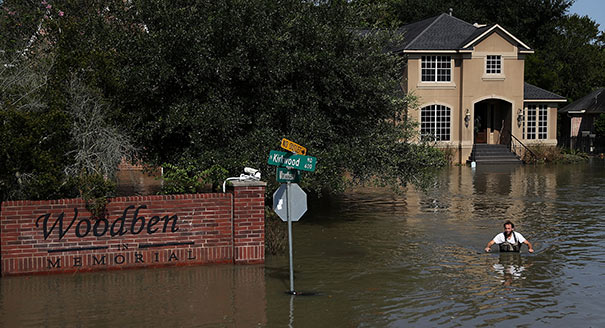
The felt needs of communities and businesses are also ripening a new bipartisan consensus. We can’t prove that climate change caused any single weather event, but scientists tell us that we can expect more of them with greater frequency as the impacts of climate change worsen. Extreme weather events don’t come with a (D) or (R) after names like Harvey and Irma, and there’s nothing political about the havoc increasingly injurious storms have wreaked in places like Texas, Louisiana, Florida, and the Caribbean.
Hurricane Katrina created environmentalists out of business people and civic leaders as never before, because they know that coastal economies cannot endure if we don’t protect and restore wetlands and meet the climate threat. There’s nothing partisan about wildfires burning in the West, which have already charred an area larger than the state of Maryland, or 100-year droughts that hurt farmers and ranchers. Governors like Jerry Brown of California and Jay Inslee of Washington, who live the reality of these challenges every day, attest to the growing demand for action bubbling up among their respective constituents. Across the country, mayors, governors, and business leaders answered President Trump’s withdrawal from the Paris Agreement with their own pledges to meet the commitments of Paris — or exceed them.
These are American issues, not partisan ones, and they’re galvanizing a new coalition that doesn’t blur party lines; it erases them. I do remember a time in the Senate when the environment was a bipartisan issue. I believe it will be again, not out of nostalgia but out of necessity — because Americans from every state and every sector of our economy are demanding it. The felt needs are ripening the moment. Now it’s in your hands to make the most of the harvest.
Nonresident Scholar, Sustainability, Climate, and Geopolitics Program
John Kerry is a nonresident scholar the Carnegie Endowment for International Peace.
Recent Work
John Kerry
John Kerry
Carnegie does not take institutional positions on public policy issues; the views represented herein are those of the author(s) and do not necessarily reflect the views of Carnegie, its staff, or its trustees.

Huawei pushed hard to enter the Egyptian data centers market, until the Americans made a better offer.

Angie Omar

Middle Eastern states should welcome an accelerated U.S. disengagement from their region.

Michael Young

In an interview, former ambassador Charles Freeman assesses the Trump administration’s war against Iran.
Michael Young

By failing to address Palestinian representation, the current process is bound to lead to just another temporary arrangement.

Nathan J. Brown

Morocco and Algeria, each in its own way, are having to navigate the global economic fallout of the U.S.-Israeli military campaign against Iran.

Yasmine Zarhloule