Source: Indian Express
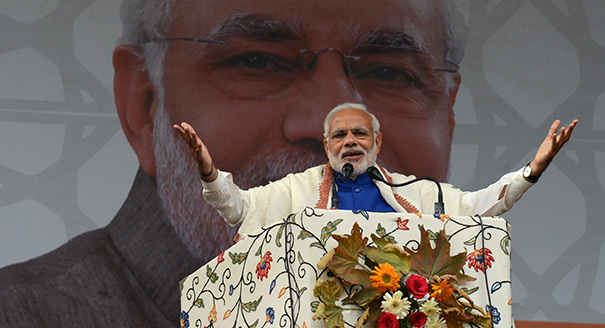
The Sangh Parivar has been articulating two different discourses about Kashmir since August. In his Independence Day address, Prime Minister Narendra Modi declared that he wanted to deal with Kashmiris, “not through insults or bullets, but by embracing” them. During a visit to Srinagar in September, Home Minister Rajnath Singh said that he aspired to turn Kashmir into a “heaven again”. Singh added that he wanted for Kashmir a, “permanent solution based on five Cs — compassion, communication, co-existence, confidence-building and consistency”. The home minister insisted that his government had no intention to amend Article 35 A of the Constitution. This provision empowers the Jammu and Kashmir legislature to define “permanent residents” — those who can acquire immovable property in the state, get appointed to state services and get aids such as scholarships. But doubts have been raised because of the government’s attitude vis-à-vis a Public Interest Litigation (PIL) filed in 2015. This PIL filed by an NGO “We the Citizens” seeks that Article 35 A be struck down.
The government’s attitude towards this PIL is important. In their third annual report on Kashmir — following a field trip in August — members of the Concerned Citizens Group (CCG), headed by Yashwant Sinha, emphasised that “the sense of dismay and despondency in the people had grown” since last year. Sinha even declared that “India has lost the Valley emotionally”. According to the CCG, the deterioration in the situation owed not just to an economic crisis — the number of tourists had halved — or to the “military approach” of solving the Kashmir problem but also to the “judicial/constitutional aggression against the people of Kashmir in attempts to undo Article 35 A”. The group’s report noted, “Article 35 A had been challenged in the Supreme Court earlier also but each time the Central government filed a counter affidavit. Now, not only the Central government has not filed an affidavit, but the Attorney General has argued for a wider debate on the constitutional provision”. Many Kashmiris see attempts to abolish Article 35 A as a ploy to change the state’s demography.
Worries about the government’s intentions regarding Articles 35 A and 370 were heightened by RSS chief Mohan Bhagwat’s Vijayadashami address on September 30. Bhagwat said, “Necessary constitutional amendments will have to be made and old provisions will have to be changed in that state. Only when the constitutional amendments are done can the residents of Jammu and Kashmir be completely assimilated with the rest of Bharat and their equal cooperation and share will be possible in the national progress”. The next day, the deputy CM of the state, Nirmal Singh, a senior BJP leader, declared that Article 370 should have been abrogated long ago. The spokesperson of Jammu and Kashmir BJP increased the confusion with his remark, that this “should be seen as views of a party leader, not of the deputy chief minister”.
Such views have, in fact, been espoused by Hindutva forces for several decades. The RSS and then the Jana Sangh held Articles 35 A and 370 responsible for Kashmiri separatism. The latter allowed Jammu and Kashmir to have its own Constitution and in theory restricted the role of the Centre to four subjects — defence, finance, foreign affairs and communications. While the state has never enjoyed such autonomy in practice, these pieces of legislation went against the Hindutva-inspired view of the nation. S.P. Mookherjee — who in the 1950s protested against the special status New Delhi was granting to Kashmir — articulated this position when he talked of “one country, one emblem and one Constitution”. This approach has affinities with that of National Security Adviser Ajit Doval, who in 2010 argued that India made a big mistake in the 1950s while dealing with Kashmiris. “Once you accepted (that) they were different, you sowed the seeds of separatism,” he said. While the Congress believes that accommodating cultural differences in the framework of federal India was the best way to defuse centrifugal forces — a position reiterated by P. Chidambaram recently — the Hindu nationalists and their fellow travellers like Doval and Jagmohan argue that autonomy creates conditions for separatism. One of the few BJP leaders who thought otherwise was former Prime Minister Atal Bihari Vajpayee, who believed in another trilogy “Kashmiriyat, Jamhooriyat, Insaniyat”.
The Sangh Parivar promotes the abrogation of Articles 35 A and 370 for tactical reasons as well. Such a move can help it to cash in on the nationalist feelings that prevail in the country today, all the more so as this policy can be seen as targeting Pakistan and Islamism — even though the Kashmir issue cannot be reduced to these two factors. This roadmap, however, would have two consequences. First, the BJP’s partner in the Jammu and Kashmir government, the PDP, would probably withdraw from the coalition, preparing the ground for President’s Rule in the state — and instability, since none of the mainstream parties seems to be in a position to regain the voters’ confidence. Second, violence would intensify. The situation has been extremely tense since the past two years. According to the South Asia Terrorism Portal, which consolidates news reports on the region, militant attacks on civilians and security forces have risen by 40 per cent since the early 2010s — when there was a relative lull, even decline, in such activities. Last year, 83 members of the security forces were killed, compared to 42 in 2014. Till September this year, security forces had lost 54 men to millitant attacks. Civilian fatalities have doubled since 2014. Till early September, 64 people have lost their lives.
Since April last year, there have been several reports of crowds gathering at encounter sites and disrupting cordon-and-search operations. This form of protest has exposed both civilian and security personnel to greater risks. Last summer, there were attacks by protesters on army camps and police patrols. Stone-pelting has changed the nature of protests and the task of security forces has gone from dispersing crowds to actively defending themselves against attacks, at a great cost to both sides.
The last time Kashmir burned in such a terrible manner was in 1987. The government’s overdrive to centralise then was clearly manifested in the rigged elections.
Ordinary Kashmiris, students and women, are coming out on the streets again because in an atmosphere of heightened nationalism, they feel their autonomy is threatened. In this context, the decision of the Supreme Court judges on the PIL about article 35 A will be particularly important. On October 30, the Court adjourned the hearing on this petition for 12 weeks after the attorney general argued that the government has appointed former IB director Dineshwar Sharma as its interlocutor for a dialogue with Kashmiris. It remains to be seen if Sharma speaks with the Hurriyat Conference. Whether this move is endorsed by the rest of the Sangh Parivar is another question.
This article was originally published in the Indian Express.