

Report
- +2
George Perkovich, Jessica Tuchman Mathews, Joseph Cirincione, …
{
  "authors": [
    "Jon Wolfsthal"
  ],
  "type": "other",
  "centerAffiliationAll": "dc",
  "centers": [
    "Carnegie Endowment for International Peace"
  ],
  "collections": [
    "Korean Peninsula"
  ],
  "englishNewsletterAll": "ctw",
  "nonEnglishNewsletterAll": "",
  "primaryCenter": "Carnegie Endowment for International Peace",
  "programAffiliation": "NPP",
  "programs": [
    "Nuclear Policy"
  ],
  "projects": [],
  "regions": [
    "East Asia",
    "North Korea"
  ],
  "topics": [
    "Nuclear Policy"
  ]
}
Source: Getty
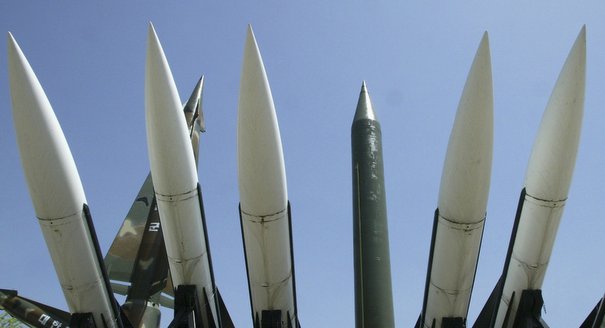
Despite spending tens of billions of dollars on missile defense over the last 30 years, the United States remains unable to shoot down North Korean ICBMs.
Source: Foreign Policy
I usually write longer, detailed essays for this column but today’s submission is simpler. And it has a simple message. Missile defense will not protect the United States from North Korean missiles. I know a lot of people think the opposite is true. Even President Donald Trump has asserted we have a 97 percent chance of shooting down a North Korean intercontinental ballistic missile (ICBM). But, as they say, “um, no.”
It would make sense for you to scratch your head and ask how can we have spent tens of billions of dollars over 30 years and still not be able to shoot down a couple of North Korea missiles. But, sorry, we can’t.
This is true for a whole host of reasons, but let’s get right to the chase. Our missile defenses don’t work all that well (better than they used to, but far from reliable and very far from perfect) and we don’t have very many of them. It is like the old joke about the married couple. The wife complains “the food at this restaurant is terrible!” To which her husband responds: “Yeah, and the portions are small, too.”
Current U.S. military planning would shoot four ground-based interceptors (GBIs) in Alaska or California at each incoming North Korean ICBM. Do the math. We shoot four at each incoming missile because each interceptor has about a 25 percent chance of working: i.e. hitting its target. And that assumes everything goes right. So far, however, little goes right for our GBIs and none have ever taken down an ICBM in a realistic, real-time, no-notice test. In fact, the reason the United States purchased so few GBIs in the Obama years is because the ones we had already purchased did not work all that well. Time and money were needed to fix major systemic problems. They’re better now, but still far from perfect.
This article was originally published in Foreign Policy

Former Nonresident Scholar, Nuclear Policy Program
Jon Wolfsthal was a nonresident scholar with the Nuclear Policy Program.
Recent Work



George Perkovich, Jessica Tuchman Mathews, Joseph Cirincione, …
Jon Wolfsthal
Carnegie does not take institutional positions on public policy issues; the views represented herein are those of the author(s) and do not necessarily reflect the views of Carnegie, its staff, or its trustees.
In an interview, Marc Lynch discusses his new book decrying the post-1990 U.S.-dominated order in the Middle East.

Michael Young

The advantage that China has over other global powers, especially America, is that its foreign policy is closely aligned with those of many of the Middle Eastern countries.



Jin Liangxiang, Maha Yahya, Hesham Alghannam
To create an environment more conducive to cooperation and development, U.S. and Chinese efforts should seek the endorsement of neighboring countries and regional organizations. Otherwise, regional and geopolitical rivalries will remain barriers.

Abdullah Baabood

Scholars from Carnegie’s global network comment on how the ongoing conflict between Israelis and Palestinians is affecting their areas of interest, and what the implications of this may be.


Maha Yahya, Rosa Balfour, Judy Dempsey, …

In an interview, Abdullah Baabood discusses Beijing’s evolving role in the Gulf region, where its priority is stability.
Michael Young