

Research
- +11
Frances Z. Brown, Nate Reynolds, Priyal Singh, …
{
  "authors": [
    "Frances Z. Brown"
  ],
  "type": "legacyinthemedia",
  "centerAffiliationAll": "dc",
  "centers": [
    "Carnegie Endowment for International Peace"
  ],
  "collections": [],
  "englishNewsletterAll": "democracy",
  "nonEnglishNewsletterAll": "",
  "primaryCenter": "Carnegie Endowment for International Peace",
  "programAffiliation": "DCG",
  "programs": [
    "Democracy, Conflict, and Governance"
  ],
  "projects": [],
  "regions": [
    "North America",
    "United States",
    "South Asia",
    "Afghanistan"
  ],
  "topics": [
    "Democracy",
    "Security"
  ]
}
Source: Getty
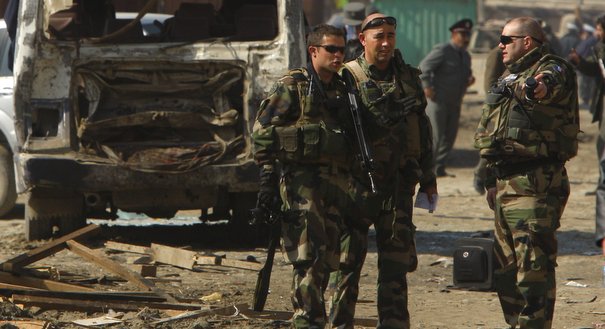
The latest attacks by the self-proclaimed Islamic State may destabilize the upcoming Afghan elections, even as U.S. President Donald Trump questions the U.S. commitment to the country.
Source: Axios
Two suicide bombings in Afghanistan's capital, Kabul, on Monday morning killed at least 25 people, including journalists, police officers and emergency responders. The Islamic State has claimed responsibility.
Why it matters: Over the past year, Kabul has faced a surge of large-scale attacks, and Afghanistan’s National Unity Government has struggled to improve security throughout the country. Although President Ashraf Ghani has offered to enter peace negotiations with the Taliban, these bombings underscore that the Islamic State poses its own grave challenge to the country's stability, just as President Trump has reportedly called U.S. support into question.
Monday's attacks appear to have been designed to specifically target journalists and emergency personnel. At least nine journalists are confirmed dead, as well as at least four police officers. The blow to Afghan journalism is noteworthy, as the burgeoning independent media is now the country's second-most trusted institution (behind only religious leaders).
The attacks come before two milestones in Afghanistan’s democratic development: parliamentary elections, slated for October, and next spring's presidential election. They also follow another Islamic State–claimed attack last week at a voter registration center that killed at least 60 — an apparent effort to discredit the electoral process and sow ethnic violence.
What to watch: First, whether Afghanistan's deteriorating security will have a further chilling effect on the upcoming elections. Second, whether Trump’s new national security team will shift positions on Afghanistan. U.S. leadership has emphasized enduring American support for the Afghan government consistent with the administration’s new South Asia Strategy, but reports broke on Monday that Trump wants to “get the hell out of ” Afghanistan. The only certainty is that Afghan journalists will continue to risk their lives to report the news.

Vice President for Studies
Dr. Frances Z. Brown is a vice president for studies at the Carnegie Endowment for International Peace. Brown served on the White House National Security Council (NSC) staff over the past three presidential administrations. Her research focuses on U.S. foreign policy, Africa, the Middle East, and governance.
Recent Work

Frances Z. Brown, Nate Reynolds, Priyal Singh, …
Saskia Brechenmacher, Frances Z. Brown
Carnegie does not take institutional positions on public policy issues; the views represented herein are those of the author(s) and do not necessarily reflect the views of Carnegie, its staff, or its trustees.

Huawei pushed hard to enter the Egyptian data centers market, until the Americans made a better offer.

Angie Omar

Middle Eastern states should welcome an accelerated U.S. disengagement from their region.

Michael Young

In an interview, former ambassador Charles Freeman assesses the Trump administration’s war against Iran.
Michael Young

By failing to address Palestinian representation, the current process is bound to lead to just another temporary arrangement.

Nathan J. Brown

Morocco and Algeria, each in its own way, are having to navigate the global economic fallout of the U.S.-Israeli military campaign against Iran.

Yasmine Zarhloule