

Paper
James L. Schoff, Douglas E. Rake, Joshua Levy
{
  "authors": [
    "James L. Schoff"
  ],
  "type": "commentary",
  "centerAffiliationAll": "",
  "centers": [
    "Carnegie Endowment for International Peace",
    "Carnegie Russia Eurasia Center"
  ],
  "collections": [],
  "englishNewsletterAll": "",
  "nonEnglishNewsletterAll": "",
  "primaryCenter": "Carnegie Endowment for International Peace",
  "programAffiliation": "",
  "programs": [],
  "projects": [],
  "regions": [
    "East Asia",
    "Japan",
    "Russia"
  ],
  "topics": []
}
Source: Getty
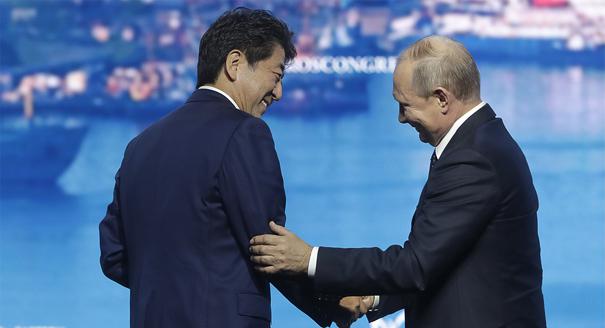
James Schoff, a senior fellow at the Carnegie Asia Program, explains the U.S. position on the close relationship between Russian President Vladimir Putin and former Japanese prime minister Shinzo Abe, and how Washington views economic cooperation between the two neighbors.
How do U.S. experts assess Abe’s attempts to improve relations with Russia?
The short answer is that they were extremely skeptical that anything would come of it.
For the most part, they thought it was a waste of time. At the margins, there was some concern that Abe might concede to some extent on sanctions, or break with G7 unity in response to Crimea, et cetera, but for the most part, they thought he would stick with the allies.
Clearly, if Abe had been able to make progress with Putin and come up with some kind of acceptable deal on the territorial issue and a peace treaty, as long as it did not sacrifice the U.S.-Japan alliance, that would have been a net positive. After all, a truly enhanced, more positive Japan-Russia relationship is to America’s strategic advantage—not only in terms of Russia being more independent of China, but also because it would signal a fundamentally different approach by the Russian leadership. So it’s an opportunity that should always be explored. But recently, U.S. officials had very little expectation that Putin was willing to come to any kind of agreement that would be even marginally acceptable to Abe.
What’s in store for Japanese-Russian economic cooperation in the post-Abe period, and what’s the U.S. position on that cooperation?
In theory, the U.S. position is very supportive—as long as it comes with real improvement in the Japan-Russia relationship: much less pressuring by Russia on the military front in terms of aircraft and other incursions into Japanese territory, a kind of demilitarization of the contested islands. In that context, improved Japan-Russia economic relations would be very welcome in the United States. Even absent a peace treaty or a major improvement in Japan-Russia relations, some economic engagement (like the continuation of some of the economic development programs that the Abe administration launched in the Russian Far East) still makes sense, both as a hedge vis-à-vis China and Chinese influence in that area—as a way of building some goodwill and establishing some connections that are positive and depoliticized as much as possible—and also because it offers some economic opportunity in the future if we’re able to make some progress on North-South Korea relations. Ultimately, the economic dimension would be very important for stabilizing that region.
But the United States will continue to be wary in case the Japan side is overly solicitous of Moscow and compromises too much in that regard. Politically, I’m not worried about that, because Japan simply cannot cave to Russian demands without really getting something in return. So a stalemate seems likely.
Would the United States be prepared to allow Japan to engage a little more closely with Russia economically in order to balance China’s growing involvement with Russia?
I think the answer is “yes.” It requires very close U.S.-Japanese consultation and a sense of trust and a sense that we’re on the same page. I think the most recent “two plus two” meeting and the Quad meeting that took place last week is a solid foundation for the Joe Biden-Yoshihide Suga relationship. And with Suga coming to Washington soon, I have every expectation that the United States-Japan relationship is going to remain quite strong and that there will be a strong sense of trust.
There will be differences about how to deal with human rights issues vis-à-vis China, perhaps, and Myanmar, for example. We’re not always going to have identical foreign policies, but the trust factor is there. And if Suga came to Biden or Japanese Foreign Minister Toshimitsu Motegi came to U.S. Secretary of State Antony Blinken and said, “I think we have a chance to make some improvement in our relationship with Russia that would be useful as a counterweight to Chinese influence and could have some other benefits in the region, perhaps expanding relationships with South Korea at the same time,” I think the United States would be open to that. That is of course barring any further deterioration of the U.S.-Russian relationship going forward.
But I think it’s clear that the Biden team considers China their biggest challenge and Asia to be the arena of greatest opportunity for the U.S. economy and for continued U.S. leadership and influence in the world. So, supporting Japan and having a robust foreign policy in the region is consistent with U.S. interests.
This Q&A was published as part of the “Relaunching U.S.-Russia Dialogue on Global Challenges: The Role of the Next Generation” project, implemented in cooperation with the U.S. Embassy to Russia. The opinions, findings, and conclusions stated herein are those of the author and do not necessarily reflect those of the U.S. Embassy to Russia.

Former Senior Fellow, Asia Program
James L. Schoff was a senior fellow in the Carnegie Asia Program. His research focuses on U.S.-Japan relations and regional engagement, Japanese technology innovation, and regional trade and security dynamics.
Recent Work
James L. Schoff, Douglas E. Rake, Joshua Levy
James L. Schoff

The country’s leadership is increasingly uneasy about multiple challenges from the Levant to the South Caucasus.

Armenak Tokmajyan
In an interview, Daniela Richterova speaks about her book on Czechoslovakia’s Cold War ties to Palestinian groups and others.

Michael Young
The downfall of the Assad regime represented a setback, but Russia’s primary focus remains Ukraine.

Sergei Melkonian
Why did Bashar al-Assad’s armed forces fail to act, unlike those in Egypt, Libya, Algeria, and Sudan?

Yezid Sayigh
Spot analysis from Carnegie scholars on events relating to the Middle East and North Africa.
Armenak Tokmajyan