

Paper
James M. Acton, Ankit Panda
{
  "authors": [
    "Ankit Panda"
  ],
  "type": "commentary",
  "centerAffiliationAll": "dc",
  "centers": [
    "Carnegie Endowment for International Peace"
  ],
  "collections": [],
  "englishNewsletterAll": "ctw",
  "nonEnglishNewsletterAll": "",
  "primaryCenter": "Carnegie Endowment for International Peace",
  "programAffiliation": "NPP",
  "programs": [
    "Nuclear Policy"
  ],
  "projects": [],
  "regions": [
    "East Asia",
    "North Korea"
  ],
  "topics": [
    "Nuclear Policy"
  ]
}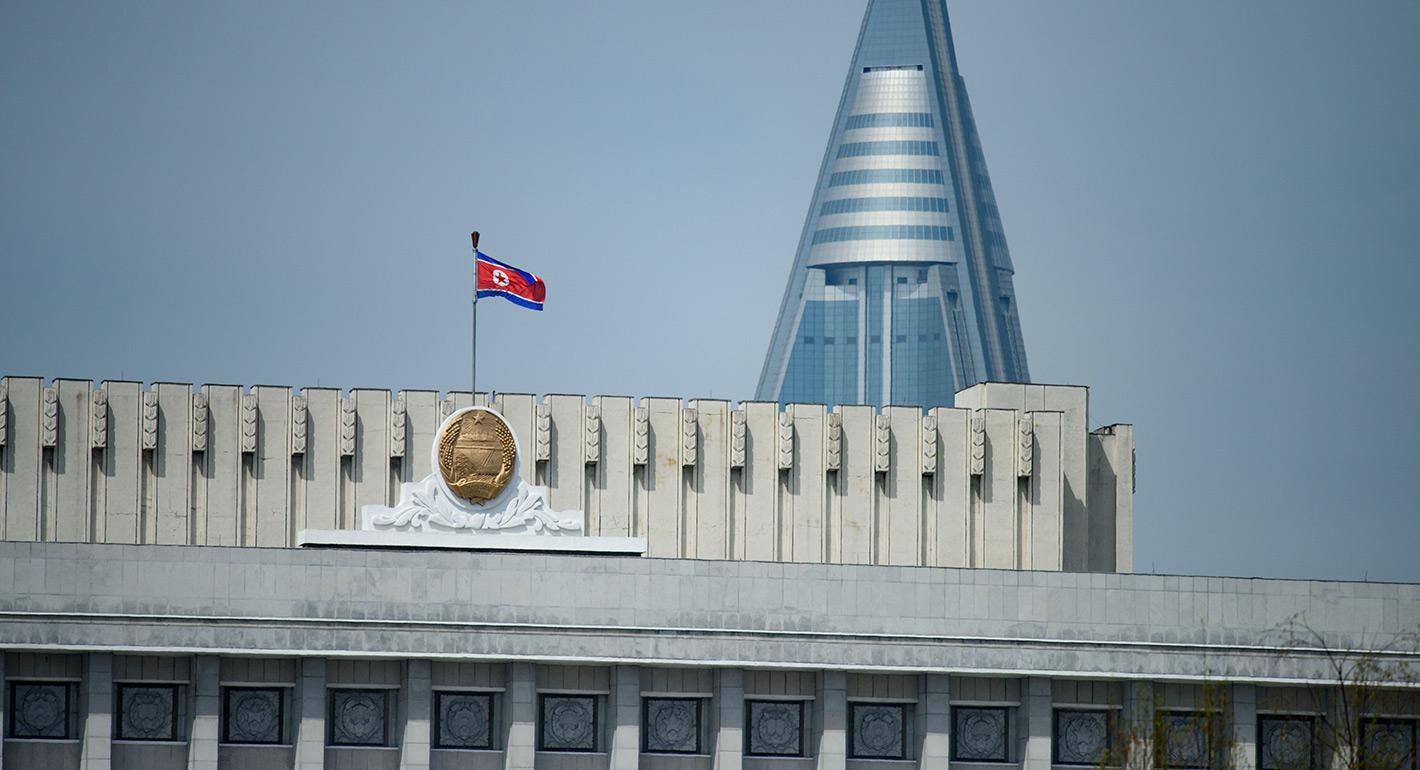
Source: Getty
With no deal with the United States in sight, North Korea has restarted its main nuclear reactor and resumed its production of nuclear material. How should the United States respond?
North Korea’s five-megawatt electrical reactor at its Yongbyon complex appears to be back up and running. The director general of the International Atomic Energy Agency (IAEA) has assessed that “since early July 2021, there have been indications, including the discharge of cooling water, consistent with the operation of the reactor.” In the past, North Korea has reprocessed spent fuel rods from this reactor to produce plutonium for its arsenal of nuclear weapons. This remains the primary purpose of the reactor today.
While the reactor’s resumption of operations no doubt represents a “challenge to President [Joe] Biden’s foreign policy agenda,” as one report noted, Pyongyang’s decision to restart this reactor has its origins in 2019—after the failed Hanoi summit meeting between former president Donald Trump and North Korean leader Kim Jong Un.
The gas-graphite reactor at Yongbyon has long been the focal point of U.S. and international diplomatic efforts to constrain North Korea’s nuclear program. Pyongyang’s decision to restart it is significant because the reactor represents the sole source of spent fuel for reprocessing for plutonium production in the country today. Additionally, having demonstrated a likely two-stage thermonuclear weapon in September 2017, North Korea likely uses this reactor to irradiate indigenously produced lithium-6 to produce tritium, a hydrogen isotope essential to boosting the yield of fission weapons and for fueling thermonuclear weapons. Since the early 2000s, North Korea’s dependency on this reactor has remained significant, but this dependency has diminished somewhat as a parallel uranium enrichment infrastructure has been built. North Korea’s production of enriched uranium did not appear to cease during the high-level diplomacy in 2018 and 2019.
The Yongbyon reactor’s last shutdown took place in early December 2018, in the aftermath of the first U.S.–North Korea summit meeting in Singapore and the two inter-Korean summits. The second inter-Korean summit resulted in a joint statement specifically indicating North Korean willingness to pursue the “permanent dismantlement of the nuclear facilities” at Yongbyon, contingent on “corresponding measures” from the United States. At the Hanoi summit in February 2019, North Korea offered to dismantle this reactor, alongside other facilities at the Yongbyon complex, in exchange for a capacious sanctions-relief package covering most of the measures adopted by the UN Security Council against the country’s economy in 2016 and 2017.
After the United States proved unwilling to pursue further negotiations with North Korea in Hanoi, where the summit ended prematurely, Kim returned to North Korea to recalibrate his approach. In April 2019, a little more than a month after the summit, he gave a notable speech to North Korea’s fourteenth Supreme People’s Assembly, the country’s rubberstamp legislature. In a readout detailing the speech, he appeared to reckon with the Hanoi logjam: the document noted that “the stand-off with the U.S. will naturally assume the protracted nature” and that “sanctions . . . will also continue.” By the end of 2019, Kim had gone further and renounced a moratorium on nuclear testing and long-range missile tests, which he had unilaterally announced in April 2018 ahead of that year’s summitry with the South Korean and U.S. presidents. Through all this time, Kim also never rescinded his directive, delivered during his 2018 New Year’s Day address to the nation, to “mass-produce nuclear warheads and ballistic missiles.”
By mid-2019, the political conditions for a restart of the Yongbyon reactor were in place. There are several reasons why the reactor’s resumed operations ended up taking much longer to materialize—until well into the summer of 2021. First, a spate of natural disasters struck North Korea during the summers of 2019 and 2020, with the Yongbyon reactor and nearby facilities affected in both years. In 2020 in particular, the Kuryong River, which runs alongside the reactor and serves as the outflow point for the reactor’s cooling systems, experienced significant flooding. This setback, along with a parallel slowdown in North Korean national defense activities in early 2020 due to the coronavirus pandemic, likely delayed what may have been plans for an earlier reactor restart. The IAEA director general’s latest report notes that, while awaiting the reactor’s restart, North Korea may have reprocessed “a complete core of irradiated fuel from the 5MW(e) reactor”; he cited five months of observed operations at the steam plant adjacent to the facility known as the Radiochemical Laboratory, the primary reprocessing facility at Yongbyon.
The possibility that North Korea may have reprocessed spent fuel left over from prior reactor operations while the Yongbyon reactor remained inoperative underscores that the country’s total stockpile of weapons-useable plutonium can grow, even without a working reactor. The reactor’s restart, however, indicates that North Korea has planned to produce more plutonium and tritium in the future. At the Eighth Party Congress of the Workers’ Party of Korea, a significant political event, Kim called for the production of “super-large hydrogen bombs” and the development of “tactical nuclear weapons.” The first of these endeavors may require the production of additional tritium, as whatever limited tritium inventory existed before the last reactor shutdown in 2018 may have been depleted. While the development of tactical nuclear weapons may not necessarily imply a need for plutonium, this pursuit may more broadly indicate a push for a larger, more diversified nuclear force, necessitating more weapons-grade fissile material in general.
All of this points to the simplest reason North Korea chose to restart the reactor at Yongbyon: because Kim sees little prospect of a deal with the United States in the near-term and sees a need for additional nuclear material for an expanding nuclear arsenal. The decisions that led to the reactor’s July 2021 restart are unlikely to be responses to North Korea’s immediate external environment this year—or the Biden administration’s policy toward Pyongyang. Rather, this choice is probably the result of strategic assessments by the regime’s top leadership in the aftermath of the Hanoi summit.
The Biden administration should treat this reactor’s restart with the seriousness it deserves. Even though Yongbyon no longer represents the proverbial beating heart of the North Korean nuclear program as it once did, especially in the 1990s, depriving North Korea of an expanding inventory of plutonium and tritium has practical value. For an administration that professes an interest in “practical progress that increases the security of the United States, [U.S.] allies, and deployed forces,” the short-term priority must be to verifiably slow the quantitative growth of North Korea’s arsenal while denying Pyongyang incentives to pursue qualitative advances in nuclear delivery systems.
With North Korea rebuffing the Biden administration’s attempts for unconditional exploratory talks, the prospect of a return to diplomacy in the near-term appears slim. As was the case after Hanoi, Kim appears to be seeking evidence of a fundamental shift in what the United States may be willing to offer up at the negotiating table in exchange for nuclear concessions, with sanctions relief at the top of his list. Absent any change, North Korea will seek to “approach the U.S. on the principle of power for power and goodwill for goodwill,” as Kim noted in January 2021.

Stanton Senior Fellow, Nuclear Policy Program
Ankit Panda is the Stanton Senior Fellow in the Nuclear Policy Program at the Carnegie Endowment for International Peace.
Recent Work

James M. Acton, Ankit Panda
Ankit Panda
Carnegie does not take institutional positions on public policy issues; the views represented herein are those of the author(s) and do not necessarily reflect the views of Carnegie, its staff, or its trustees.
In an interview, Marc Lynch discusses his new book decrying the post-1990 U.S.-dominated order in the Middle East.

Michael Young
The advantage that China has over other global powers, especially America, is that its foreign policy is closely aligned with those of many of the Middle Eastern countries.


Jin Liangxiang, Maha Yahya, Hesham Alghannam
To create an environment more conducive to cooperation and development, U.S. and Chinese efforts should seek the endorsement of neighboring countries and regional organizations. Otherwise, regional and geopolitical rivalries will remain barriers.
Abdullah Baabood
Scholars from Carnegie’s global network comment on how the ongoing conflict between Israelis and Palestinians is affecting their areas of interest, and what the implications of this may be.


Maha Yahya, Rosa Balfour, Judy Dempsey, …
In an interview, Abdullah Baabood discusses Beijing’s evolving role in the Gulf region, where its priority is stability.
Michael Young