

• Research
  • Diwan
  • About
  • Experts
Carnegie Middle East logoCarnegie lettermark logo
PalestineSyria
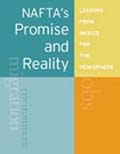
NAFTA's Promise and Reality: Lessons from Mexico for the Hemishphere
Report

NAFTA's Promise and Reality: Lessons from Mexico for the Hemishphere

This report from the Carnegie Endowment for International Peace examines the impact of NAFTA after ten years.

Link Copied
By Dr. Demetrios Papademetriou, Mr. John Audley, Ms. Sandra Polaski, Mr. Scott Vaughan
Published on Nov 9, 2003

Additional Links

Full Text (PDF)

Source: Carnegie

About the Report
This report from the Carnegie Endowment for International Peace examines the impact of NAFTA after ten years. The report asks:

    • whether NAFTA has achieved-or is on track to achieve-its policy objectives;
    • what impact it has had on the lives and livelihoods of North Americans, particularly Mexicans; and
    • what lessons can be drawn for future trade policy for the US and for developing countries that negotiate trade pacts with the US.

To answer these questions, the authors looked beyond the two headline figures that have typically been used to measure the impact of NAFTA: the increase in the volume of trade between the countries and the increase in the flow of foreign investment.

Click on the link above to read the full text.
Read the Spanish translation.
New York Times 11/19/03 article (may require free registration)

About the Authors
Sandra Polaski
is director of Carnegie’s Trade, Equity, and Development Project. Demetrios G. Papademetriou is co-director and co-founder of the Migration Policy Institute. Scott Vaughan, formerly a visiting scholar with Carnegie's Trade, Equity, and Development Project, is director of the Unit for Sustainable Development and Environment at the Organization of American States. John Audley, formerly director of Carnegie's Trade, Equity, and Development Project, is senior transatlantic advisor at the German Marshall Fund.

*Errata:
In Figure 10 (page 25) the trend line labeled "wages" inadvertantly showed unit labor costs. The new figure correctly presents the data on wages.

On page 27, the study cited in footnote 37 claims that NAFTA eliminated 766,000 net jobs during its first seven years. The text has been changed to reflect this.

Authors

Dr. Demetrios Papademetriou
Former Senior Associate
Mr. John Audley
Former Senior Associate
Ms. Sandra Polaski
Former Senior Associate, Director, Trade, Equity and Development Program
Sandra Polaski
Mr. Scott Vaughan
Former Visiting Scholar
North AmericaSouth AmericaEconomyTrade

Carnegie does not take institutional positions on public policy issues; the views represented herein are those of the author(s) and do not necessarily reflect the views of Carnegie, its staff, or its trustees.

More Work from Malcolm H. Kerr Carnegie Middle East Center

  • Commentary
    Diwan
    Unpacking Lebanon’s Gap Law

    In an interview, Ishac Diwan looks at the merits and flaws in the draft legislation distributing losses from the financial collapse.

      Michael Young

  • Commentary
    Diwan
    Has Sisi Found a Competent Military Entrepreneur?

    Mustaqbal Misr has expanded its portfolio with remarkable speed, but a lack of transparency remains.

      Yezid Sayigh

  • Research
    Arab Diaspora Business Communities in Egypt

    Arab diaspora business communities in Egypt often mirror the same systemic challenges facing Egyptian businesses.

      • +4

      Nur Arafeh, Yezid Sayigh, Qaboul al-Absi, …

  • Article
    Saudi Arabia in Africa: Sound Economic and Geopolitical Strategy, or Resource Exploitation?

    Largely characterized thus far by a single-minded focus on extractivism, Riyadh must commit to greater equitability in its approach to investment and development deals with Sudan, Ethiopia, and Eritrea.

      Hesham Alghannam

  • A picture taken from a position at the Israeli border with the Gaza Strip shows the destruction due to Israeli bombardment in the besieged Palestinian territory on May 18, 2025
    Article
    Destruction, Disempowerment, and Dispossession: Disaster Capitalism and the Postwar Plans for Gaza

    Once Israel’s war in the territory is brought to an end, the foundational principles guiding reconstruction should be Palestinian self-determination, local agency, and sovereignty.

      Nur Arafeh, Mandy Turner

Get more news and analysis from
Malcolm H. Kerr Carnegie Middle East Center
Carnegie Middle East logo, white
  • Research
  • Diwan
  • About
  • Experts
  • Projects
  • Events
  • Contact
  • Careers
  • Privacy
  • For Media
Get more news and analysis from
Malcolm H. Kerr Carnegie Middle East Center
© 2026 Carnegie Endowment for International Peace. All rights reserved.