• Research
  • Diwan
  • About
  • Experts
Carnegie Middle East logoCarnegie lettermark logo
PalestineSyria
Consequences of Iran’s Presidential Election Results

Source: Getty

Article

Consequences of Iran’s Presidential Election Results

Mahmoud Ahmadinejad’s election victory could pose an insurmountable challenge to the Obama administration’s engagement strategy, but Iran remains integral to critical foreign policy challenges.

Link Copied
By Karim Sadjadpour
Published on Jun 14, 2009

Additional Links

Full Text

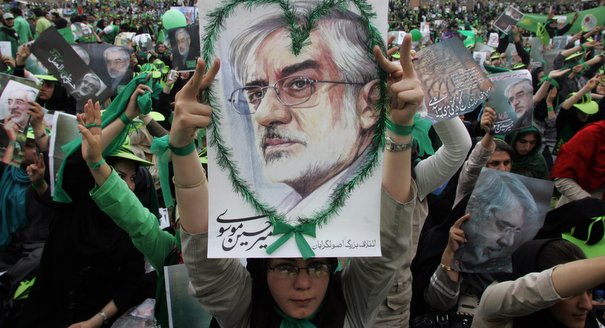
Following the surprise announcement that President Ahmadinejad had won outright the first round of Iran’s presidential election, Karim Sadjadpour explained the implications for the Obama administration’s diplomatic initiative with Iran and the domestic reaction.

Key points:

  • The United States should wait until the election has played out domestically before commenting on or reaching out to the Iranian government.
     
  • Ahmadinejad’s victory could pose an insurmountable challenge to the Obama administration’s engagement strategy, but Iran remains integral to critical challenges including Afghanistan, the Arab–Israeli conflict, terrorism, and energy security. Once the dust settles the United States will eventually have no choice but to talk to Tehran, but it will likely be a cold, hard-nosed dialogue rather than friendly greetings.
     
  • Despite being the true source of power, Supreme Leader Ayatollah Khamenei is rarely held accountable for Iran’s economic malaise or political isolation, given the high profile of the Iranian president. The United States should announce publicly they wish to talk directly with Khamenei.
     
  • In the thirty years since the Islamic revolution, Iran’s political elite have never been so divided.
     
  • While dramatic, the current protests are not yet significant enough to pose an existential threat to the regime.

Sadjadpour said:

“In retrospect, it looks like the entire campaign was a show, in the sense that Ayatollah Khamanei was never going to let Ahmadinejad lose. Assuming these results are allowed to stand, I think we should be clear about what type of regime we are dealing with in Tehran. Just as we talk about Assad’s Syria and Mubarak’s Egypt, I think we are now dealing with Khamanei’s Iran.”

About the Author

Karim Sadjadpour

Senior Fellow, Middle East Program

Karim Sadjadpour is a senior fellow at the Carnegie Endowment for International Peace, where he focuses on Iran and U.S. foreign policy toward the Middle East.

    Recent Work

  • Q&A
    What’s Keeping the Iranian Regime in Power—for Now

      Aaron David Miller, Karim Sadjadpour, Robin Wright

  • Q&A
    How Washington and Tehran Are Assessing Their Next Steps

      Aaron David Miller, David Petraeus, Karim Sadjadpour

Karim Sadjadpour
Senior Fellow, Middle East Program
Karim Sadjadpour
North AmericaUnited StatesMiddle EastIranPolitical ReformForeign Policy

Carnegie does not take institutional positions on public policy issues; the views represented herein are those of the author(s) and do not necessarily reflect the views of Carnegie, its staff, or its trustees.

More Work from Malcolm H. Kerr Carnegie Middle East Center

  • GCC foreign minister meeting in Kuwait City on June 2, 2025
    Article
    Can the Gulf Cooperation Council Transcend Its Divisions?

    Without structural reform, the organization, which is racked by internal rivalries, risks sliding into irrelevance.

      Hesham Alghannam

  • Commentary
    Diwan
    U.S. Aims in Iran Extend Beyond Nuclear Issues

    Because of this, the costs and risks of an attack merit far more public scrutiny than they are receiving.

      • Nicole Grajewski Profile Picture

      Nicole Grajewski

  • Commentary
    Diwan
    The Jamaa al-Islamiyya at a Crossroads

    The organization is under U.S. sanctions, caught between a need to change and a refusal to do so.

      Mohamad Fawaz

  • Commentary
    Diwan
    Iran and the New Geopolitical Moment

    A coalition of states is seeking to avert a U.S. attack, and Israel is in the forefront of their mind.

      Michael Young

  • Commentary
    Diwan
    All or Nothing in Gaza

    Implementing Phase 2 of Trump’s plan for the territory only makes sense if all in Phase 1 is implemented.

      Yezid Sayigh

Get more news and analysis from
Malcolm H. Kerr Carnegie Middle East Center
Carnegie Middle East logo, white
  • Research
  • Diwan
  • About
  • Experts
  • Projects
  • Events
  • Contact
  • Careers
  • Privacy
  • For Media
Get more news and analysis from
Malcolm H. Kerr Carnegie Middle East Center
© 2026 Carnegie Endowment for International Peace. All rights reserved.