

Commentary
Dmitri Trenin
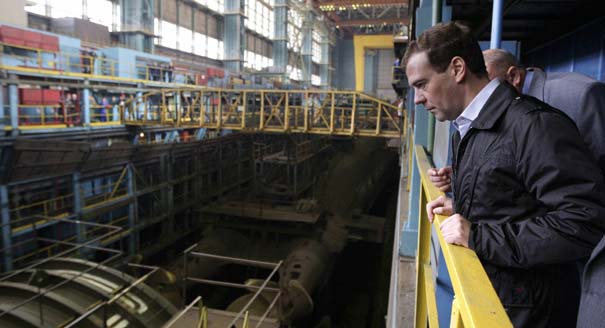
Source: Getty
The global economic crisis emphasized Russia’s need to modernize or face marginalization. The current brand of conservative modernization, however, is unlikely to succeed, leading to a showdown between true modernizers and conservatives.
Russia’s present dilemma could be described as modernization or marginalization (“M or M”). This is more or less clear to Russia’s leaders. Putin evoked it in his “millennium article” in December 1999; Medvedev’s current speeches and articles echo some of the themes raised by Putin early in his presidency. One can also mention “Putin’s plan” (2007-8), also known as Strategy-2020, as a blueprint for modernization.
Thus, none of this is new. What is new is the sense of urgency brought about by the global economic crisis. The crisis dispelled the myth of sustained energy-powered growth, which would take care of all problems, and allow postponement of reforms. (Medvedev said as much in one of his speeches). It also exposed the naivete of those who thought Russia would be able to sit it out, on its “island of stability”. There is also a sense, in 2010, that there can be no going back to the gilded years of the Putin presidency: that paradise is lost.
The Kremlin’s current concept of modernization is rather narrow, addressing mostly the technological base of the national economy. However, the so-called conservative modernization, which lays emphasis on preserving the current politico-economic system virtually intact, will probably fail, as it makes it impossible, e.g., to deal with the root causes of corruption. To be effective, modernization must embrace political and social spheres, and help transform elements of Russian culture. This, however, is beyond what Putin and Medvedev seem to have in mind at present.
Putin and Medvedev are not one and the same, but they are much more of a team than many give them credit for. The tandem has been a resounding success. It allows the PM and the President, among other things, to reach out to different audiences: conservative, paternalistic and loyalist (Putin) and more independent-minded IT generation (Medvedev). In that division of labor, Putin assures widespread popular acquiescence in the political system and arbitrates among the interest groups at the top, essentially providing general political stability. Medvedev’s task is to lead the country forward. Modernization is his “speciality”.
Putin is the dominant actor, the principal decider, while Medvedev is a junior partner, though not a mere clone. The 2012 election will not be decided by a P v M competition; the roles are likely to remain unchanged, even if positions that they occupy do not.
Down the road, things are likely to get more interesting. The status quo in Russia is increasingly unbearable; while change under the present circumstances is considered impossible. A showdown between two large groups – the modernizers and the conservatives – is approaching. The latter group looks more formidable, but numbers do not tell the whole story. The stakes are exceedingly high, including internationally. If a Russian leader becomes convinced that the lack of modernization sends Russia tumbling down the global pecking order, he might decide, in exasperation, to join the modernizers’ camp and let it prevail. A coalition for modernization could then emerge, including patriotic-(nationalist)minded elite figures, businessmen, the bulk of the SME entrepreneurs, and sections of the middle classes, especially if the flat income tax scale has to be replaced by a progressive one. More pessimistic scenarios, however, can not be discounted, let alone dismissed.
While the outlook in Russia for the next couple of years is incremental change in the economy and virtually none in the other relevant areas, a likely failure of conservative modernization by the mid-2010s, if not earlier, may lead to “an hour of truth” within the elite and a dramatic, and probably messy, showdown between the status quo-oriented groups and the coalition for change. The result of that showdown will resolve the “M or M” issue and determine the future of Russia.
Former Director, Carnegie Moscow Center
Trenin was director of the Carnegie Moscow Center from 2008 to early 2022.
Recent Work
Dmitri Trenin
Dmitri Trenin
Carnegie does not take institutional positions on public policy issues; the views represented herein are those of the author(s) and do not necessarily reflect the views of Carnegie, its staff, or its trustees.