

Commentary
Middle Eastern states should welcome an accelerated U.S. disengagement from their region.
Michael Young
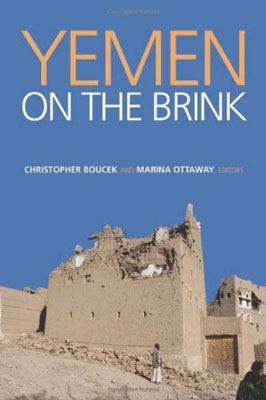
Without addressing Yemen's immediate security challenges—including a civil war in the North, a secessionist movement in the South, and a resurgent al-Qaeda organization—the country's long-term economic and governance issues cannot be resolved.
Source: Washington

“A compelling study on the part of Carnegie to help explain the complexities of Yemen to increasingly concerned Western policy makers.”
—Nabeel Khoury, U.S. Department of State
“Political, economic, and security developments in Yemen increasingly affect the European Union, and this book will serve as a valuable resource for policy makers as they work to address the many challenges facing Yemen.”
—Gilles De Kerchove, EU Counter-Terrorism Coordinator

Former Associate, Middle East Program
Boucek was an associate in the Carnegie Middle East Program where his research focused on security challenges in the Arabian Peninsula and Northern Africa.

Former Senior Associate, Middle East Program
Before joining the Endowment, Ottaway carried out research in Africa and in the Middle East for many years and taught at the University of Addis Ababa, the University of Zambia, the American University in Cairo, and the University of the Witwatersrand in South Africa.
Carnegie does not take institutional positions on public policy issues; the views represented herein are those of the author(s) and do not necessarily reflect the views of Carnegie, its staff, or its trustees.

Middle Eastern states should welcome an accelerated U.S. disengagement from their region.

Michael Young

The accord represents a pivotal moment in the region to avert a security vacuum in the Gulf.


Azeema Cheema, Mohanad Hage Ali

In an interview, Jason Burke discusses his sweeping account of the “revolutionists” who so shaped the 1970s and early 1980s.
Michael Young

By failing to address Palestinian representation, the current process is bound to lead to just another temporary arrangement.

Nathan J. Brown

Morocco and Algeria, each in its own way, are having to navigate the global economic fallout of the U.S.-Israeli military campaign against Iran.

Yasmine Zarhloule