

Article
Deborah Gordon, Stephen D. Ziman
Source: Getty
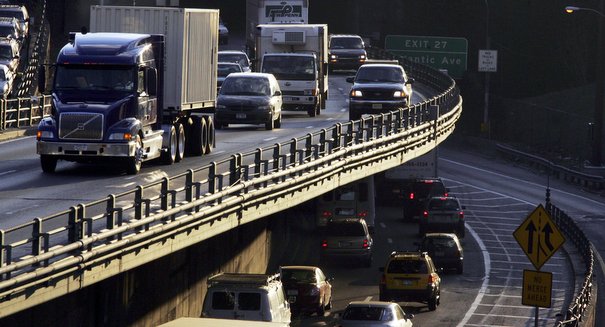
Given that on-road transportation has the greatest negative effect on the climate compared to all other economic sectors, cutting air-pollutant emissions from this form of transportation would be good both for the climate and for public health.
The Earth’s rapidly warming temperatures over the past several decades cannot be explained by natural processes alone. The science is conclusive: both man-made and natural factors contribute to climate change. Human activities— fossil-fuel combustion in transportation and other sectors, urbanization, and deforestation—are increasing the amount of heat-trapping gases in the atmosphere. These record levels of greenhouse gases are shifting the Earth’s climate equilibrium.
Climate impacts differ by sector. On-road transportation has the greatest negative effect on climate, especially in the short term. This is primarily because of two factors unique to on-road transportation: (1) nearly exclusive use of petroleum fuels, the combustion of which results in high levels of the principal warming gases (carbon dioxide, ozone, and black carbon); and (2) minimal emissions of sulfates, aerosols, and organic carbon from on-road transportation sources to counterbalance warming with cooling effects. Scientists find that cutting on-road transportation climate and air-pollutant emissions would be unambiguously good for the climate (and public health) in the near term.
Transportation’s role in climate change is especially problematic, given the dependence on oil that characterizes this sector today. There are too few immediate mobility and fuel options in the United States beyond oil-fueled cars and trucks.
U.S. and international policy makers have yet to tackle transportation-climate challenges. In its fourth assessment report, the Intergovernmental Panel on Climate Change (IPCC) found that the global transportation sector was responsible for the most rapid growth in direct greenhouse gas emissions, a 120 percent increase between 1970 and 2004. To further complicate matters, the IPCC projects that, without policy intervention, the rapidly growing global transportation sector has little motivation to change the way it operates, because consumer choices are trumping best practices.
Herein lies a fundamental mismatch between the climate problem and solutions: transportation is responsible for nearly one of every three tons of greenhouse gas emissions but represents less than one of every twelve tons of projected emission reductions. Clearly this sector is a major contributor to climate change; therefore, it should be the focus of new policies to mitigate warming. Government must lead this effort as the market alone cannot precipitate the transition away from cars and oil, which dominate this sector.
Policy makers need to remember four essential findings and recommendations when developing new strategies for ensuring that the United States maintains its leadership position in the global economy:

Former Director and Senior Fellow, Energy and Climate Program
Gordon was director of Carnegie’s Energy and Climate Program, where her research focuses on oil and climate change issues in North America and globally.
Recent Work
Deborah Gordon, Stephen D. Ziman
Deborah Gordon, Smriti Kumble, David Livingston
Carnegie does not take institutional positions on public policy issues; the views represented herein are those of the author(s) and do not necessarily reflect the views of Carnegie, its staff, or its trustees.

In an interview, Rozina Ali discusses her new book on the rise and manifestations of Islamophobia in the United States.

Michael Young

In an interview, Ian Lustick and Eli Clifton discuss their new book on why a prominent ally has so much influence in America.
Michael Young

As the U.S. stumbles in its war with Iran, we are likely to see an acceleration of its disengagement from the region.
Michael Young

Middle Eastern states should welcome an accelerated U.S. disengagement from their region.
Michael Young

In an interview, former ambassador Charles Freeman assesses the Trump administration’s war against Iran.
Michael Young