A Political System Overturned
Among the bevy of Nepali communist parties is the Nepal Majdoor Kisan Party (Nepal Workers Peasants Party or NWPP), which draws inspiration from Juche, North Korea’s doctrine of national self-reliance. Founded in 1975, the party had remained largely on the sidelines of Nepal’s communist movement. Its electoral strength had come almost entirely from its lone stronghold, the Bhaktapur-1 constituency in the Kathmandu Valley, where its candidates had won every general election since 1991. In this year’s Nepali election, however, that decades-long record in Bhaktapur-1 was broken by the upstart Rastriya Swatantra Party (RSP). What might have seemed like a local upset was in fact part of a nationwide political upheaval. The RSP went on to secure 182 of the 275 total seats, two short of a two-thirds majority in the lower house of Parliament.
The NWPP’s rout in its home constituency is among the many remarkable stories to emerge from a snap election that has overturned much of the conventional wisdom about Nepali politics. The RSP’s parliamentary majority is the first since the Nepali Congress (NC) secured one in 1999. No election result has been as decisive since Nepal’s first general election in 1959, when the NC won a two-thirds majority. Many observers had doubted that the current electoral system—which combines first-past-the-post and proportional representation—could allow one party to secure a majority.
The RSP’s parliamentary majority is the first since the Nepali Congress secured one in 1999. No election result has been as decisive since Nepal’s first general election in 1959.
Just as striking as the verdict was the magnitude of the RSP’s showing. Twelve RSP candidates received more than 50,000 votes under the first-past-the-post system. Its prime ministerial candidate, former Kathmandu mayor Balen Shah, received nearly 70,000 votes—the highest in Nepal’s electoral history. In doing so, he easily beat former prime minister and Communist Party of Nepal (Unified Marxist–Leninist) (UML) chairman K.P. Sharma Oli in Oli’s home district of Jhapa, where Oli had won every election since 1991 except one. Several other senior leaders belonging to the NC, the UML, and the Nepali Communist Party lost to RSP candidates. Constituencies considered safe for those parties saw a massive churn in favor of the RSP, which won each of the fifteen seats across the Kathmandu Valley’s three cities.
Electoral data suggests that the RSP did particularly well in urban and semi-urban areas with high internet access, while older parties did better in areas with limited state reach, where party networks remain essential for service delivery. Rapid urbanization, internal migration, and a younger electorate meant that old party bastions such as the Bhaktapur-1 seat could be breached. Communist parties saw their generational domination of the popular vote reduced from around 40 percent to 21 percent. Almost a third of the incoming MPs are below the age of forty. In the last Parliament, this figure was roughly one in ten.
After the incumbent Oli government resigned in the wake of the September Gen Z protests, the president dissolved Parliament and tasked an interim government, led by former chief justice Sushila Karki, with holding snap elections in March 2026. The arson and rioting that followed the mass killings of protesters during the protests were symbols of a deep frustration and discontent with the status quo in Nepali politics. Governments had cycled rapidly through prime ministers, corruption and cronyism had flourished, and economic reform had largely fallen off the agenda. High youth unemployment had forced many young Nepalis to emigrate in search of opportunities. Older parties and leaders were left discredited in the wake of the protests and had no clear answers to the RSP’s narrative of change. At the center of this seismic upheaval is the new prime minister, Balen Shah.
The Rise of Balen Shah
The RSP has begun its historic mandate in a hurry.
At 12:34 pm on March 27, 2026—an auspicious time chosen through astrology—thirty-six-year-old Shah was sworn in as the country’s youngest-ever elected prime minister. In a ceremony replete with Hindu and Buddhist religious symbolism, Shah appointed a fourteen-member cabinet, whose oldest member is aged fifty-one.
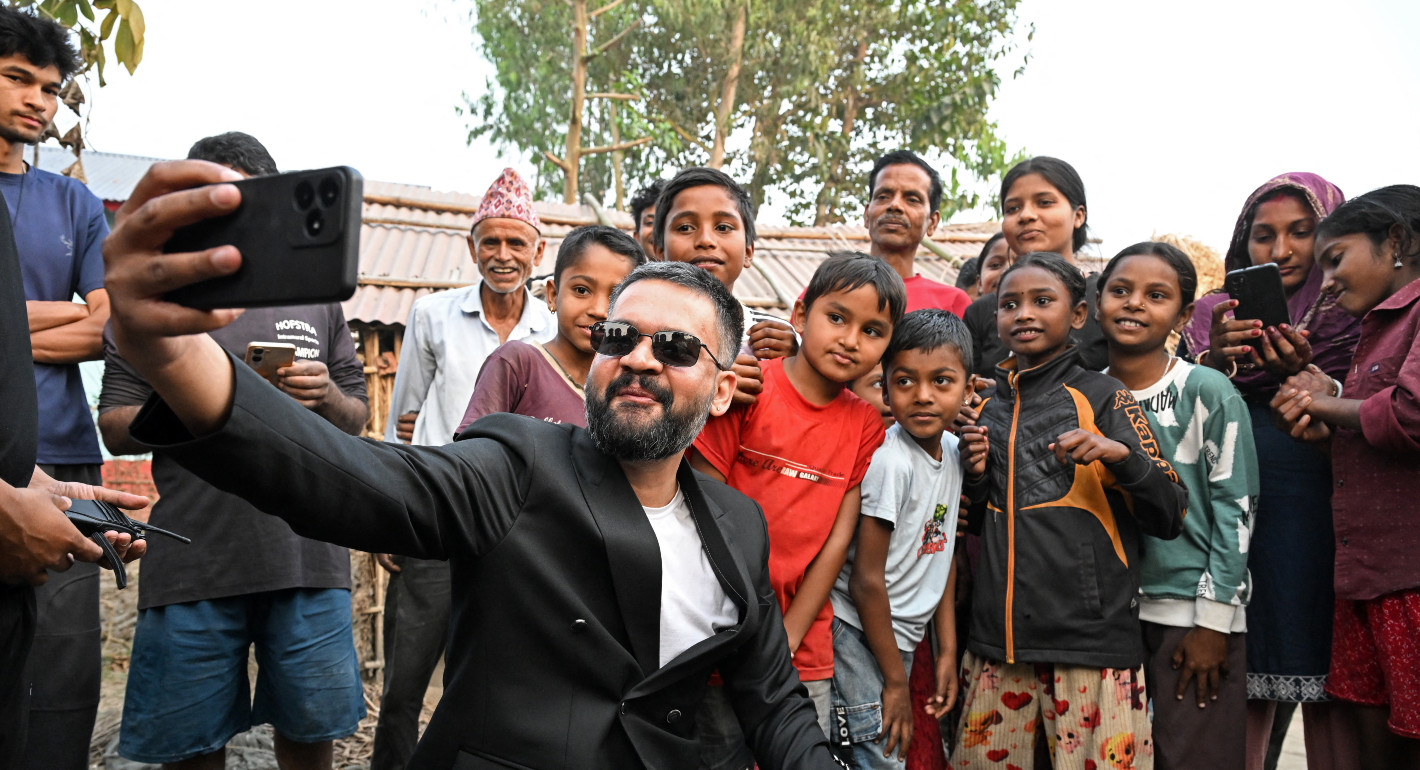
Shah, a rapper and structural engineer from Madhes, could have settled abroad like many other young Nepalis but chose to stay back.
By the following morning, the Shah government had authorized the arrests of Oli and former home minister Ramesh Lekhak of the NC on charges of criminal negligence amounting to reckless homicide, following the new administration’s decision to implement the recommendations of the commission investigating the September protests. That evening, it released a 100-point governance reform agenda. The next morning, authorities arrested another former minister on money laundering charges and opened corruption investigations into three former prime ministers, including Oli. The government also instructed public and private hospitals to immediately reserve 10 percent of beds for economically disadvantaged patients and offered jobs at the national power authority to the families of those killed in the September protests.
Shah, a rapper and structural engineer from Madhes (Nepal’s southern plains bordering India) who was raised in Kathmandu, could have settled abroad like many other young Nepalis but chose to stay back.
At his first public rally in Janakpur in the Madhes plains, Shah spoke for just shy of nine minutes—his longest campaign speech. Employing colloquial Maithili, the dominant language of the region—something no prime ministerial candidate had done in recent memory—Shah referred to the Madhes movement that began in 2007 and its long struggle for political representation by telling the nearly 20,000-strong crowd to go to Kathmandu to visit Pashupati and Swayambhu, its two most famous shrines, but not to demand rights.
Nepal’s government and politics have long been dominated by the Khas-Arya high-caste people from the hills, who also control the judiciary and the bureaucracy. The people of Madhes were seen to be culturally closer to Indians across the border, and their loyalty to the nation was suspect in the eyes of Nepal’s rulers. To counter this, the people of the Madhes plains demanded greater political representation and devolution of power through federalism, both of which were achieved on paper, but not in practice, via the 2015 constitution. For the Madhes movement, Kathmandu was the antagonist that had historically treated the plains as an appendage. Madhes opposition to the 2015 constitution’s haphazard provincial delineation and unequal citizenship rights was fiercely countered by the Kathmandu elite, who saw the protests as driven by India (which supported the Madhes movement). Shah’s entreaty to Madhesis to stop going to Kathmandu to demand rights was received against the backdrop of this contentious history, in which Nepal’s rulers have failed to devolve power to the provinces as mandated by the constitution.
Shah’s Madhesi roots enabled the party to win thirty of the thirty-two first-past-the-post seats in Madhes province. The rest of the region followed a similar electoral pattern, with the RSP sweeping the southern plains. On the campaign trail, it was common to hear voters say they did not know who their local candidate was, but that they would vote for Shah. “Ab ki baar, Balen sarkar” (this time, Balen’s government)—an intentional callback to Indian Prime Minister Narendra Modi’s ubiquitous 2014 campaign slogan—was the popular refrain.
Shah had risen from obscurity to become mayor of the very city that discriminated against people of the plains, had openly rejected the traditional parties, and had even called the prime minister a terrorist after the first day of the Gen Z protests. For many voters, here was a chance to elect a Madhesi with nationwide appeal as prime minister.
Shah’s tenure as Kathmandu mayor had its ups and downs. He combined old-school nationalism with a healthy disdain for the existing party system and traditional media. He chose to communicate primarily on social media with his millions of followers. When the Indian Parliament unveiled a new map of the subcontinent purportedly showing “Akhand Bharat”—a Hindu nationalist concept of a historically unified Indian civilization—Shah responded by hanging a “Greater Nepal” map in the mayor’s office. He argued with ward chiefs over parking issues, bulldozed illegal constructions, displaced landless squatters and street vendors, and faced intense opposition from scrap dealers. One night a few months before the election, Shah wrote in a now-deleted Facebook post, “Fuck America, Fuck India, Fuck China,” and made similar remarks about other Nepali leaders. In another post, he threatened to torch Singha Durbar, the seat of the Nepali government.
Shah’s tenure as Kathmandu mayor combined old-school nationalism with a healthy disdain for the existing party system and traditional media.
At the same time, he gave away thousands of scholarships at private schools in Kathmandu to outstation students and intervened in parking and other civic issues. He came to be viewed as an anti-establishment disruptor and, in turn, quickly became a popular icon. Across Nepal’s highways, his portrait was plastered on the backs of trucks and buses. He was offered the interim prime minister post in the aftermath of the protests, which he refused. As Sudan Gurung, who is now home minister, put it at the time, “We want to see Balen as prime minister for five years.”
The RSP’s Breakthrough
Formed just a few months before the 2022 general election, the RSP—led by former TV presenter Rabi Lamichhane—won twenty-one seats on an anti-corruption platform, becoming the fourth-largest party in its first electoral outing. It later joined a coalition government led by the Maoists and the UML, with Lamichhane appointed home minister. His tenure was marked by repeated controversies. The Supreme Court declared that he had failed to reacquire Nepali citizenship after renouncing his American one. He was also embroiled in a scandal involving the embezzlement of funds from several cooperative schemes.
Lamichhane accused the media of a witch hunt in a much-televised press conference and authorized the arrest of the publisher of Nepal’s largest media house on charges of holding multiple citizenships. In October 2024, Lamichhane was jailed for his alleged role in the embezzlement case, and he remained in and out of jail until protesters—one of whom was allegedly a party member—broke him out on the second day of the Gen Z protests. After surrendering himself and subsequently being released on bail, Lamichhane went on to contest the elections. The attorney general also withdrew the money laundering and organized crime charges against him in January. Despite these controversies, the RSP’s broader political appeal remained intact.
The RSP lacks a distinctive ideological identity, unlike traditional actors in Nepali politics. Beyond the multitude of left-wing parties, the NC represents a democratic socialist strand of politics, while several regional parties—especially in the Madhes—emphasize identity politics. By contrast, the RSP’s primary appeal lies in offering an alternative politics that seeks to break the hold of traditional parties on policymaking and governance, while promising to end the old guard’s corruption and cronyism.
The RSP lacks a distinctive ideological identity, unlike traditional actors in Nepali politics.
Since the reinstatement of multiparty democracy in 1990, Nepalis have largely had to choose among three broad political currents: the left, the NC, and regional identity-based parties. In the recent election, the RSP offered a coherent alternative. Its candidates were ideology-agnostic: technocrats with a policy orientation, youth leaders who had participated in the protests, breakaway political aspirants who hadn’t found space in old party networks, former security officials, members of the business elite, and erstwhile independent candidates. In effect, the party is an umbrella organization that brings together those disaffected with the existing parties under a technocratic vision centered on governance reform.
The RSP presented itself as the political heir to the Gen Z movement’s demands and capitalized on Shah’s immense popularity by turning the election into a presidential-style campaign centered on his candidacy for prime minister. The party carefully choreographed Shah’s appearances: He addressed a rally every eight days, and multiple road shows were held each day to bring his message to voters. During these brief stops, Shah would meet crowds in person, reinforcing his popularity among the masses. A 660-member social media team was deployed to amplify his message across the country. The RSP also fielded several candidates under the age of forty, including several youth activists who had participated in the protests.
The RSP’s landslide victory can thus be attributed to multiple factors: a steadily growing party organization that established itself as an alternative to old parties; extensive use of social media and new platforms to carry its message, especially to younger voters; extreme fatigue with established parties and their inability to deliver governance and economic reforms; collective anger at the mishandling of the Gen Z protests; a deep-seated desire for change, particularly among the youth; demographic change inside Nepal; and Shah’s personal popularity. The older parties, with a predilection for old-school campaigning that relied more on grassroots-based networking and speeches by their leaders, had no answers. Infighting within the old parties didn’t help—leaders who had either been sidelined or not given tickets to contest the election refused to mobilize their networks. By the time of the polls, the writing was on the wall.
From Protest to Power
On the eve of Shah’s swearing-in, he returned to his rap roots by uploading a video for his song “Jai Mahakali” on YouTube. Edited with visuals from his successful election campaign, the song—whose chorus is also the war cry of the famed Gorkha soldiers—captures the national mood on his victory: “Victory to the goddess Mahakali/Here comes the Gorkhali/We’ll win over the world this time/Unafraid is this Nepali” (author’s translation).
Governing Nepal will not be so straightforward. In a country long plagued by political instability resulting from cross-cutting coalitions and frequent changes in government, the supermajority handed over to the RSP reflects both the traditional parties’ abysmal past performance and the public’s lofty expectations from its government. But new realities lie ahead. The government’s 100-point reform agenda underscores the inefficiencies embedded in Nepal’s existing systems.
The RSP has called for a “delivery-based governance” system aimed at streamlining processes and making state institutions more accountable for timely service delivery. The reform document emphasizes the digitization of services to improve bureaucratic accountability. It also proposes reforms to public procurement and investment rules, alongside efforts to downsize the government. The administration has pledged to depoliticize public institutions, including through periodic reviews of ministries by the prime minister’s office.
The RSP has called for a “delivery-based governance” system aimed at streamlining processes and making state institutions more accountable for timely service delivery.
The government’s self-image as emerging from the Gen Z movement is evident in its early decision to implement the findings of the Karki Commission. The commission recommended charges against both Oli and Lekhak for the killings on the first day of the protests, as well as against other security personnel, including the then top police official. The government issued “urgent warrants of arrest,” rather than court-issued warrants, for both political leaders, prompting criticism about their legality and raising concerns about political vendetta.
The commission’s report, which is yet to be officially released, has been leaked to the public and remains conspicuously silent on those responsible for the rioting and arson on the second day of the protests, which included Lamichhane’s prisonbreak and the burning of media offices whose publisher he had previously jailed. The commission also questioned Shah in his capacity as mayor over his earlier provocative posts and delays in dispatching fire engines to burning government buildings.
The RSP government has said it will form a high-level commission within a week to investigate the second day’s violence. Its 100-point agenda also outlines a plan to probe the assets of major political figures and senior officials who have held office since 1991, when multiparty politics returned to Nepal, through a separate commission to be formed within fifteen days.
Constraints on Reform
As ambitious as the program is, the government will also have to navigate other challenges. Beyond managing intra-party contradictions, it must rein in the populist tendencies displayed by some of its ministers. The new home minister, Gurung, wrote on social media after the arrests of Oli and Lekhak, “You messed with the wrong generation.” He later added, “Promise is a promise: Nobody is above the law,” framing the arrests not as revenge but as the “beginning of justice.” The UML has already labeled the arrest of Oli as an act of political vendetta and launched a protest campaign. The law minister subsequently clarified that the arrests followed the “spirit” and “mandate” of the people.
The RSP government’s decision to abolish all student unions affiliated with political parties in educational institutions, and to bar bureaucrats, teachers, and other state-affiliated personnel from directly or indirectly engaging with political parties, has already generated friction. These groups have long been embedded within Nepal’s institutions, and a straightforward decree may not be sufficient to remove them.
The swearing-in ceremony offered a glimpse of the Shah government’s ideological moorings and raised concerns about wasteful public expenditure from a party committed to improving governance. Its electoral promise to select ministers based on expertise is already being critiqued; Gurung, a first-time parliamentarian with an activist background, has no previous experience in internal security. While the government will be aided by a legislature firmly under its control, bypassing legislative norms in favor of executive-led decisionmaking processes risks undermining Nepal’s democratic institutions and norms.
The party will also face challenges in fulfilling its promise of 7 percent GDP growth and turning Nepal into a $100 billion economy within five years. Yet the 100-point reform agenda does not address these goals. Opening a relatively closed economy may not deliver results within a single five-year term, and the RSP will have to manage both the hunger for economic opportunities among the youth and resistance from institutions that have benefited from protectionist policies. The party has also promised, among other things, to create 1.2 million jobs across various sectors to stave off the outward migration of Nepali youth, as well as to turn Nepal into an IT export hub within the next five years.
To succeed, the RSP must address fundamental constraints not only in the economy but also in the bureaucracy. While the reform agenda identifies several of these inefficiencies, implementing corrective measures may prove more difficult than anticipated. The government’s immediate challenge will be the war in West Asia and its economic fallout. Nearly 1.9 million Nepalis work in the region, sending home over 40 percent of Nepal’s total remittances annually. The RSP has maintained that it will pursue a non-aligned foreign policy focused on “development diplomacy,” which will require the government to navigate an increasingly inward-looking global economy. The agenda also highlights energy exports as a priority and proposes the creation of a government-backed infrastructure construction company to address persistent delays in project execution.
To succeed, the RSP must address fundamental constraints not only in the economy but also in the bureaucracy.
The RSP’s proposed reforms combine big-ticket initiatives with improvements in everyday service delivery. Even marginal gains will be noticeable among a population long accustomed to an unresponsive state. But digitization will require significant upgrades to Nepal’s existing systems, institutions, and resources. The government will also have to bridge the digital divide; over 40 percent of Nepalis do not use the internet.
The RSP has also proposed issuing a constitutional review discussion paper within seven days to consider amendments to the electoral system and other provisions. Yet even its supermajority may not be adequate to pass vital constitutional amendments, which would require majorities both in the upper house and in the provincial assemblies. Since its promulgation, many have demanded changes to the constitution, and its fragility was exposed in the September protests. But the constitution was also the product of years of consensus-building and political negotiation. Tampering with its foundations may bring unwelcome surprises.
Whether it engages in populist symbolism or focuses on governance reforms, the RSP can no longer frame itself as an agent of anti-establishment politics. Now that it is in power, it has become the establishment and must carry the expectations of a people who have long been disappointed by promises of change. The Nepali people may grant the new leadership some patience given the tedium of previous governments, but sooner or later, they will expect results.
A New Political Era
In any case, this moment marks a reset in Nepali politics. Beyond the decimation of the NC and the left forces, parties that derived power from ethnic and caste groups were also almost entirely wiped out. Their politics were framed as a contest that demanded rights and representation—even if only nominally, since many abandoned the agenda once in power—from dominant castes and ethnicities who represented the state. The RSP’s victory and Shah’s framing of his Madhesi roots within a broader Nepali identity suggest a temporary pause in these divisions, with identity politics becoming subordinate to the larger project of nation-building. If the old goal of politics was representation, the RSP instead presents economic growth as the vehicle for social and political progress.
As a post-republic party, the RSP is not tied to the struggles over political rights, social inclusion, marginalization, and historical inequities that the old parties had to navigate. Its reform agenda promises to acknowledge discrimination faced by Dalits and other historically marginalized groups through formal apologies and a social justice framework within fifteen days. The question, however, is whether a technocratic approach to governance will be sufficient to address these deeper societal issues.
The government has taken some initial steps toward inclusion, appointing five women ministers—one-third of the total cabinet—including the first minister from a historically marginalized community. Yet the legislature continues to reflect entrenched inequalities. Despite a younger Parliament, nearly half of all MPs belong to the dominant Khas-Arya ethnic group, undermining the goal of inclusion. The RSP has also selected members of the social elite as its proportional representation (PR) candidates, diluting the affirmative action goals the PR system was meant to advance.
What will help the RSP is the genuine optimism of the Nepali people, the like of which has not been seen in almost two decades.
The tepid response to the UML’s protests against Oli’s arrest suggests the old parties are still struggling to regain their footing after a historic loss. But it is too early to write their obituaries, for they have faced worse times in Nepal’s tumultuous political history. It has also become increasingly clear that their leadership remained oblivious to the large-scale changes in Nepali society driven by rapid urbanization and demographic change. An aging leadership class believed it was immune to both intra-party dissent and public discontent because voters had few credible alternatives. The old parties also failed to recognize the aspirations of a younger population that had little memory of the intergenerational struggle for rights from which those parties had emerged, and instead viewed the state primarily as a provider of public services, a sentiment the RSP successfully harnessed. The parties, in tandem with their loyal networks, created a vicious cycle of cronyism and corruption that few outsiders could penetrate.
If the old guard is to revive itself, its insularity must give way to a more globalized vocabulary of politics that redefines the relationship between state and citizen as one of service delivery and creation of economic opportunities. To come back with any semblance of strength, the old parties will need to rethink the very institutions and networks that had kept them in power. Changes in leadership alone will not suffice.
The decisive verdict in this year’s election means an RSP government will shape the discourse of a post–Gen Z–revolt Nepal. The old parties will have very little to offer by way of oppositional politics if the incoming government’s reform agenda is seen to be moving ahead. What will help the RSP is the genuine optimism of the Nepali people, the like of which has not been seen in almost two decades. If the party can break the cycle of cronyism and misgovernance and inject hope through genuine reform, it may be standing at the cusp of a new era in Nepali politics.