

{
  "authors": [
    "Robert Kagan",
    "David Brooks",
    "Thomas Carothers"
  ],
  "type": "event",
  "centerAffiliationAll": "dc",
  "centers": [
    "Carnegie Endowment for International Peace"
  ],
  "collections": [],
  "englishNewsletterAll": "asia",
  "nonEnglishNewsletterAll": "",
  "primaryCenter": "Carnegie Endowment for International Peace",
  "programAffiliation": "AP",
  "programs": [
    "Asia",
    "Russia and Eurasia",
    "Democracy, Conflict, and Governance",
    "South Asia",
    "Middle East"
  ],
  "projects": [],
  "regions": [
    "Middle East",
    "China",
    "Caucasus",
    "Russia"
  ],
  "topics": [
    "Political Reform",
    "Democracy",
    "Economy",
    "Security",
    "Military",
    "Foreign Policy"
  ]
}
The Return of History and the End of Dreams
Wed, May 14th, 2008
Washington, D.C.
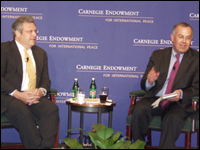
IMGXYZ902IMGZYXIn a discussion moderated by New York Times columnist David Brooks, Robert Kagan offered a distillation of the argument of his latest book, The Return of History and the End of Dreams: the post-Cold War fantasy of political convergence has dashed on the rocks of today's messy political realities, in which Beijing and Moscow are emerging as an autocratic alternative to the Western liberal democratic political model. The world's democracies will increasingly face the challenges of a world divided between democratically selected governments and autocrats, he said. In this sense, "history" -- the old rivalries and struggles for power and influence among great powers -- has returned, and the dream of post-Cold War international convergence is over.
Kagan challenged the notion, prevalent after the Cold War ended, that greater economic modernization and liberalization will inevitably induce democratization. Rather than increasing wealth serving to undermine a nondemocratic regime, he said, countries like China and Russia are finding that their governments are actually bolstered by a successful economy. For now, their citizens are willing to stay out of politics and earn money, especially if they know they will be punished for interfering in the political realm.
In addition to achieving material aims, Kagan said, countries are also driven by other motivations: pride, honor, and a memory of past historical success. Countries like China, Iran, and Russia share a common narrative: they were subjugated, oppressed, and now they can regain their proper place in the world. The autocrats ruling these countries have a very different worldview than democratic leaders, viewing democracy promotion as an act of geopolitical aggression.
Carnegie does not take institutional positions on public policy issues; the views represented herein are those of the author(s) and do not necessarily reflect the views of Carnegie, its staff, or its trustees.
Event Speakers
Former Senior Associate

Kagan, author of the recent book, The Return of History and the End of Dreams (Knopf 2008), writes a monthly column on world affairs for the Washington Post and is a contributing editor at both the Weekly Standard and the New Republic.
David Brooks
Harvey V. Fineberg Chair for Democracy Studies; Director, Democracy, Conflict, and Governance Program

Thomas Carothers, director of the Carnegie Endowment for International Peace’s Democracy, Conflict, and Governance Program, is a leading expert on comparative democratization and international support for democracy.