

{
  "authors": [
    "Peter Balas",
    "Judy Dempsey",
    "Vladimir Epaneshnikov",
    "Sergey Kopyrkin",
    "Olga Shumylo-Tapiola"
  ],
  "type": "event",
  "centerAffiliationAll": "",
  "centers": [
    "Carnegie Endowment for International Peace",
    "Carnegie Europe"
  ],
  "collections": [
    "Europe’s Eastern Neighborhood"
  ],
  "englishNewsletterAll": "",
  "nonEnglishNewsletterAll": "",
  "primaryCenter": "Carnegie Endowment for International Peace",
  "programAffiliation": "",
  "programs": [],
  "projects": [],
  "regions": [
    "Asia",
    "Russia",
    "Europe"
  ],
  "topics": []
}
The Eurasian Customs Union: What’s in it for the EU?
Wed, October 24th, 2012
Brussels
IMGXYZ3985IMGZYXThe Eurasian customs union formed by Russia, Belarus, and Kazakhstan in 2010—the largest in the world by territory—is becoming very real. As its influence on the world stage and in Europe’s neighborhood is likely to increase, the European Union should attempt to understand the project and find ways to protect its own interests.
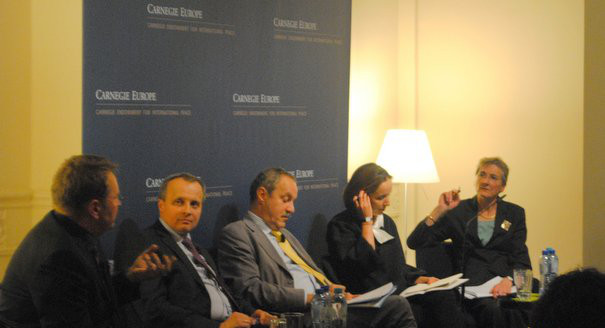
To mark the launch of her new paper, “The Eurasian Customs Union and the EU: Friends or Foes?,” Carnegie’s Olga Shumylo-Tapiola discussed this initiative and its impending implications for the EU with Vladimir Epaneshnikov, senior counsellor of commercial affairs at the Permanent Mission of the Russian Federation to the European Union, Sergey Kopyrkin, deputy permanent representative of political and administrative affairs at the Permanent Mission of the Russian Federation to the European Union, and Peter Balas, deputy director general for External Trade at the European Commission. Carnegie's Judy Dempsey moderated.
Carnegie does not take institutional positions on public policy issues; the views represented herein are those of the author(s) and do not necessarily reflect the views of Carnegie, its staff, or its trustees.
Event Speakers
Peter Balas
Nonresident Senior Fellow, Carnegie Europe

Judy Dempsey is a nonresident senior fellow at Carnegie Europe
Vladimir Epaneshnikov
Sergey Kopyrkin
Former Nonresident Associate, Carnegie Europe

Shumylo-Tapiola is a nonresident associate at Carnegie Europe in Brussels, where her research focuses on Eastern Europe and Eurasia.