

{
  "authors": [
    "Alexander Gabuev",
    "Vita Spivak",
    "Yanmei Xie"
  ],
  "type": "commentary",
  "blog": "Carnegie Politika",
  "centerAffiliationAll": "",
  "centers": [
    "Carnegie Endowment for International Peace",
    "Carnegie Russia Eurasia Center"
  ],
  "collections": [],
  "englishNewsletterAll": "",
  "nonEnglishNewsletterAll": "",
  "primaryCenter": "Carnegie Russia Eurasia Center",
  "programAffiliation": "",
  "programs": [],
  "projects": [],
  "regions": [],
  "topics": []
}
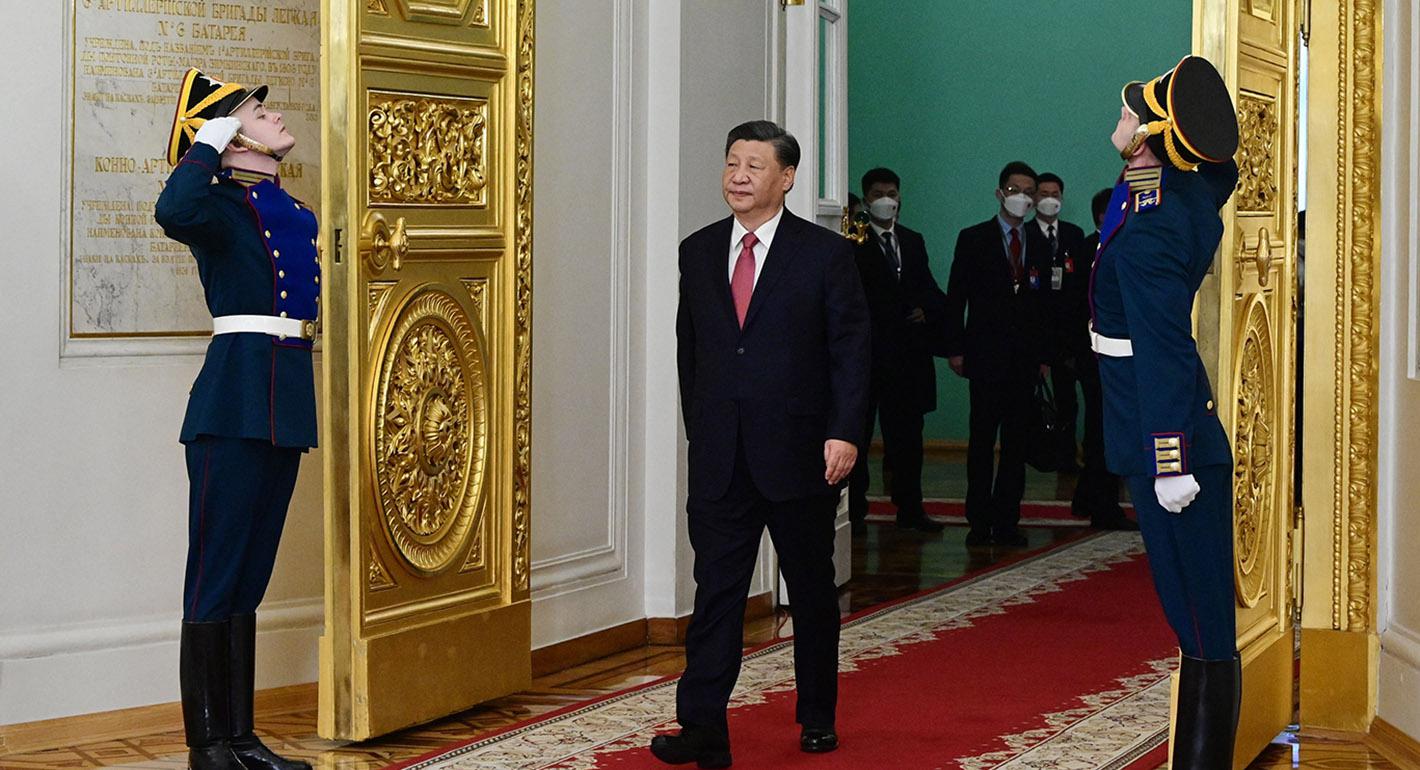
Source: Getty
Podcast: What’s Behind Xi Jinping’s Visit to Moscow?
Following Chinese leader Xi Jinping’s three-day visit to Moscow, this episode of the podcast is devoted to the ever-evolving relationship between Russia and China.
Why did Xi Jinping choose to visit Moscow at a time when Russia has been ostracized by the global community for its invasion of Ukraine? Did both sides get what they wanted from the visit? Has Russia resigned itself to being the junior partner in this burgeoning relationship? What is China’s agenda in putting forward a peace plan for Ukraine? Podcast host Alexander Gabuev is joined by Yanmei Xie, a geopolitics analyst at Gavekal Research, and Vita Spivak, an analyst at Control Risks and non-resident senior fellow at the Carnegie Endowment for International Peace.
Listen or download: Simplecast | Subscribe: Apple, Google Podcasts, Spotify, Amazon, RSS
About the Authors

Director, Carnegie Russia Eurasia Center
Alexander Gabuev is director of the Carnegie Russia Eurasia Center. Gabuev’s research is focused on Russian foreign policy with particular focus on the impact of the war in Ukraine and the Sino-Russia relationship. Since joining Carnegie in 2015, Gabuev has contributed commentary and analysis to a wide range of publications, including the Financial Times, the New York Times, the Wall Street Journal, and the Economist.

Former Nonresident Scholar
Vita Spivak was a nonresident scholar at the Carnegie Russia Eurasia Center.
Yanmei Xie is a senior associate fellow at MERICS. She previously worked as a journalist in Washington, covering U.S. national politics, and as a senior analyst at International Crisis Group.
Carnegie does not take institutional positions on public policy issues; the views represented herein are those of the author(s) and do not necessarily reflect the views of Carnegie, its staff, or its trustees.