

Commentary
Dmitri Trenin
{
  "authors": [
    "Dmitri Trenin"
  ],
  "type": "commentary",
  "centerAffiliationAll": "",
  "centers": [
    "Carnegie Endowment for International Peace",
    "Carnegie Russia Eurasia Center"
  ],
  "collections": [],
  "englishNewsletterAll": "",
  "nonEnglishNewsletterAll": "",
  "primaryCenter": "Carnegie Russia Eurasia Center",
  "programAffiliation": "",
  "programs": [],
  "projects": [],
  "regions": [],
  "topics": []
}
Source: Getty
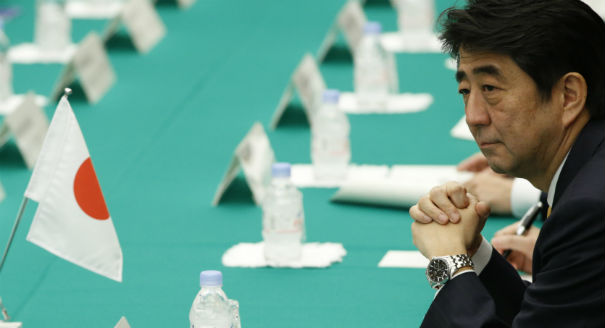
Since winning the election to Japan’s lower house of parliament in December 2012, Prime Minister Shinzo Abe has made the world talk about Japan in a new way: a country back on track, not on a long downward slope.
Since winning the election to Japan’s lower house of parliament last December, Prime Minister Shinzo Abe has made the world talk about Japan in a new way: a country back on track, not on a long downward slope. Within a few months, what came to be known as Abenomics, has raised the prospect of Japan walking out of the woods of economic malaise where it has spent two decades. In July, Abe’s Liberal Democratic Party has won another victory, this time to the upper house. As a result, Japan is expected to have a stable government for the next three years, until new general elections.
Success of Abenomics is usually seen as crucial to the entire agenda of Abe’s cabinet. The prime minister, however, is not wholly focused on economics. He is interested in changing Japan’s post-WWII Constitution, which severely restricts the use of force. He anticipates a much broader role for Japan’s Self-Defense Forces, the modestly named but well-heeled Japanese military. And he stands his ground firmly on the disputed Senkaku islands, provoking the ire of Beijing. Other neighbors and even the United States are paying attention.
Japan badly needs a new start to reverse the 20-year downward trend and to find a place for itself in the 21st century Asia and in the world. For that, it needs more than economic success. The commodity which has been particularly scarce in post-WWII Japan, and for a good reason, is strategic thinking. Things have moved on though. Tokyo’s venerable alliance with Washington, which should by all means continue, must not be an excuse for continued strategic sloth. Japan needs to think of itself as a major player in both Asia-Pacific and Eurasia, and adapt its foreign policy accordingly.
Above all, it needs to build a relationship with China that is neither tilted toward Beijing nor fraught with the risk of confrontation. For that, a Trans-Pacific alliance with the United States is indispensable, but hardly sufficient. To complement it, Tokyo must leverage its relations with the continental powers in Eurasia—Russia and India. Japan should also make its presence felt in Eurasia’s energy-rich regions: the Middle East, including Iran, the Caspian, and Central Asia. In this day and age, this is not about checkbook diplomacy, but about strategy.
Time has arrived for giving a serious thought to full and final normalization of Japan-Russia relations. Indeed, the very process of solving the territorial issue and signing a peace treaty should be used to transform Russo-Japanese economic and political relations toward something resembling the current German-Russian model. Shinzo Abe visited Moscow during his first six months in office and found an interested partner there. Mr. Abe appears to be a strategic thinker. He has far less than three years if he aspires to become a strategic actor as well.
Former Director, Carnegie Moscow Center
Trenin was director of the Carnegie Moscow Center from 2008 to early 2022.
Recent Work
Dmitri Trenin
Dmitri Trenin
Carnegie does not take institutional positions on public policy issues; the views represented herein are those of the author(s) and do not necessarily reflect the views of Carnegie, its staff, or its trustees.