

Paper
George Perkovich
{
  "authors": [
    "George Perkovich"
  ],
  "type": "legacyinthemedia",
  "centerAffiliationAll": "dc",
  "centers": [
    "Carnegie Endowment for International Peace",
    "Malcolm H. Kerr Carnegie Middle East Center"
  ],
  "collections": [
    "Iranian Proliferation",
    "U.S. Nuclear Policy"
  ],
  "englishNewsletterAll": "ctw",
  "nonEnglishNewsletterAll": "",
  "primaryCenter": "Carnegie Endowment for International Peace",
  "programAffiliation": "NPP",
  "programs": [
    "Nuclear Policy"
  ],
  "projects": [],
  "regions": [
    "North America",
    "United States",
    "Middle East",
    "Iran"
  ],
  "topics": [
    "Nuclear Policy",
    "Arms Control"
  ]
}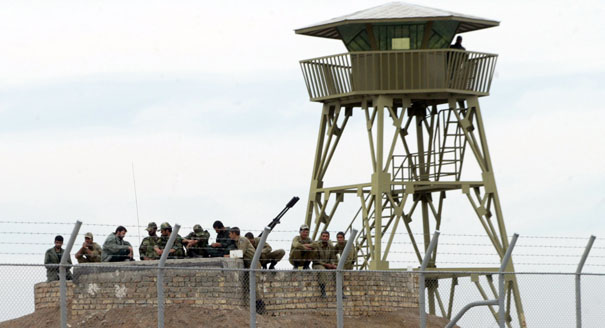
Source: Getty
The world would be a safer place if Iran did not enrich uranium, but contrary to the arguments that hawks put forward, the United States is not in any position to prevent Iran from doing so.
Source: Foreign Affairs
In “Still Time to Attack Iran,” Georgetown professor Matthew Kroenig echoes an argument that has been making the rounds in Washington -- that nuclear negotiations must result in the complete elimination of Iran’s nuclear fuel cycle program to be considered a success. This is the standard logic a bipartisan group of U.S. senators -- including Robert Menendez (D–N.J.), Mark Kirk (R–Ill.), and Charles Schumer (D–N.Y.) -- embraced last month when they introduced legislation that would torpedo any final agreement that allowed Iran to retain any enrichment capabilities and facilities.
The senators’ preferred policy sets an unachievable goal. Yes, the world would be a safer place if Iran did not enrich uranium. But contrary to the arguments that hawks put forward, the United States is not in any position to prevent Iran from doing so. Iran is one of 14 countries that already enrich uranium. Even if Iran deserves to be singled out for having broken conditions that other uranium-enriching states uphold and offering weak civilian rationales for enriching, the unfortunate fact is that neither more sanctions nor military strikes will push Iran out of the enrichment club. Iran has already paid tens of billions of dollars in direct costs; lost more than $100 billion in sanctions; and suffered a cyberattack, the assassination of key scientists and engineers, and the perpetual threat of war to protect its self-proclaimed right to enrich uranium. There is no reason to think that more sanctions or military strikes would change Tehran’s stance now.
It is telling that congressional hawks do not explain how they intend on eliminating Iran’s enrichment program in the long term. They are fond of citing military strikes as a final trump card, but such strikes are almost certainly incapable of ending Iran’s enrichment program on their own. To do so, they would have to eliminate not only Iran’s enrichment infrastructure but its capacity to reconstitute it and the Iranian leadership’s determination to do so. There is good reason to believe that military strikes would not achieve any of these goals. Indeed, as Avner Golov and Amos Yadlin, the former head of Israeli military intelligence (and one of the pilots who conducted Israel’s 1981 attack on Iraq’s Osiraq nuclear reactor) have written recently, “An attack, no matter how successful, cannot stop Iran’s military nuclear program forever.”There is a real possibility that some existing facilities for manufacturing and operating nuclear centrifuges would escape destruction. (And if Iran does have secret, unknown enrichment facilities, as Israel alleges, it would by definition be impossible for the United States to know whether it had destroyed them all.) Furthermore, given that Iran has had at least a decade to prepare for such a military attack, it likely has contingency plans to resurrect its nuclear program quickly with whatever facilities and nuclear scientists survive the attack.
The hawks counter that an attack could be combined with a strengthened sanctions regime that would severely restrict Iran’s capacity to rebuild its destroyed nuclear infrastructure. But the United States or Israel would need to apply vast diplomatic leverage to gain international support for such sanctions, something an attack against Iranian enrichment facilities would make nearly impossible. Hawks blithely assume that existing international sanctions on Iran would continue after military strikes, but a number of key governments that now enforce sanctions -- among them China, India, Japan, Russia, and Turkey -- have emphasized that they do not support military action against Iran. They might defect from any sanctions regime in protest over an illegal military attack aimed at stopping enrichment in Iran.
Hawks also neglect the possibility that Iran could respond to military strikes with its own diplomatic offensive. It is easy to imagine Tehran going to the UN Security Council after an Israeli strike to demand action against Israel, a nuclear-armed state that was complicit in an act of illegal aggression against Iran for merely exercising what it believes to be its right to enrich uranium. Iran could say that, if the Security Council refuses to impose sanctions on Israel, Iran would have no means of self-defense other than withdrawing from the Nonproliferation Treaty and taking action against Israel as it sees fit. No doubt the United States would block action in the Security Council. But many states would express sympathy for Iran and welcome the opportunity to isolate Israel and its protector. In this scenario, Israel’s already declining international legitimacy would plunge, while demand for Israel’s nuclear disarmament would grow, and international support for sanctions on Iran would quickly dissolve.
The Israeli government and hawks in the U.S. Congress rightly emphasize the importance of a long-term verification regime in Iran. But they do not discuss how the international community could establish or operate one in Iran after an attack. Right now, Iran cooperates with the International Atomic Energy Agency’s verification of its nuclear program. Inspectors are unarmed. Iranians permit them to access enrichment sites. After being attacked by Israel, Iran would be unlikely to forsake enrichment and allow on-site inspectors and constant long-distance monitoring of its declared and suspected nuclear activities.
After eight years of diplomacy, the P5+1 have reluctantly concluded that the only realistic course is to negotiate a long-term agreement in which Iran would circumscribe its enrichment activities, eschew completion of a heavy-water reactor, forgo research and development related to nuclear militarization, and accept robust verification procedures to build international confidence that all such commitments will be fulfilled. The threat of force to prevent Iran from acquiring nuclear weapons will remain in the background of any further negotiations, of course, as U.S. President Barack Obama has insisted.
But it is important to underscore what must be in the foreground of these negotiations -- not the cessation of Iran’s nuclear enrichment but its capacity to create a nuclear weapon quickly. In that way, international diplomacy and the threat of force go hand in hand: If Tehran rejected a diplomatic solution that allowed carefully limited enrichment in Iran, or if Iran agreed to such an arrangement and then violated it, military action would be legally and politically defensible. That is why the Obama administration’s strategy should not be impeded by Israel and ill-conceived congressional gambits. The Menendez-Kirk-Schumer bill may be politically expedient, but it is also entirely unnecessary and dangerous.

Japan Chair for a World Without Nuclear Weapons, Senior Fellow
George Perkovich is the Japan Chair for a World Without Nuclear Weapons and a senior fellow in the Carnegie Endowment for International Peace’s Nuclear Policy Program. He works primarily on nuclear deterrence, nonproliferation, and disarmament issues, and is leading a study on nuclear signaling in the 21st century.
Recent Work
George Perkovich
George Perkovich
Carnegie does not take institutional positions on public policy issues; the views represented herein are those of the author(s) and do not necessarily reflect the views of Carnegie, its staff, or its trustees.

Ongoing uncertainty in the Middle East allows Moscow to both increase its influence in Tehran and continue to enjoy the financial windfall of higher oil prices.

Nikita Smagin

This year’s wars have made alternative routes to transit through Russia no less risky for Central Asian countries.

Galiya Ibragimova

Governments in Estonia, Latvia, and Lithuania want to ensure that a U.S. military withdrawal would not leave them dangerously exposed to a Russian attack.

Sergejs Potapkins
Troubled by the growing salience of nuclear debates in East Asia, Moscow has responded in its usual way: with condemnation and threats. But by exacerbating insecurity, Russia is forcing South Korea and Japan to consider radical security options.

James D.J. Brown

The Russian leadership wants to avoid a dangerous precedent in which it is squeezed out of Iran by the United States and Israel—and left powerless to respond in any meaningful way.
Nikita Smagin