

Commentary
Trump has promised Belarus a massive potash deal. But Minsk is seeking something greater: restored Western transit and greater room for maneuver from Russia.
Balázs Jarábik
{
  "authors": [
    "Toby Dalton",
    "George Perkovich",
    "James M. Acton"
  ],
  "type": "commentary",
  "centerAffiliationAll": "dc",
  "centers": [
    "Carnegie Endowment for International Peace"
  ],
  "collections": [],
  "englishNewsletterAll": "ctw",
  "nonEnglishNewsletterAll": "",
  "primaryCenter": "Carnegie Endowment for International Peace",
  "programAffiliation": "NPP",
  "programs": [
    "Nuclear Policy"
  ],
  "projects": [],
  "regions": [
    "United States",
    "India",
    "Pakistan"
  ],
  "topics": [
    "Nuclear Policy"
  ]
}
Source: Getty
An innovative thinker, convenor, and mentor in the nuclear policy community, Krepon possessed an unwavering commitment to humanity that earned him respect around the world.
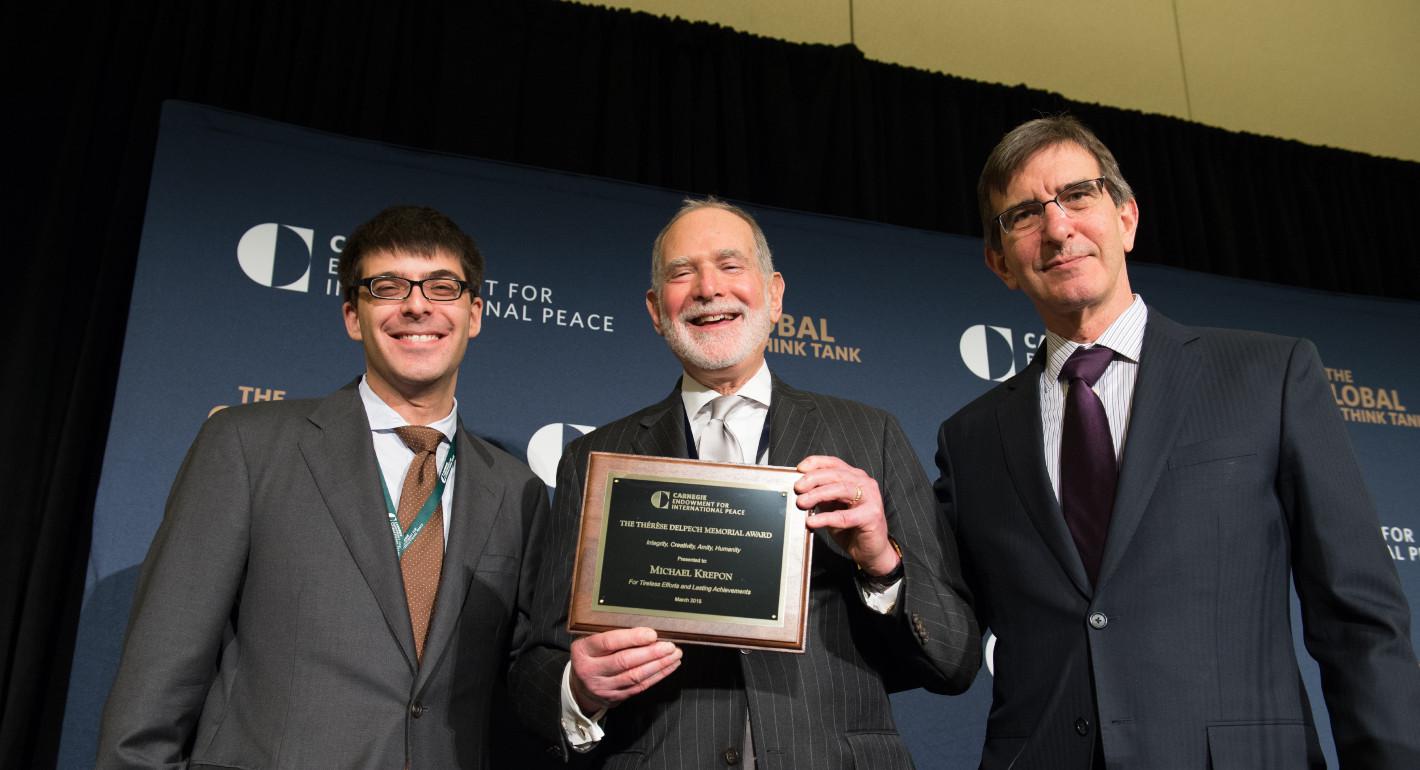
In March 2015, the Carnegie Endowment awarded Michael Krepon the Thérèse Delpech Memorial Award for exceptional service to the nuclear policy community. The award commendation cites Michael’s “tireless efforts and lasting achievements” to make the world a safer place—efforts that Michael described in his acceptance remarks as his “meaningful work.” He exhorted the nuclear policy community to continue its pursuit through the inevitable challenges to come.
Michael passed away on July 16 after a fifteen-year battle with cancer. Michael was a dear friend and colleague, a mentor, a traveling companion, and an example to which we aspire.
Michael was brave and maybe a little brash: starting an independent international security think tank– the Stimson Center—in 1989 took guts and confidence, which Michael and Stimson co-founder Barry Blechman had. They saw something new was needed in the field as the Cold War was coming to an end—and they built it.
Self-confidence was a true virtue in Michael’s case. He matched it with a refusal to give up when world politics took turns for the worse and it was nearly impossible to see a passable road ahead. He never resorted to cynicism or snarkiness. Instead, he remained positive and earnest.
Michael was driven in this work by a profound awareness of the unimaginable suffering that two nuclear weapons had inflicted on Japan in 1945 and by a deep commitment to preventing any repeat. In recent years, this commitment manifested itself in his advocacy for renewing the arms control regime—an inevitably incremental project that, in Michael’s view, was a moral necessity precisely because it was the only pragmatic way to prevent any further use of nuclear weapons in war. His moral stubbornness was grounded in what he saw as the “essential truths” of the nuclear age that we must learn and relearn periodically.
It’s also quite possible that his capacity to stay positive and remain hopeful was fed by his oft-noted interest in helping young people start or deepen their careers. His mentorship served many people, including us. He made particular efforts to engage, cultivate, and mentor younger scholars and analysts from South Asia.
In South Asia, well before and long after India and Pakistan tested nuclear weapons in 1998, Michael led sustained efforts to facilitate the adoption of confidence-building measures to prevent nuclear war. He published numerous edited volumes, articles, papers, and op-eds on the topic. He traveled frequently to both countries, and he encouraged scholars, analysts, and officials to think creatively and critically about how to find offramps from nuclear competition.
Sometimes his tone could be a bit hortatory, especially when explaining what he saw as the folly of overinvesting in nuclear deterrence without the adoption of corresponding arms control measures. No doubt, Michael’s tone could grate on officials, but his earnestness, ideas, and unwavering commitment to humanity earned him respect that opened doors in the halls of government around the world.
Less well-known, except to those who visited Michael and his garden near Charlottesville, Virginia, was his abiding interest in moss and ferns. On any visit, whatever the weather, Michael would gleefully pull on rubber boots to guide a tramp through his back woods, pointing out his latest plantings. In the last year, his attention turned to shaping a series of pools in the small creek that trickled through his property—a tranquil space that invited reflection and no doubt gave Michael calm.
Michael is gone, but his “tireless efforts and lasting achievements” remain with us and inspire us. We miss him greatly.

Senior Fellow and Co-director, Nuclear Policy Program
Toby Dalton is a senior fellow and co-director of the Nuclear Policy Program at the Carnegie Endowment. An expert on nonproliferation and nuclear energy, his work addresses regional security challenges and the evolution of the global nuclear order.

Japan Chair for a World Without Nuclear Weapons, Senior Fellow
George Perkovich is the Japan Chair for a World Without Nuclear Weapons and a senior fellow in the Carnegie Endowment for International Peace’s Nuclear Policy Program. He works primarily on nuclear deterrence, nonproliferation, and disarmament issues.

Jessica T. Mathews Chair, Co-director, Nuclear Policy Program
Acton holds the Jessica T. Mathews Chair and is co-director of the Nuclear Policy Program at the Carnegie Endowment for International Peace.
Carnegie does not take institutional positions on public policy issues; the views represented herein are those of the author(s) and do not necessarily reflect the views of Carnegie, its staff, or its trustees.

Trump has promised Belarus a massive potash deal. But Minsk is seeking something greater: restored Western transit and greater room for maneuver from Russia.

Balázs Jarábik

Minsk clearly expected the dialogue with Washington to yield more results, in particular the lifting of EU sanctions and permission to export potash.

Artyom Shraibman

With the growth in points of friction between the great powers, organizations like the SCO will continue to play a role in the strategic adaptation of the smaller powers caught between them.

Temur Umarov
Ongoing uncertainty in the Middle East allows Moscow to both increase its influence in Tehran and continue to enjoy the financial windfall of higher oil prices.

Nikita Smagin

The demands of the Kremlin’s war in Ukraine, demographic problems, and public hostility toward Central Asians mean Russia does not have enough workers.

Salavat Abylkalikov