

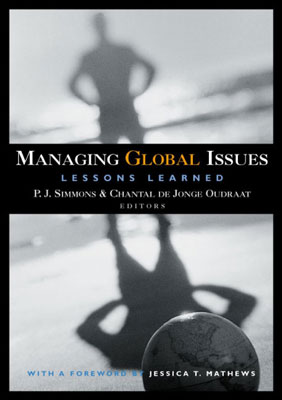
Managing Global Issues: Lessons Learned
This volume identifies the successes and failures of international and transnational governance and provides the basis for a broad comparative analysis across problem areas.
Source: Washington

Part I: Introduction (P.J. Simmons and Chantal de Jonge Oudraat )
This section will provide an overview of literature on global governance and international regimes and will outline of the analytical framework of the study.
Part II: Global Issues
- Communications
William J. Drake, Senior Associate, Carnegie Endowment for International Peace
- Corruption
Peter Richardson, Transparency International
- Crime, Illicit Markets, and Money Laundering
Phil Williams, Professor, University of Pittsburgh
- Development Assistance
Catherine Gwin, World Bank
- Economics: Global Finance
Robert E. Litan, Director of Economic Studies, Brookings Institution
- Economics: International Trade
Vinod K. Aggarwal, Professor, University of California, Berkeley
- Environment: Nature Conservation
Peter H. Sand, Lecturer, Institute of International Law, Munich
- Environment: Pollution
Peter M. Haas, Professor, University of Massachusetts at Amherst
- Global Commons: The Oceans, Antarctica, the Atmosphere, and Outer Space
Christopher C. Joyner, Professor of Government, Georgetown University
- Health
Octavio Gómez-Dantés, Director, Health Policy Research, National Institute of Public Health, Mexico
- Human Rights
Dinah L. Shelton, Professor, Notre Dame Law School
- Labor Rights
Brian Langille, Professor, University of Toronto
- Refugee Protection and Assistance
Kathleen Newland, Senior Associate, Carnegie Endowment
- Violence: Intrastate Conflict
Timothy D. Sisk, Senior Research Associate, University of Denver
- Warfare: Conventional Weapons
Joanna Spear, Senior Lecturer, King's College London
- Warfare: Nuclear, Biological, and Chemical Weapons
Thomas Bernauer, Professor, University of Zurich
Part III: Conclusions
- From Agenda to Accord
P.J. Simmons and Chantal de Jonge Oudraat
- From Accord to Action
P.J. Simmons and Chantal de Jonge Oudraat
Advance Praise
"...an enormously valuable contribution to the literature on globalism and the process of globalization currently underway...Highly recommended for advanced students and researchers, faculty, and participants in international policy making."
—CHOICE
"Comprehensive in its coverage of global challenges, hard-headed in its assessment of what works and what doesn't in dealing with them, this is quite simply the best guide I've seen to the new world that confronts us."
—John Lewis Gaddis, Yale University
"An important primer for fresh thinking on critical issues in global governance, with evidence and argument for a practical and far seeing approach."
—Lloyd Axworthy, former Minister of Foreign Affairs, Canada
"An enormous contribution. This book makes clear how intertwined the world has become and how the requirements for managing global issues will have to adjust. After reading this book it will be impossible to think in traditional foreign policy terms."
—Princeton Lyman, The Aspen Institute
" . . . cogently analyzes 16 of the global agenda's major issues, probing each for the light it sheds on the problems that inhibit fair and effective global governance. The collective result is a powerful and compelling statement about the present state of the world and where it is heading."
—James N. Rosenau, The George Washington University
About the Authors
Former Associate
Former Associate

Distinguished Fellow
Mathews is a distinguished fellow at the Carnegie Endowment for International Peace. She served as Carnegie’s president for 18 years.
Carnegie does not take institutional positions on public policy issues; the views represented herein are those of the author(s) and do not necessarily reflect the views of Carnegie, its staff, or its trustees.