

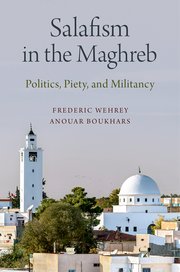
Salafism in the Maghreb: Politics, Piety, and Militancy
The Arab Maghreb is a vitally important region that impacts the security and politics of Europe, sub-Saharan Africa, and the broader Middle East. It is also home to the conservative, literalist interpretation of Islam known as Salafism, which has emerged as a major social and political force.
Source: Oxford University Press
The Arab Maghreb-the long stretch of North Africa that expands from Libya to Mauritania-is a vitally important region that impacts the security and politics of Europe, sub-Saharan Africa, and the broader Middle East. As Middle East scholars Frederic Wehrey and Anouar Boukhars show in Salafism in the Maghreb, it is also home to the conservative, literalist interpretation of Islam known as Salafism, which has emerged as a major social and political force. Through extensive interviews and fieldwork, Wehrey and Boukhars examine the many roles and manifestations of Salafism in the Maghreb, looking at the relationship between Salafism and the Maghreb's ruling regimes, as well as competing Islamist currents, increasingly youthful populations, and communal groups like tribes and ethno-linguistic minorities. They pay particular attention to how seemingly immutable Salafi ideology is often shaped by local contexts and opportunities. Informed by rigorous research, deep empathy, and unparalleled access to Salafi adherents, clerics, politicians, and militants, Salafism in the Maghreb offers a definitive account of this important Islamist current.
This research was made possible through generous support from the Henry Luce Foundation.
Advance Praise
“[An] indispensable study of the recent evolutions of Salafism in the Maghreb...Boukhars and Wehrey’s comprehensive account will be a valuable point of reference for all students of the region and for those interested in the global phenomenon of Salafism.”
—International Affairs
About the Authors

Senior Fellow, Middle East Program
Frederic Wehrey is a senior fellow in the Middle East Program at the Carnegie Endowment for International Peace, where his research focuses on governance, conflict, and security in Libya, North Africa, and the Persian Gulf.
Former Nonresident Fellow, Middle East Program
Boukhars was a nonresident fellow in Carnegie’s Middle East Program. He is a professor of countering violent extremism and counter-terrorism at the Africa Center for Strategic Studies, National Defense University.
Carnegie does not take institutional positions on public policy issues; the views represented herein are those of the author(s) and do not necessarily reflect the views of Carnegie, its staff, or its trustees.