

Article
Amr Hamzawy
{
  "authors": [
    "Amr Hamzawy"
  ],
  "type": "legacyinthemedia",
  "centerAffiliationAll": "dc",
  "centers": [
    "Carnegie Endowment for International Peace"
  ],
  "collections": [],
  "englishNewsletterAll": "menaTransitions",
  "nonEnglishNewsletterAll": "",
  "primaryCenter": "Carnegie Endowment for International Peace",
  "programAffiliation": "MEP",
  "programs": [
    "Middle East"
  ],
  "projects": [],
  "regions": [
    "North Africa",
    "Egypt",
    "Lebanon"
  ],
  "topics": [
    "Political Reform"
  ]
}
Source: Getty
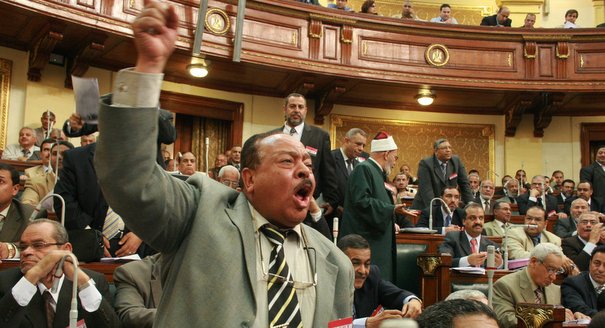
The Muslim Brotherhood's reaction to the Hizbullah controversy reveals that until now the movement is split in its strategic outlook between two opposing political directions.
Source: Al Ahram Weekly

What concerns us, here, however, is that the disparity of opinion between the Muslim Brotherhood parliamentary bloc and the Office of the Supreme Guide is indicative of divergent outlooks within the Muslim Brotherhood on the concept of the state and its national security requirements. Whereas the former group's approach is consistent with its desire to assimilate as an active and responsible player in the legitimate political life of Egypt, the latter's position reflects the continued hold of the logic of perpetual confrontation and conflict between the Muslim Brothers as an officially banned organisation and the ruling elite.
In defence of Egyptian sovereignty and national security in the People's Assembly, Muslim Brotherhood MP Essam Mukhtar declared, "The national security of Egypt is a red line that no one should be allowed to cross." With even greater fervour, MP Hassanein El-Shura stressed that the Muslim Brotherhood parliamentary members "condemn any assault against Egyptian national security. Egypt first! Egypt first!" Such statements reflect a mindset that fully embraces the concept of the nation state and gives it prevalence over the antithetical concept of a resistance movement that transcends borders as theologically justified in the discourse and literature of the Muslim Brotherhood. The Muslim Brotherhood MPs' views on the question of a Hizbullah cell in Egypt may not be identical with those of the ruling elite, but they are very close when it comes to potential threats to Egypt's national security and sovereignty, which are essential corollaries to the nation state. Thus, to the Brotherhood parliamentary bloc, this must take priority over the aims of supporting the resistance, contrary to the official rhetoric of the Brotherhood, which accords the "resistance against Zionists and Americans" a supreme and holy status that overrides all other considerations. This latter is the logic that has been used, occasionally, to justify rebellion against ruling authorities, to rally support for the jihad in Lebanon in 2006 and in Palestine in 2008, and to vindicate the violation of Egyptian sovereignty and national security.
The Muslim Brotherhood MPs' position reflected a prime trait of responsible political behaviour, which is awareness of where political opposition stops and the need to stand united on major national issues starts. These parliamentarians, thus, took excellent advantage of the space available to them in the People's Assembly where we saw the largest opposition faction demonstrate its solidarity with the ruling party in the defence of Egypt's national security and in contributing to shaping a public outlook unconditionally opposed to Hizbullah's attempt to intervene in the country's domestic affairs. The press statements of the supreme guide and some of his bureau members in defence of Hizbullah, the sanctity of the resistance and its use of Egyptian territory to support the Palestinians in Gaza, on the other hand, reflect the continued existence of a dangerous trend in the Muslim Brotherhood leadership.
With its persistent refusal to acknowledge an overriding commitment to the sovereignty of the nation state, the Brotherhood will remain incapable of leveraging itself from its current position as a banned organisation to an officially recognised movement with a legally recognised status as a political party or otherwise. In contrast to the "Egypt first" attitude voiced by the Brotherhood's bloc in parliament, the Brotherhood leadership acted in accordance with what we might term the "resistance first" principle, in which context the concerns of national sovereignty and security come a distant second. Accordingly, its spokespersons were disdainfully indifferent to the significance of the existence of a Hizbullah paramilitary cell in Egypt as part of an arms smuggling network passing through Egyptian territory, in spite of the fact that such phenomena constitute a security breach that no sovereign nation can afford to ignore or countenance. Such contempt for national sovereignty was not only a tactical error, it was also deeply offensive to the patriotic sentiments of a large segment of the public who now have as much cause as the government to suspect the aims and priorities of Egypt's largest grassroots movement.
I am convinced that the divergence in the stances between Muslim Brotherhood MPs and the Office of the Supreme Guide is not part of a cynical assignation of roles, with one group hastening to placate a public shocked by the revelations concerning Hizbullah's activities in Egypt while the second group continues to display its long-held solidarity with the most influential resistance movement in the Arab world. Rather, the parliamentarians' view is connected, above all, with an awareness of the duties and obligations that come with taking part in a nation's official political life. The Brotherhood almost instinctively knew that their future in the People's Assembly was contingent upon their embracing an unequivocally patriotic stance against Hizbullah's violation of Egyptian sovereignty. They knew that adopting the militant Islamist resistance rhetoric would not only place them in a precarious position with the authorities, but also cast them outside of the realm of responsible and popularly acceptable parliamentary behaviour. Moreover, Hassan Nasrallah's admission of responsibility for creating and running the cell deprived the MPs of any opportunity to seek refuge in a grey area. They could no longer, for example, question the veracity of the information revealed by the security agencies or voice doubts about Hizbullah's actual involvement.
The Office of the Supreme Guide, on the other hand, focussed its attention, first and foremost, on keeping its reaction to the Hizbullah cell consistent with its Islamist, pro-resistance discourse, in accordance with which this ideological imperative transcends principles and prerequisites of the nation state. The Office of the Supreme Guide set the demands of the resistance above the national concerns of Egypt during the war in Gaza in 2008-2009, and it clung to this prioritisation in its reaction to the Hizbullah cell case.
The coexistence between the nation state outlook and the "above-the-state" outlook cannot last for long in the ranks of the Muslim Brotherhood. The organisation will have to make up its mind. If it hopes to assimilate fully into Egyptian political life, it will have to place Egypt first and adopt the Muslim Brotherhood parliamentary bloc's attitude toward the Hizbullah cell as a binding strategic approach for the entire organisation. If, on the other hand, it plans on continuing as a theocratic movement whose rhetoric and vision transcends and even defies the needs of the nation state, then it stands little hope of emerging from its current status as a banned organisation.

Director, Middle East Program
Amr Hamzawy is a senior fellow and the director of the Carnegie Middle East Program. His research and writings focus on Egypt’s and other middle powers’ involvement in regional security in the Middle East, particularly through collective diplomacy and multilateral conflict resolution
Recent Work
Amr Hamzawy


Amr Hamzawy, Andrew Leber, Eric Lob, …
Carnegie does not take institutional positions on public policy issues; the views represented herein are those of the author(s) and do not necessarily reflect the views of Carnegie, its staff, or its trustees.
Transactional relationships are stable but can be shallow.



Paul Haenle, Maha Yahya, Benjamin Ho, …

It’s about managing oil prices, bread prices, and strategic partnerships.


Amr Hamzawy, Karim Sadjadpour, Aaron David Miller, …
The murder of George Floyd has underscored the deep inequities that have long plagued American society. In a note to the Carnegie community, Bill Burns reflects on Carnegie’s commitment to build a more just future here at home and around the world, without which peace will remain beyond our grasp.

William J. Burns

While the world hoped this pandemic might lead to more cooperation between these two great powers, American and Chinese leaders instead fell into a blame game and allowed their increasing suspicions to guide their decision-making.
Lyu Jinghua

Biological viruses and computer malware differ in important respects. They have considerable potential to spread widely, invading, disrupting and destroying their targets.

Ariel (Eli) Levite, Lyu Jinghua