

In The Media
Michele Dunne, Robert Kagan
{
  "authors": [
    "Robert Kagan"
  ],
  "type": "legacyinthemedia",
  "centerAffiliationAll": "",
  "centers": [
    "Carnegie Endowment for International Peace"
  ],
  "collections": [],
  "englishNewsletterAll": "",
  "nonEnglishNewsletterAll": "",
  "primaryCenter": "Carnegie Endowment for International Peace",
  "programAffiliation": "",
  "programs": [],
  "projects": [],
  "regions": [
    "North America",
    "United States",
    "Western Europe"
  ],
  "topics": [
    "Foreign Policy"
  ]
}
Source: Getty
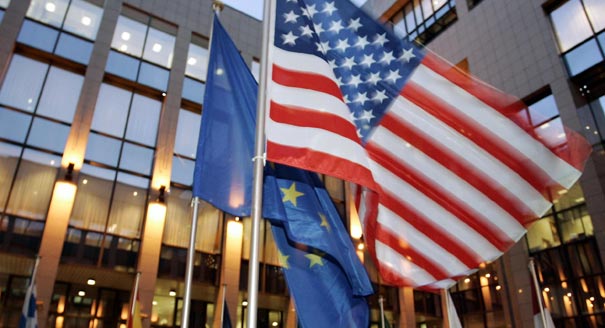
On economic and military issues, Europeans typically want to be left in peace. It remains to be seen whether President Obama will be able to drag Europe out of its comfort zone with his calls for bold action.
Source: Washington Post

Of course Europeans want to be left in peace. They experienced enough turmoil in the 20th century to last a millennium: the two world wars that devastated the continent and took tens of millions of lives; the Holocaust, which still inspires deep guilt, and not only in Germany; the rampant inflations and depressions of the 1920s and 1930s; the wild political swings from romantic and belligerent nationalism to fascism to socialism to flirtations with communism to democracy; the Cold War that divided the continent, not only along the Iron Curtain but also within and between the nations of Western Europe. Just beneath the skin, all of Europe remains deeply scarred.
So how surprising is it that what Europeans yearn for in their self-contained world is stability and predictability, a little peace and quiet? They don't want more excitement. The most revolutionary innovation in the history of geopolitics, the European Union, was paradoxically brought to fruition not by a desire for revolution but by a deep conservatism -- a mortal fear of the turmoil that can be caused by unconstrained ambitions, both national and individual. The German people, for whom and by whom the European Union was consecrated, want to be constrained. The E.U.'s economic strictures, which now act as a barrier to Keynesian deficit spending, were put there by the Germans, for whom memories of inflation, not depression, are the great nightmare. The Germans and French prefer welfare payments to government stimulus spending, for they are part of the passive system of social safety nets on which their citizens have grown so comfortably dependent. The creative destruction of the business-oriented political economies of the Anglo-Americans is too violent and unstable, too brutal and unpredictable. Better to regulate more tightly the international capitalists who can cause havoc through their inventiveness. Better to be less rich than less secure.
In foreign affairs, there have been brief moments of European global ambition. In the late 1990s, Tony Blair and Jacques Chirac joined hands to promote a more muscular and capable European military. They were troubled and embarrassed by the vast military superiority, and accompanying arrogance, of the Americans during the Bosnian and Kosovo conflicts and were determined to make Europe an independent global player. A few years later, the great thinker and strategist Robert Cooper envisioned E.U. enlargement as postmodern Europe's novel contribution to global security, the "voluntary liberal empire" that would expand the zone of peace, liberalism and security to Turkey, the Balkans, Ukraine and what Europeans once called the continent's "new neighborhood."
But Europe has largely recoiled from those fleeting ambitions. The E.U. army remains as distant a prospect as it was a decade ago. The eastward enlargement of 2004 produced indigestion and is regretted by many Western Europeans. Fear of Russia limits talk of admitting Ukraine, much less Georgia. Fear of Islamicization has killed any hope of admitting Turkey. The only question about enlargement today is whether it is dead or, as the optimists hope, merely in a 30-year coma.
It is into this Europe that President Obama has flown, with what Europeans regard as some radical and frightening plans for the economy; with a new strategy for Afghanistan and Pakistan that is far more aggressive, militaristic and success-oriented than they would prefer; with ideas about Iran that are welcome (the promise to talk) but also unnerving (the threat to impose more sanctions). As one savvy French journalist told me, "We have all been surprised. He is so . . . American!"
Americans are creators of turmoil. Europeans see them the way the ancient Greeks saw the Athenians, as "incapable of either living a quiet life themselves or of allowing anyone else to do so." As the scholar Stephen Sestanovich pointed out in a brilliant essay on "American Maximalism," Democratic and Republican administrations alike over the past half-century have favored "large, even risky" transformative strategies, whether confronting the Soviet Union, unifying Germany, fighting in the Balkans or solving global economic crises, and have abjured the safer, incremental approaches that Europeans always prefer. Yet Europe has often been dragged out of its comfort zone by this born gambler of a superpower.
Europeans love Obama, but European leaders have been fretting ever since his election. George W. Bush did the Europeans a huge favor by giving them the best excuse for inaction in transatlantic history. Now comes Obama, so much more compelling and yet, still, American.
One wonders whether Obama officials quite see the enduring gap between Europe and the United States, or whether they have convinced themselves that the gap was merely a creation of Bush and will now vanish. This was the view put forth by a senior administration official in Brussels recently. But Europeans, and presumably seasoned veterans such as Richard Holbrooke, know better. The question will be whether the Obama administration, like some previous American administrations, can get Europe to do what Americans believe needs doing. Or perhaps, in the interest of comity, it will tacitly accept that most Europeans don't want to send more troops to Afghanistan, spend more on defense or on economic stimuli, impose tougher economic sanctions on Iran, or stand firm against any of Russia's many demands. Instead of challenging them to do more, the administration may politely move on without them: the soft unilateralism of low expectations.
This article originally appeared in the Washington Post.
Former Senior Associate
Kagan, author of the recent book, The Return of History and the End of Dreams (Knopf 2008), writes a monthly column on world affairs for the Washington Post and is a contributing editor at both the Weekly Standard and the New Republic.
Recent Work

Michele Dunne, Robert Kagan
Robert Kagan, Michele Dunne
Carnegie does not take institutional positions on public policy issues; the views represented herein are those of the author(s) and do not necessarily reflect the views of Carnegie, its staff, or its trustees.

But their "principal to principal" model will only be as effective as the political strength of each leader back home.

Damien Ma

U.S. unpredictability has allowed China to capitalize on its positioning as the “responsible great power”. Paradoxically, the more China wins the perception game, the more likely expectations will rise for Beijing to deliver not just words but to demonstrate with its deeds.

Chong Ja Ian

Hanoi and Beijing have long treated each other as distant cousins rather than comrades in arms. That might be changing as both sides draw closer to hedge against uncertainty and America’s erratic behavior.

Nguyễn Khắc Giang

Across Asia, China is better positioned to withstand energy shocks from the fallout of the Iran war. Its abundant coal capacity can ensure stability in the near term. Yet at the same time, the country’s energy transition away from coal will make it even less vulnerable during the next shock.
Damien Ma

Malaysia’s chairmanship sought to fend off short-term challenges while laying the groundwork for minimizing ASEAN’s longer-term exposure to external stresses.

Elina Noor