• Commentary
  • Research
  • Experts
  • Events
Carnegie China logoCarnegie lettermark logo
{
  "authors": [
    "Amr Hamzawy"
  ],
  "type": "legacyinthemedia",
  "centerAffiliationAll": "dc",
  "centers": [
    "Carnegie Endowment for International Peace",
    "Malcolm H. Kerr Carnegie Middle East Center"
  ],
  "collections": [],
  "englishNewsletterAll": "menaTransitions",
  "nonEnglishNewsletterAll": "",
  "primaryCenter": "Carnegie Endowment for International Peace",
  "programAffiliation": "MEP",
  "programs": [
    "Middle East"
  ],
  "projects": [],
  "regions": [
    "Palestine",
    "Levant"
  ],
  "topics": [
    "Political Reform",
    "Security",
    "Foreign Policy"
  ]
}
Source: Getty

In The Media

Formula for Engaging Hamas

The United States should establish direct talks with Hamas on how it can play a productive role in the peace process and gradually integrate into Palestinian political and security institutions.

Link Copied
By Amr Hamzawy
Published on Aug 16, 2009

Source: New York Times

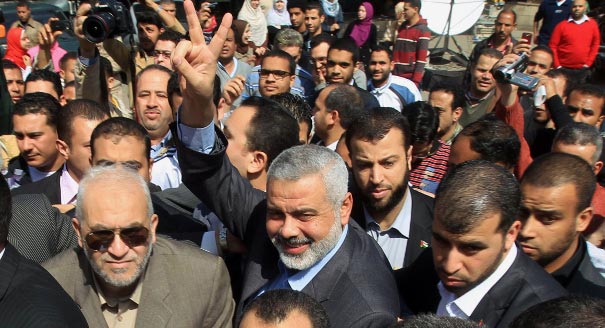
Formula for Engaging HamasEarlier this summer, Ismail Haniya, the Hamas leader, declared: “If there is a real project that aims to resolve the Palestinian cause on establishing a Palestinian state on 1967 borders, under full Palestinian sovereignty, we will support it.”

 With Hamas willing to accept a two-state solution to the Israeli-Palestinian conflict, when will President Obama abandon the Bush doctrine of isolating Hamas? We usually hear Hamas’s resistance voice, which calls for the destruction of Israel. But we cannot ignore Hamas’s diplomatic voice, which has, over the years, voiced support for coexisting with Israel.
 
In 2003, Hamas stated it would renounce violence if the Israelis were “willing to fully withdraw from the 1967 occupied territories and they present a timetable for doing so.” In 2007, Hamas acknowledged that it is a “reality” that Israel exists and “a matter of fact” that it will continue to exist.
 
Till now, the U.S. has demanded that Hamas renounce violence, honor past agreements and recognize Israel’s right to exist — that is, give up all of its leverage before negotiations actually begin. That policy has failed.
 
The U.S. should put Hamas’s diplomatic voice to the test. Domestically, it may be too early for Mr. Obama to pursue direct talks in a public forum. Internationally, however, it may be too late for the more gradualist approach of indirect talks: Mr. Obama will squander a good deal of his prestige in the Arab world if he doesn’t make a departure from Bush administration policy soon.
 
Thus, the U.S. should establish direct talks on substantive issues in a public, multilateral forum. It could build off the two forums currently fostering talks with Hamas, one of European countries and another of Arab states. The talks should focus on how Hamas can play a productive role in the peace process and gradually integrate into Palestinian political and security institutions.
 
Otherwise, the U.S. must explain how further exclusion of Hamas could possibly advance the peace process.

About the Author

Amr Hamzawy

Director, Middle East Program

Amr Hamzawy is a senior fellow and the director of the Carnegie Middle East Program. His research and writings focus on governance in the Middle East and North Africa, social vulnerability, and the different roles of governments and civil societies in the region.

    Recent Work

  • Commentary
    Iran Is Pushing Its Neighbors Toward the United States

      Amr Hamzawy

  • Paper
    U.S. Peace Mediation in the Middle East: Lessons for the Gaza Peace Plan
      • Sarah Yerkes

      Amr Hamzawy, Sarah Yerkes, Kathryn Selfe

Amr Hamzawy
Director, Middle East Program
Amr Hamzawy
Political ReformSecurityForeign PolicyPalestineLevant

Carnegie does not take institutional positions on public policy issues; the views represented herein are those of the author(s) and do not necessarily reflect the views of Carnegie, its staff, or its trustees.

More Work from Carnegie China

  • Commentary
    Malaysia’s Year as ASEAN Chair: Managing Disorder

    Malaysia’s chairmanship sought to fend off short-term challenges while laying the groundwork for minimizing ASEAN’s longer-term exposure to external stresses.

      Elina Noor

  • Commentary
    When It Comes to Superpower Geopolitics, Malaysia Is Staunchly Nonpartisan

    For Malaysia, the conjunction that works is “and” not “or” when it comes to the United States and China.

      Elina Noor

  • Commentary
    Neither Comrade nor Ally: Decoding Vietnam’s First Army Drill with China

    In July 2025, Vietnam and China held their first joint army drill, a modest but symbolic move reflecting Hanoi’s strategic hedging amid U.S.–China rivalry.

      • Nguyen-khac-giang

      Nguyễn Khắc Giang

  • Commentary
    China’s Mediation Offer in the Thailand-Cambodia Border Dispute Sheds Light on Beijing’s Security Role in Southeast Asia

    The Thai-Cambodian conflict highlights the limits to China's peacemaker ambition and the significance of this role on Southeast Asia’s balance of power.

      Pongphisoot (Paul) Busbarat

  • Trump and Xi on a red background
    Commentary
    Emissary
    China Is Determined to Hold Firm Against Trump’s Pressure

    Beijing believes that Washington is overestimating its own leverage and its ability to handle the trade war’s impacts. 

      • Sheena Chestnut Greitens

      Rick Waters, Sheena Chestnut Greitens

Get more news and analysis from
Carnegie China
Carnegie China logo, white
Keck Seng Tower133 Cecil Street #10-01ASingapore, 069535Phone: +65 9650 7648
  • Research
  • About
  • Experts
  • Events
  • Contact
  • Careers
  • Privacy
  • For Media
Get more news and analysis from
Carnegie China
© 2026 Carnegie Endowment for International Peace. All rights reserved.







