

Paper
Sarah Yerkes, Natalie Triche, Amr Hamzawy
{
  "authors": [
    "Amr Hamzawy"
  ],
  "type": "legacyinthemedia",
  "centerAffiliationAll": "",
  "centers": [
    "Carnegie Endowment for International Peace",
    "Malcolm H. Kerr Carnegie Middle East Center"
  ],
  "collections": [],
  "englishNewsletterAll": "",
  "nonEnglishNewsletterAll": "",
  "primaryCenter": "Carnegie Endowment for International Peace",
  "programAffiliation": "",
  "programs": [],
  "projects": [],
  "regions": [
    "Egypt"
  ],
  "topics": [
    "Political Reform"
  ]
}
Source: Getty
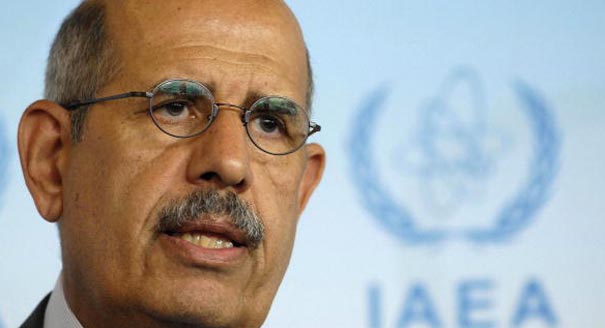
Mohamed ElBaradei has an opportunity to help Egyptians achieve a more democratic government. To succeed, he must do three things: remind Egypt that democracy requires an engaged citizenry, call on the opposition to formulate well-defined political programs, and move back to Egypt so that he can engage directly with its citizens.
Source: Al-Shorouk el Jadid

Ask of them, Dr. ElBaradei, for example, to issue electoral cards. Exhort them to overcome their doubt about the honesty of elections and their results, a doubt which has accumulated over the past few decades. This year, when it’s time for the Shura Council midterm elections and then the parliamentary elections, Egyptians can overcome this doubt by going to the polls. The ability of authoritarian regimes to falsify elections, by rigging results and resorting to repression against opposition candidates and observers, is surely losing ground, due largely to the increase in public enthusiasm for and participation in voting.
Remind them of their duties and responsibilities. Remind them that Egypt will not achieve democracy, either socially or politically, without their active demands and their patience with the risks and challenges of public work, including facing repression from the security services. Do not let them look at you as a hero-savior who came from "abroad" to achieve democracy simply by waving a magic wand, costing them little individually or collectively. You know very well that reality is not thus. You know very well that democracy – if we ever get close to it – will take a long time to achieve, and that the costs will inevitably be expensive in a state where the people have long since been awaiting democracy. Moreover, we, in Egypt, have experienced - before other Arab countries - the disastrous consequences of hero-saviors, who, despite their good intentions and desires, have kept the citizens from participating and searching collectively for the public interest.
-2-
With optimism and openness, many opposition parties and movements have interacted with you. Many voices have been raised in support of your candidacy in the 2011 presidential elections and your leading of a unified opposition front against the ruling regime. The opposition’s optimism and openness towards your call for democracy, however, must not make you forget about the opposition’s weaknesses, its severe marginalization and the dilemmas and constraints that arise as a result. The opposition parties from across the ideological spectrum lack true popular support and specific ideas of how to fight for democratic change. Some have even surrendered to a relationship with the ruling regime under which they enjoy some political presence provided that they stop their full-fledged opposition to the regime. As far as the non-party-based opposition is concerned, the Muslim Brotherhood-half is in dire straits, suffering from the lack of a strategic compass for its political activity. And the other half dedicated to buildling alliances and overcoming ideological barriers in the push for change and reform, including Kifaya (or what is left of it) and other entities, has been reduced to non-effective entities limited to internal disputes and media interviews.
In other words, the party- and non-party-based opposition cannot provide you with significant political or popular support. The truth is the opposition’s optimism when dealing with you is partly due to its dire need for an independent national personality with both domestic and international credibility. It needs help attracting significant popular support around an agenda for democratic change and reform, an objective it has failed to accomplish over the past years.
I believe that, aside from cautiously avoiding internal party- and non-party-based opposition conflicts, you must call on the opposition to be more active in terms of developing its popular support and formulating well-defined political programs. These programs should be designed to promote democracy and development within Egypt. In a previous article, I asked the opposition and the citizens interested in public affairs to remind you of the need to focus on the development of a specific program for your political role. I asked them to remind you to stay away from the general democratic rhetoric that has prevailed in Egypt for years and has failed to generate significant results. I will also make sure I remind you of this. Today, I ask you to call on the parties and opposition movements supporting you to work hard to get rid of their current inefficiencies. I ask you to call on them to restore the popular activity and organizational work in the hope that the momentum you built up in the media be transformed into real social and political action. The latter would aim at putting pressure on the ruling regime to ensure honest legislative and presidential elections this year and the next and to change the political rules in Egypt by pushing it towards a competitive democracy. Such democracy does not exist without strong and effective parties.
Ask the opposition parties, Doctor ElBaradei, about the average age of their members and leaders. Ask them about the rates of new member admission over the past several years (which are close to zero). Ask them about their internal democracy and their promotion of younger members. Ask them about their organizational efforts outside urban areas and about their mass conferences (which are possible despite the Emergency Law). Confront civil society movements about their severe weakness and the immature political awareness of some of their members, who are harming the others by calling on you to specify your position on Israel, Camp David and the Israeli-Egyptian peace treaty as a pre-condition to offering you their support. They are still almost entirely ignoring having a dialogue with you about your social, political and economic program for Egypt, as if the worries of the nation could be reduced to the relationship with Israel and the position on the Palestinian issue regardless of its importance.
-3-
Dr. ElBaradei, regardless of my reservation about your demand for political and constitutional reform as a prerequisite for your candidacy, I believe that when you talked about the Egyptian capacity for democracy and progress and the right of its people to enjoy a decent life, you struck a chord with a large number of Egyptian citizens who are interested in public affairs. I believe you managed to attract many activists and intellectuals around your call for greater democracy.
Now, however, I think you are called upon to develop your political speech and public action in two additional – and inevitable – ways, if you want to build on the momentum you have achieved and carry it to new levels. The first is to invest sufficient time and effort to formulate a clear vision and program, moving beyond the general rhetoric of the last few weeks. You must explain the objectives of political and constitutional reform and elaborate on your idea of a transitional government to unleash the post-Mubarak era. As a part of this program, you must deal realistically with a set of internal conditions, first and foremost the search for reformist allies within the ruling regime and state institutions, as well as the organizational and popular strength of the opposition. You must also deal with external conditions, perhaps most significantly the emphasis on the stability of Egypt's regional and international alliances regardless of its domestic political developments. Both of these conditions are necessary to push Egypt towards democratization.
The second way to build on your momentum, around which I think your public action should be oriented, is, quite frankly, working on getting rid of both the "Strange Visitor" and "Passing Stranger" stigmas. These are stigmas that the regime’s media is trying to charge you with, through repetitive hints about your absence from Egypt over the past several years and your lack of professional experience in Egypt throughout the last years. I am convinced that this will not be resolved unless you come back to live in Egypt and engage directly with its cities and villages in order to familiarize yourself with the country’s present social and political realities.

Director, Middle East Program
Amr Hamzawy is a senior fellow and the director of the Carnegie Middle East Program. His research and writings focus on Egypt’s and other middle powers’ involvement in regional security in the Middle East, particularly through collective diplomacy and multilateral conflict resolution
Recent Work

Sarah Yerkes, Natalie Triche, Amr Hamzawy
Amr Hamzawy
Carnegie does not take institutional positions on public policy issues; the views represented herein are those of the author(s) and do not necessarily reflect the views of Carnegie, its staff, or its trustees.
Transactional relationships are stable but can be shallow.


Paul Haenle, Maha Yahya, Benjamin Ho, …

It’s about managing oil prices, bread prices, and strategic partnerships.


Amr Hamzawy, Karim Sadjadpour, Aaron David Miller, …
The murder of George Floyd has underscored the deep inequities that have long plagued American society. In a note to the Carnegie community, Bill Burns reflects on Carnegie’s commitment to build a more just future here at home and around the world, without which peace will remain beyond our grasp.
William J. Burns

While the world hoped this pandemic might lead to more cooperation between these two great powers, American and Chinese leaders instead fell into a blame game and allowed their increasing suspicions to guide their decision-making.
Lyu Jinghua

Biological viruses and computer malware differ in important respects. They have considerable potential to spread widely, invading, disrupting and destroying their targets.
Ariel (Eli) Levite, Lyu Jinghua