

Paper
The nuclear relationship between China and the United States is increasingly shaped by widening perception gaps rather than deliberate strategic design.
Tong Zhao
{
  "authors": [
    "Mark Medish",
    "Joel McCleary"
  ],
  "type": "legacyinthemedia",
  "centerAffiliationAll": "dc",
  "centers": [
    "Carnegie Endowment for International Peace"
  ],
  "collections": [],
  "englishNewsletterAll": "ctw",
  "nonEnglishNewsletterAll": "",
  "primaryCenter": "Carnegie Endowment for International Peace",
  "programAffiliation": "russia",
  "programs": [
    "Russia and Eurasia"
  ],
  "projects": [],
  "regions": [
    "North America",
    "United States"
  ],
  "topics": [
    "Security",
    "Military"
  ]
}
Source: Getty
Given the real risk of potential future biological attacks, the United States must be able to better assess the bioweapons threat, develop stronger tracking mechanisms, and implement a system to protect the civilian population.
Source: The Washington Times

Certainly, if we spend too much time worrying about worst-case scenarios, we will miss opportunities for real progress on peace and prosperity. Yet, given the man-made horrors witnessed in the 20th century, ignoring the risks would be unwise.
Despite the post-Sept. 11, 2001, anthrax scares and subsequent threats, the U.S. national security paradigm is surprisingly confused on biological defense. This is in stark contrast with the sophistication of our nuclear policy.
Earlier this year, the bipartisan Congressional Commission on the Prevention of Weapons of Mass Destruction Proliferation and Terrorism, chaired by former Sen. Bob Graham, Florida Democrat, and former Sen. Jim Talent, Missouri Republican, gave the United States a failing grade on biodefense preparedness. The report also warned that a weapon-of-mass-destruction (WMD) event is more likely than not by the end of 2013 and a biological attack is the most likely form.
Why is the United States incapable of designing and implementing effective biodefense? The most fundamental problem is lack of agreement in national security circles as to what constitutes a biological WMD, whether bioweapons should be understood as strategic threats, tools of terror or weapons of mass exaggeration, and thus, what the true consequences of an attack would be.
There is universal awareness that nuclear weapons work. Likewise, chemical weapons are hauntingly familiar. The public knows about the 1.25 million casualties from gas poisoning during World War I. We have seen the grim images of chemical atrocities in the Iran-Iraq war of the 1980s.
As for bioweapons, there are, fortunately, no battlefield data. There has been no biological Hiroshima. Yet in the 1960s, as culmination of Project 112, launched by President Kennedy, the United States effectively set off a series of biological tests equivalent to the Trinity test for nuclear weapons. Covert large-area field tests apparently proved that aerosolized bioweapons had nuclear lethal equivalence, even with noncontagious bacterial agents such as tularemia.
In a revelatory 1966 article about secret biological warfare laboratories in the United States, investigative reporter Seymour Hersh quoted a government scientist explaining that germ warfare is "just disease control in reverse."
The U.S. program was dismantled unilaterally in 1969 by President Nixon, who remarked: "Mankind already carries in its own hands too many of the seeds of its own destruction." The full extent of the U.S. germ-warfare program and its results remain largely shrouded in secrecy, even to today's national security leaders.
A related obstacle to a clear understanding of biological weapons is simple illiteracy. Our national security leadership is a generation removed from education in modern microbiology and therefore ill-equipped to grasp how biological weapons could work.
Even 40 years after the field tests, we have not factored into our medical response plans the full clinical implications of the overwhelming infectious dosages that human victims would inhale from a powerful bioweapon. Bioweapons are far more potent than natural diseases.
The intelligence community appears to be similarly challenged when it comes to detecting WMD programs. Western intelligence agencies cried wolf about a presumed nuclear-weapons program in Iraq before the 2003 war - a "false positive" error. The spy agencies have been equally prone to "false negatives" about biological WMD programs, which are particularly insidious and hard to detect. The CIA missed biowarfare programs in apartheid South Africa in the 1980s and in Iraq before the first Gulf War.
Even under the stewardship of somebody as sophisticated as Robert M. Gates, the CIA missed the Soviet Union's massive offensive biological weapons program. The Soviet program, which was called Biopreparat, is well-chronicled in David Hoffman's Pulitzer Prize-winning book "Dead Hand." After the collapse of the Soviet Union, Russian President Boris Yeltsin conceded the existence of the secret program to President George H.W. Bush and promised to shut it down.
As Mr. Hoffman correctly observes: "The tools of mass destruction are more diffuse and more uncertain than ever before. ... Today one can threaten a whole society with a flask carrying pathogens created in a fermenter in a hidden garage - and without a detectable signature."
This is a key point. Unlike nuclear devices, bioweapons could hit their strategic targets without fear of attribution or mutual assured destruction, thus rendering deterrence ineffective. In other words, absent better forensic detection, biodefense will depend mostly on preparedness to endure attacks rather than prevention. Mr. Hoffman further warns, "The same disguise that concealed the Soviet biological weapons program as civilian research could be used today to hide a dangerous germ warfare program anywhere."
Western intelligence missed the proliferation network of Pakistani nuclear physicist A.Q. Khan, who admitted to sharing secrets with Iran and North Korea. Could there be an A.Q. Khan of biological warfare today?
What is to be done? Panic is unwarranted, but complacency would be imprudent. President Obama rightly has rededicated the United States to the Nuclear Non-Proliferation Treaty and nuclear arms reduction with Russia. While the administration has taken some first steps on biodefense, including a call for development of antidotes, a systematic escalation of efforts is needed, as in the nuclear arena.
To build a credible biodefense policy, we must go back to basics and develop a common understanding of the threat. The White House should convene a blue-ribbon panel to address three central challenges:
First, we need our national security leaders to understand the full history and dark achievements of the U.S. and Soviet bioweapons programs during the Cold War. Second, while we should continue to pursue avenues of prevention, including multilateral cooperation under the biochemical weapons conventions, we must develop stronger forensics that could track bioweapons back to their source. Most important, we must use technology to build the preparedness needed to protect civilian populations.

Former Visiting Scholar
Medish served in the Clinton administration as special assistant to the President and senior director for Russian, Ukrainian, and Eurasian Affairs on the National Security Council from 2000 to 2001.
Joel McCleary
Carnegie does not take institutional positions on public policy issues; the views represented herein are those of the author(s) and do not necessarily reflect the views of Carnegie, its staff, or its trustees.

The nuclear relationship between China and the United States is increasingly shaped by widening perception gaps rather than deliberate strategic design.

Tong Zhao

But their "principal to principal" model will only be as effective as the political strength of each leader back home.

Damien Ma

U.S. unpredictability has allowed China to capitalize on its positioning as the “responsible great power”. Paradoxically, the more China wins the perception game, the more likely expectations will rise for Beijing to deliver not just words but to demonstrate with its deeds.

Chong Ja Ian

For Malaysia, the conjunction that works is “and” not “or” when it comes to the United States and China.

Elina Noor
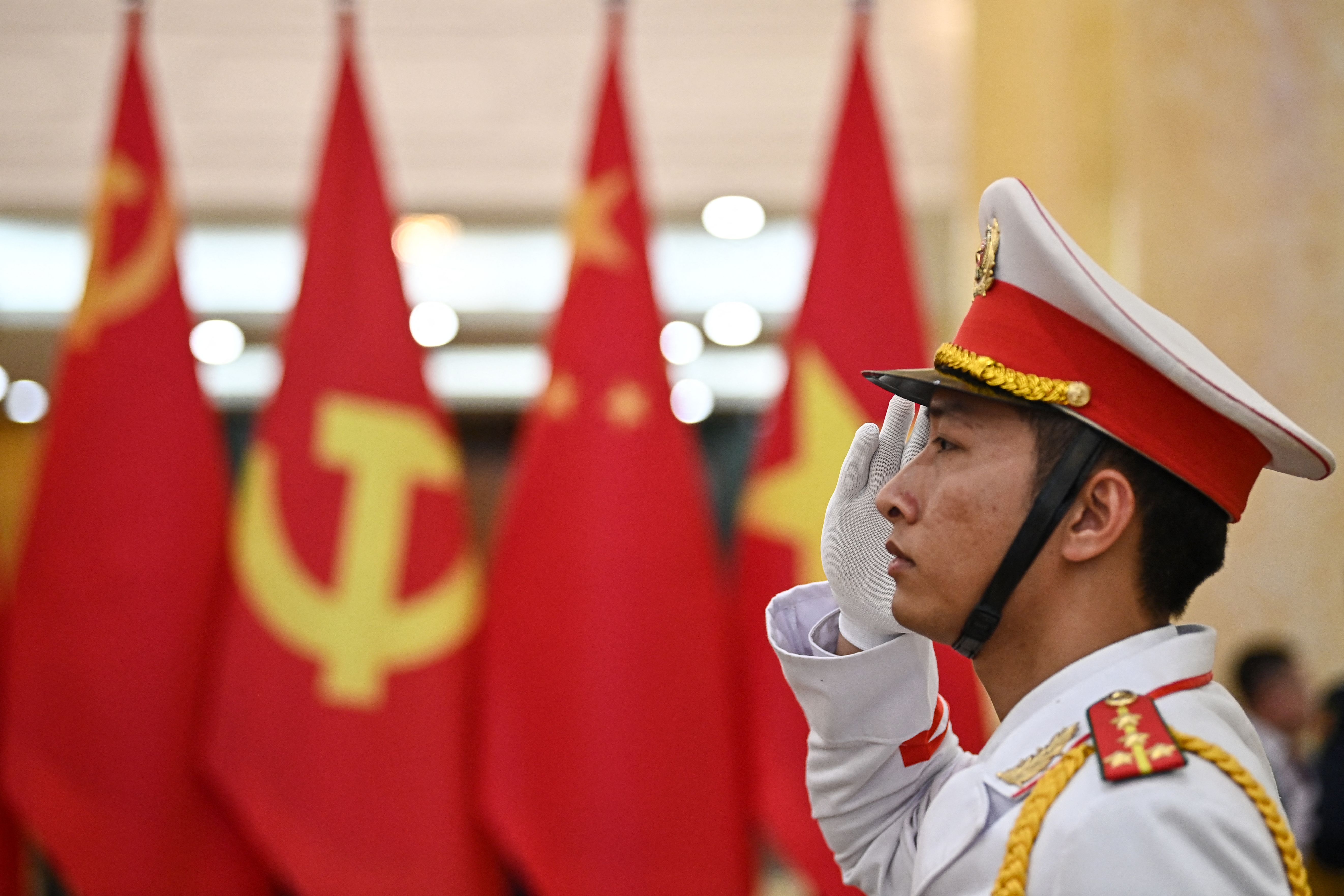
In July 2025, Vietnam and China held their first joint army drill, a modest but symbolic move reflecting Hanoi’s strategic hedging amid U.S.–China rivalry.

Nguyễn Khắc Giang