

Commentary
But their "principal to principal" model will only be as effective as the political strength of each leader back home.
Damien Ma
{
  "authors": [
    "Heather Grabbe",
    "Sinan Ülgen"
  ],
  "type": "other",
  "centerAffiliationAll": "",
  "centers": [
    "Carnegie Endowment for International Peace",
    "Carnegie Europe",
    "Malcolm H. Kerr Carnegie Middle East Center",
    "Carnegie Russia Eurasia Center"
  ],
  "collections": [
    "Turkey’s Transformation",
    "Brexit and UK Politics"
  ],
  "englishNewsletterAll": "",
  "nonEnglishNewsletterAll": "",
  "primaryCenter": "Carnegie Europe",
  "programAffiliation": "",
  "programs": [],
  "projects": [],
  "regions": [
    "Middle East",
    "Europe",
    "Türkiye",
    "Levant"
  ],
  "topics": [
    "Foreign Policy"
  ]
}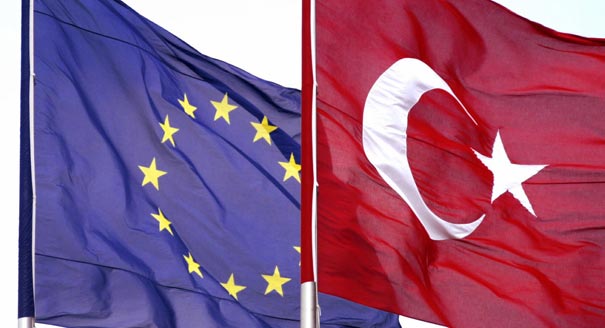
Source: Getty
Turkey and the EU both face urgent foreign and security issues that cannot wait. As a result, they need a new, more effective channel for strategic dialogue to complement the accession process.
Turkey’s membership negotiations with the European Union (EU) have regrettably slowed to a crawl after five years. At least half of the 35 negotiating chapters, or subject areas, which need to be agreed on are blocked on the EU side owing to the problem of Cyprus and France’s opposition to Ankara’s membership. The only hope for progress now is for Turkey to implement the Additional Protocol to the Ankara Agreement that calls on Turkey to lift the restrictions on Cypriot vessels from being admitted to its ports and airports. This would be welcome, but it’s a long shot. Meanwhile, Turkey and the EU both face urgent foreign and security issues that cannot wait. As a result, they need a new, more effective channel for strategic dialogue to complement the accession process.
As longtime supporters of Turkey’s bid to join the EU—both as analysts and policy actors—we oppose anything that could undermine Turkey’s track toward EU accession. We propose a strategic dialogue at several levels to engage Turkey and the EU in resolving regional conflicts and problems of common concern as part of the preparations for membership. An effective dialogue on foreign, security, and defense issues would complement the accession process. It could even help to re-invigorate it by reminding all sides of their many mutual interests.
In practice, the EU and Turkey should adopt informal but regular talks in the form of four meetings per year, at the summit, ministerial, and working levels. The format would be “27-plus-one,” with all of the 27 EU member states and Turkey participating, and intensified dialogue between EU High Representative for Foreign and Security Policy, Baroness Catherine Ashton, and Turkish Foreign Minister Ahmet Davutoglu. In addition, Turkey should meet the EU heads of state and government once a year to discuss major strategic questions.
Rather than focusing on EU-Turkey relations, the agenda should be strategic issues of mutual concern, particularly in the region surrounding Turkey and the current EU members. This initiative should be accompanied by concrete measures to facilitate Turkey’s integration as a valued partner in the framework of the EU’s Common Security and Defence Policy, which guides European strategy.
Heather Grabbe
Grabbe is director of the Open Society European Policy Institute.

Senior Fellow, Carnegie Europe
Sinan Ülgen is a senior fellow at Carnegie Europe in Brussels, where his research focuses on Turkish foreign policy, transatlantic relations, international trade, economic security, and digital policy.
Carnegie does not take institutional positions on public policy issues; the views represented herein are those of the author(s) and do not necessarily reflect the views of Carnegie, its staff, or its trustees.

But their "principal to principal" model will only be as effective as the political strength of each leader back home.

Damien Ma

U.S. unpredictability has allowed China to capitalize on its positioning as the “responsible great power”. Paradoxically, the more China wins the perception game, the more likely expectations will rise for Beijing to deliver not just words but to demonstrate with its deeds.

Chong Ja Ian

Hanoi and Beijing have long treated each other as distant cousins rather than comrades in arms. That might be changing as both sides draw closer to hedge against uncertainty and America’s erratic behavior.

Nguyễn Khắc Giang

Across Asia, China is better positioned to withstand energy shocks from the fallout of the Iran war. Its abundant coal capacity can ensure stability in the near term. Yet at the same time, the country’s energy transition away from coal will make it even less vulnerable during the next shock.
Damien Ma

Malaysia’s chairmanship sought to fend off short-term challenges while laying the groundwork for minimizing ASEAN’s longer-term exposure to external stresses.

Elina Noor