

Research
- +10
Rosa Balfour, Frances Z. Brown, Yasmine Farouk, …
{
  "authors": [
    "Moisés Naím"
  ],
  "type": "legacyinthemedia",
  "centerAffiliationAll": "",
  "centers": [
    "Carnegie Endowment for International Peace"
  ],
  "collections": [],
  "englishNewsletterAll": "",
  "nonEnglishNewsletterAll": "",
  "primaryCenter": "Carnegie Endowment for International Peace",
  "programAffiliation": "",
  "programs": [],
  "projects": [],
  "regions": [
    "East Asia",
    "Japan",
    "North America"
  ],
  "topics": [
    "Economy",
    "Nuclear Energy"
  ]
}
Source: Getty
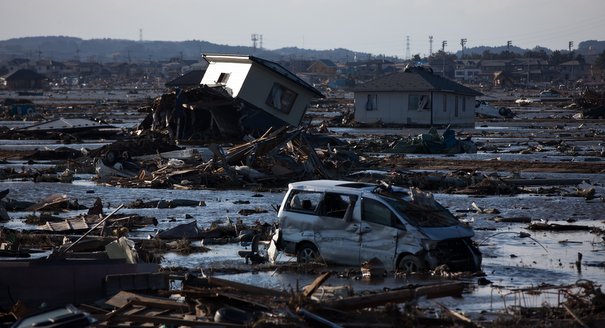
The Japanese earthquake, tsunami, and nuclear incident of 2011 will be remembered as a terrible human tragedy—but not one with lasting economic or financial consequences.
Source: El Pais

The international financial markets are also behaving at odds with what one would expect after such a disaster. They are betting that the Japanese economy recuperates sooner than the images of devastation may suggest. They also bet that the financial impact in other countries will be minor and the long-term economic effects will not be significant.
Less than one week after disaster hit Japan—with the nuclear plants still burning and the stock market in decline—international investment funds specializing in Japanese companies received record amounts of money. That week, investors deposited $956 million; the week before, the amount was a meager $180 million.
The same happened with the currency. Days after the tragedy, the yen reached its highest level since World War II. A currency this strong has very harmful effects on the country’s exports and causes multiple international imbalances. The central banks of the seven most industrialized countries intervened and were able to stabilize the yen at more reasonable levels. This, too, was unusual: central bank coordination of this kind had not happened in over a decade.
The yen had strengthened because the markets anticipated a massive repatriation of Japanese capital deposited in other countries and currencies. As this money will be needed to finance the nation’s reconstruction, demand for the yen will obviously increase. Assuming that this would raise the value of the currency, speculators rushed to buy yen. But in this case some lost their bet: the central banks’ intervention contained the yen’s appreciation.
Those who will probably not lose, however, are the investors betting on Japan’s rapid recovery. While this accident was devastating, the highest estimate of its costs is $300 million, with a majority of analysts estimating the damage at $200 million. If proven correct, this estimate represents only 4 percent of Japanese economic activity and 1 percent of the country’s wealth. Financial Times columnist Martin Wolf points out that in Japan, the world financial crisis had an impact equivalent to 10 percent of its economy, and Japan had the hardest-hit economy among the world’s richest nations. Even though the images we saw in Japan after the financial crisis were not as painful and dramatic as those we see now, the reality is that the 2009 crash affected a vastly larger number of Japanese.
Another calculation is that Japan’s recovery will be as quick as those of other major catastrophes. HSBC’s Garry Evans studied the financial impacts of the earthquakes in Kobe, Japan in 1995, Taiwan in 1999, Chile in 2010, and the September 11 terrorist attacks. He found that after an initial fall, the respective stock markets recovered to their pre-catastrophe level between 23 and 78 days afterward. One hundred days later, they were above this level. Moreover, the economies affected by these disasters grew, thanks to the stimulus sparked by the reconstruction efforts and investments. In 2010, Chile suffered from a devastating earthquake and grew 5 percent. After the Kobe earthquake, Japan’s growth rate also accelerated.
Obviously, Japan’s tragedy has other negative economic effects, many of which may not even be apparent yet. For now it is clear, for example, that global supply chains have been disrupted by the damage to Japan’s manufacturing base. This, in turn, may fuel global inflationary pressures. The insurance sector will also be hard hit, as will the nuclear energy industry. That this will be the case is another conclusion international markets seem to have reached: as the price of most other commodities has soared, that of uranium dropped 30 percent.
The Japanese earthquake, tsunami, and nuclear incident of 2011 will be remembered as a terrible human tragedy—but not one with lasting economic consequences.

Distinguished Fellow
Moisés Naím is a distinguished fellow at the Carnegie Endowment for International Peace, a best-selling author, and an internationally syndicated columnist.
Recent Work



Rosa Balfour, Frances Z. Brown, Yasmine Farouk, …
Moisés Naím
Carnegie does not take institutional positions on public policy issues; the views represented herein are those of the author(s) and do not necessarily reflect the views of Carnegie, its staff, or its trustees.

China’s banking crisis in the 2000s was resolved by transferring the costs to households through financial repression—a decision that recapitalized the banks while exacerbating the structural imbalances that continue to shape the Chinese economy today.

Michael Pettis

Chinese biotech companies have been on the receiving end of U.S. economic coercion. Yet their responses have differed significantly because firm and state interests are not uniformly aligned. For Washington, treating all Chinese tech firms the same, irrespective of their actual interests, risks pushing them farther into Beijing’s corner.

Xue Gong

Across Asia, China is better positioned to withstand energy shocks from the fallout of the Iran war. Its abundant coal capacity can ensure stability in the near term. Yet at the same time, the country’s energy transition away from coal will make it even less vulnerable during the next shock.

Damien Ma

In the latest Five-Year Plan, the Chinese president cements the shift to an innovation-driven economy over a consumption-driven one.
Damien Ma

Rather than climate ambitions, compatibility with investment and exports is why China supports both green and high-emission technologies.

Mathias Larsen