

Q&A
Detlef Waechter
{
  "authors": [
    "Detlef Waechter"
  ],
  "type": "other",
  "centerAffiliationAll": "dc",
  "centers": [
    "Carnegie Endowment for International Peace",
    "Carnegie Russia Eurasia Center"
  ],
  "collections": [
    "U.S. Nuclear Policy"
  ],
  "englishNewsletterAll": "ctw",
  "nonEnglishNewsletterAll": "",
  "primaryCenter": "Carnegie Endowment for International Peace",
  "programAffiliation": "NPP",
  "programs": [
    "Nuclear Policy"
  ],
  "projects": [],
  "regions": [
    "North America",
    "United States",
    "Western Europe"
  ],
  "topics": [
    "Nuclear Policy",
    "Global Governance"
  ]
}
Source: Getty
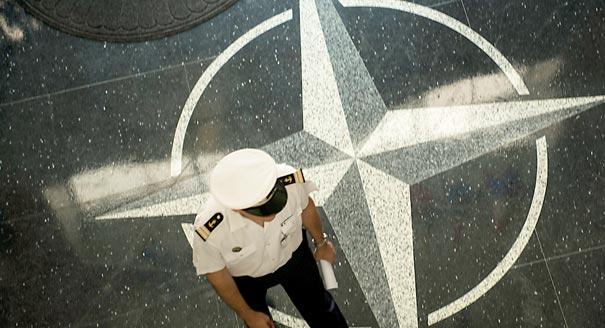
As NATO debates its future nuclear policy, it should focus on concrete measures to maintain a credible nuclear deterrent in the medium term and avoid abstract debates over complete disarmament or the need to keep nuclear weapons indefinitely.
With NATO again debating its future nuclear policy—including the role of its tactical nuclear forces—it should focus on concrete measures to maintain a credible nuclear deterrent in the medium term and avoid abstract debates over complete disarmament or the need to keep nuclear weapons indefinitely. Policy makers should seriously consider a fuller range of options to develop a credible nuclear deterrent and to explore Russia’s interest in reducing short-range nuclear forces alongside other categories of weapons. Although quick breakthroughs on a new round of arms control arrangements are highly unlikely, it is worth making a concerted effort to reach an agreement on NATO’s nuclear posture before the next NATO summit in 2012.
At its most recent summit in Lisbon last November, NATO’s members tasked the North Atlantic Council—the principal decision-making body—with a general review of the Alliance’s “overall defence and deterrence posture.” Rather than focusing specifically on nuclear issues—which many observers had sought—this overall posture review will look at the interconnections of nuclear weapons, missile defense, and conventional capabilities.
As the Council undertakes this review, it must approach its work carefully. Otherwise, thorny nuclear issues could revive the Alliance’s fierce pre-Lisbon dispute—and derail an important opportunity to move toward nuclear disarmament while maintaining credible nuclear deterrence in a nuclear-armed world. Specifically, NATO should avoid theoretical debates about disarmament, the principles of deterrence, or the potential strategic effects of European anti-ballistic missile defense.
Instead, NATO should focus its efforts on developing a concrete nuclear posture. Its nuclear assets are aging. Disarmament by default is not a sound option for a serious and coherent military alliance. NATO must carefully examine whether the present posture is technologically, financially, and politically sustainable and, if not, what changes are necessary to guarantee credible deterrent capabilities.
Former Visiting Scholar, Nuclear Policy Program
Waechter is a visiting scholar in Carnegie’s Nuclear Policy Program, where his research focuses on NATO, nuclear, security and disarmament policy.
Recent Work
Detlef Waechter
Detlef Waechter
Carnegie does not take institutional positions on public policy issues; the views represented herein are those of the author(s) and do not necessarily reflect the views of Carnegie, its staff, or its trustees.

China has showcased its engineering prowess with small modular reactor demonstration projects. But turning these technological achievements into commercial success will be a greater challenge.

Tong Zhao

The nuclear relationship between China and the United States is increasingly shaped by widening perception gaps rather than deliberate strategic design.
Tong Zhao

But their "principal to principal" model will only be as effective as the political strength of each leader back home.

Damien Ma

U.S. unpredictability has allowed China to capitalize on its positioning as the “responsible great power”. Paradoxically, the more China wins the perception game, the more likely expectations will rise for Beijing to deliver not just words but to demonstrate with its deeds.

Chong Ja Ian

For Malaysia, the conjunction that works is “and” not “or” when it comes to the United States and China.

Elina Noor