

Commentary
But their "principal to principal" model will only be as effective as the political strength of each leader back home.
Damien Ma
{
  "authors": [
    "Deborah Gordon",
    "Shin-pei Tsay"
  ],
  "type": "legacyinthemedia",
  "centerAffiliationAll": "dc",
  "centers": [
    "Carnegie Endowment for International Peace"
  ],
  "collections": [],
  "englishNewsletterAll": "ctw",
  "nonEnglishNewsletterAll": "",
  "primaryCenter": "Carnegie Endowment for International Peace",
  "programAffiliation": "SCP",
  "programs": [
    "Sustainability, Climate, and Geopolitics"
  ],
  "projects": [],
  "regions": [
    "North America",
    "United States"
  ],
  "topics": [
    "Climate Change"
  ]
}
Source: Getty
The establishment of an oil price floor could reduce the mounting budget deficit, restore the solvency of the U.S. transportation system, dampen the impact of volatile oil markets, and spur transportation innovation.
Source: The Hill

This simple action would reduce the mounting budget deficit, restore the solvency of a crumbling transportation system, dampen the impact of volatile oil markets, and awaken American innovation.
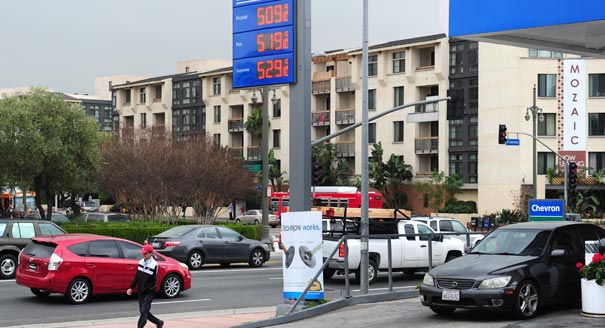
Nothing is more endemic to the American way than cheap oil. This has made recent spikes in oil prices all the more unsettling. But, despite the protests at the pump, there is a disconcerting disconnect between the immediate shock of putting more of your paycheck into the gas tank and the brutal truth about what is really at stake in terms of long-term American security.
Our transportation system is going broke. Higher gas prices are not bringing in a single extra cent to fund infrastructure or services—and we need it. The 18.4 cents per gallon assessed for federal gas taxes has been frozen at the same level since 1993. This paltry, fixed amount is collected whether a gallon of gas costs slightly over $2, as it did just two years ago, or approaches $4, as it is today.
The current total transportation deficit —general fund transfers, interest fund debt, deferred maintenance, productivity deficit, and hidden budgetary costs —is estimated at $100 billion and growing.
We don’t have adequate resources to meet the transportation challenges of the 21st century brought on by higher oil prices. And thus, we don’t have another choice but to fill up at the gas pump despite rising oil prices.
If the lion’s share of the money Americans are shelling out for gas isn’t going to the federal government to pay for roads, trains, bridge repair, and public transit, then where is it going?
This week, the answer to this puzzle became crystal clear as ExxonMobil (and the other Big Oil companies) reported first-quarter earnings. Anger rose as Americans found out that they have made the world’s richest corporations vastly wealthier. ExxonMobil pocketed over $10 billion in the last three months, nearly as much as it earned in all of 2002. And record profits will be made this year if oil prices continue to rise. Based on analysis using data over the past decade, every $10 increase in the world oil price (or 25-cent increase in gas price) yields nearly $5 billion more in profits posted by ExxonMobil alone.
If there is a take-away from these outrageous profits, it is that we cannot control world oil prices or the proceeds that flow to Big Oil. Oil is a risky business for oil companies and consumers alike. Dysfunctional at best, oil markets are subject to geopolitics, civil unrest, natural disasters, and speculation on a global scale. So what can be done to assuage public concern about increasing gasoline prices?
Certainly, the billions of federal dollars doled out as oil industry tax breaks and subsidies must be repealed. Congress must follow through immediately. Big Oil can surely take care of itself without the assistance of hard-earned tax dollars.
Second, while shocking to many, motorists must face up to the fact that the price they pay at the pump does not sustain a workable national transportation system. The growing shortfall in gas tax receipts means deferring maintenance, borrowing from general funds, and contributing to the deficit.
We are simply not paying enough to acquire world-class mobility and this seriously hampers our economic growth now and global competitiveness in the years to come. We’ve also seen the risks of underfunding much needed repairs—America’s transportation system, mainly built in the mid-20th century, is rapidly aging.
Finally, policy makers must redouble their efforts to transform America’s energy position from one of fragility to one of sustained fortitude. This means establishing an oil price floor on the order of $3.50 per gallon—a reduction from current pump prices—to spur technological innovation and stimulate the commercialization of alternatives to oil and autos.
Consumers should be able to manage these lower levels once they have adapted to even higher gas prices. That way, when the price of oil comes crashing down—as it always seems to do—motorists won’t be confounded. The extra revenue collected during times of low crude prices could also put an end to debt-fueled transportation spending. Such a policy is thoroughly rational, and starts us on a path to a cleaner, solvent, and more robust transportation system.
As public discontent rises along with gas prices, it’s high time to examine long-held beliefs and abandon old habits. It’s time for a reality check at the pump. We must do what it takes to secure long-term U.S. mobility in the face of mounting oil prices.

Former Director and Senior Fellow, Energy and Climate Program
Gordon was director of Carnegie’s Energy and Climate Program, where her research focuses on oil and climate change issues in North America and globally.

Former Nonresident Associate, Energy and Climate Program
Shin-pei Tsay was a nonresident associate in the Energy and Climate Program at the Carnegie Endowment for International Peace.
Carnegie does not take institutional positions on public policy issues; the views represented herein are those of the author(s) and do not necessarily reflect the views of Carnegie, its staff, or its trustees.

But their "principal to principal" model will only be as effective as the political strength of each leader back home.

Damien Ma

U.S. unpredictability has allowed China to capitalize on its positioning as the “responsible great power”. Paradoxically, the more China wins the perception game, the more likely expectations will rise for Beijing to deliver not just words but to demonstrate with its deeds.

Chong Ja Ian

For Malaysia, the conjunction that works is “and” not “or” when it comes to the United States and China.

Elina Noor
Regulation, not embargo, allows Beijing to shape how other countries and firms adapt to its terms.

Alvin Camba
Beijing believes that Washington is overestimating its own leverage and its ability to handle the trade war’s impacts.


Rick Waters, Sheena Chestnut Greitens