{
  "authors": [
    "Nathan J. Brown"
  ],
  "type": "legacyinthemedia",
  "centerAffiliationAll": "dc",
  "centers": [
    "Carnegie Endowment for International Peace",
    "Malcolm H. Kerr Carnegie Middle East Center"
  ],
  "collections": [
    "Arab Awakening"
  ],
  "englishNewsletterAll": "menaTransitions",
  "nonEnglishNewsletterAll": "",
  "primaryCenter": "Carnegie Endowment for International Peace",
  "programAffiliation": "MEP",
  "programs": [
    "Middle East"
  ],
  "projects": [],
  "regions": [
    "North Africa",
    "Egypt"
  ],
  "topics": [
    "Political Reform"
  ]
}
Source: Getty
In The Media
The Muslim Brotherhood as Helicopter Parent
The Muslim Brotherhood’s tight control over the Freedom and Justice Party could produce tension between those seeking large numbers of votes for the party and others who wish to focus on fulfilling the Brotherhood's mission.
The Muslim Brotherhood as Helicopter ParentSoon after I began teaching, a student came to my office hours because she had been ill and missed a portion of the class. That was not unusual -- but what did seem a bit out of the ordinary was that she brought her mother. I explained to the student that she could take an incomplete but that I advised this only as a last resort, since it would not be easy to make up the work after she had begun a new set of courses the next semester. Her mother piped in, "He's right honey. You know how I feel about incompletes." I had encountered my first "helicopter parent"-- those who hover closely over their grown sons and daughters, monitoring their choices, offering unsolicited advice, and intervening in their daily interactions.
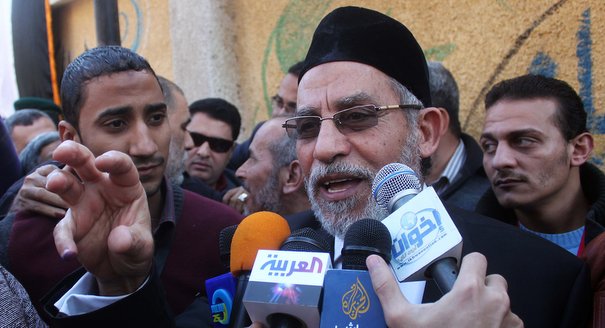
There is no image that better captures the behavior of Egypt's Muslim Brotherhood toward the political party it claims only to be launching, and that may be a problem for Egyptian democracy. The new Freedom and Justice Party will be free, says the parent Muslim Brotherhood, to make its own choices. But the Brotherhood as helicopter parent cannot resist suggesting to its offspring who the new party's leaders will be, what it stands for, how it will be organized, who should join it, and who its candidates will be. The party is completely independent in decision making -- so long as it does precisely what it is told. And actually, it is not only the party that is being told what to do -- individual members of the Brotherhood movement have been told to join no other party and to obey movement discipline in the political realm. This kind of relationship between movement and party is already making the Brotherhood a difficult partner for other political actors; over the long term, it may make the Islamists awkward electoral actors.
A close relationship between party and movement was to be expected, but this relationship is more than close; it is micromanaged. In a recent meeting of the Muslim Brotherhood's Consultative Council (a policy making body with approximately 100 members that had not been able to gather in the Mubarak years for fear of arrest), as well as in a series of other decisions widely reported in the Egyptian press, the protective parent movement has taken the following steps:
After repeatedly insisting that the party would be able to select its own leader, the Brotherhood has been unable to resist giving its offspring an unusually generous gift: three members of its top body, the Guidance Bureau, will move over to the party to run it.All three (Mohammed Morsi, Saad al-Katatni, and Essam al-Arian) are skilled and experienced in all sorts of ways -- in speaking to the press, organizing and running movement affairs, and serving as parliamentarians.While their personalities are very different, all come across as very capable figures. But all three also stand out as very loyal to the Brotherhood movement.
The movement (and not the party) is also said to have put the finishing touches on the party platform. And that platform is not likely to be a terse or vague document; earlier leaked drafts suggested a very detailed set of policy proposals.
The movement has not only written the party's platform, it has also approved its bylaws.In the process, it has left its very strong imprint.Those bylaws, for instance, make clear that the party is dedicated to peaceful and gradual reform along Islamic lines. Reform of what? The party aims to "reform the individual, the family, the society, the government, and then institutions of the state." Reforming political institutions is standard stuff. But it takes a very special kind of political party to tell voters that it wants to reform them and their families as well.Actually, that is the traditional mission of the parent Brotherhood movement -- it makes much more sense for a movement like the Brotherhood to focus on helping its members improve themselves than it does for a party to run on reforming the individual and the family as a program
The movement (and not the party) has decided that it will contest up to one-half of the seats in parliament. (Earlier, movement leaders had consistently suggested they would seek at most one-third of the seats, though they were often careful to add that no final decision had been made.) The raised electoral horizons for the party were not well explained -- the most plausible argument was that competing for the extra seats would be the best way to ensure that the party would wind up with the target it seems to want: something like one-quarter to one-third of parliamentary seats; the crossed signals surrounding the decision may have also been an outcome of transferring authority from the small and more cohesive Guidance Bureau to the larger, more diverse, and less wieldy Consultative Council.
The movement is not only determining the number of candidates for upcoming parliamentary elections; it also seems to be picking the names.According to at least one account, the movement is actually preparing separate candidate lists, some for a party list system(full of skilled parliamentarians), and some for a district-based system (full of those likely to serve their local constituencies well).The final list of candidates will therefore not be determined until the new electoral law makes clear the blend of list and district voting.
The movement has also made clear how much it expects its members to be bound by its guidance in the political realm. Brotherhood members are not required to join the party, but they are told not to join any other.The movement decided that its members will not contest the presidency; if former Guidance Bureau member Abd al-Minaam Abu al-Futuh actually files for candidacy, that will likely be grounds to evict the estranged leader from the organization. There are numerous accounts that the Brotherhood is going beyond telling its members what not to do; local branches are also reportedly suggesting which of their members should go into the political work of the party.
When pressed about their close management of the party, movement officials react defensively: this is only to get the party off the ground, they claim. Once it is founded, it is free to evolve as its members see fit. But with its structure, leaders, members, and program so closely shaped by the movement, it is not likely it will evolve very much at all.
The movement is currently exploring its options in realms far from the political sphere. It has suggested intentions of forming youth clubs, broadcast media, and even soccer teams (leading to some Egyptians joking that Brotherhood players will follow the path of the political party by seeking only to tie every game). If the Brotherhood does develop in so many different directions while keeping close control over the various aspects of the movement, it will post difficulties for Egyptian democratic institutions. Historically, it is precisely the Brotherhood's broad focus and diverse interests that has made it a difficult coalition partner. When a secular political leader sits down with someone from the Brotherhood, he or she finds that the potential partner is cautious, anxious to protect a broad range of activities, and wary about committing to specific agendas or compromise over programmatic issues.
Recently the Brotherhood's general guide explained that while the movement stands for democracy and freedom, it did so within an Islamic reference and that "democracy cannot make permitted what is forbidden, or forbid what is permitted" in religious terms, "even if the entire nation agrees to it." Such a general formula actually has an ironically populist resonance in what remains a fairly conservative and religious society. The problem will come when the movement's leaders watch closely to ensure that the party interpret that general formula in accordance with its own strict instructions. Other political actors will likely find that a Brotherhood party tied closely to such a movement to be a difficult partner in the rough-and-tumble game of democratic politics. And indeed, the revolutionary coalition that brought down Husni Mubarak is already showing serious signs of fraying over precisely such issues. The Brotherhood absented itself from some recent meetings and demonstrations held by other political forces with an oppositional flavor. But it did not hesitate to send its representatives to an official sanctioned gathering.
The close relationship with the movement will probably serve the party well in the electoral realm -- in the short term. It will have a nationwide army of dedicated workers to organize its campaign. But in the long term, the movement and party have very different organizational impulses. A party interested in winning elections wants to attract large numbers of voters. A movement interested in an ideological mission is more concerned with the level of commitment of its core supporters. In recent days, a former Brotherhood parliamentarian was videotaped telling Brotherhood members that they should only marry within the movement. It is that sort of insular attitude -- one that served the movement well under harsh authoritarian conditions -- that makes the transition to mass democratic politics such a challenge. But with the close watch the movement is keeping over the party, the tension between seeking large numbers of votes and fulfilling the movement's mission is not likely to be felt over the short term.
To compare the Freedom and Justice Party to my student contemplating an incomplete is not an exact analogy. When it comes to democratic transformation, the party's helicopter parent is giving its offspring the precise opposite advice to that provided by my student's mother: it is very much recommending an incomplete.
Nathan J. Brown, a professor of political science and international affairs at George Washington University, is a distinguished scholar and author of nine books on Arab politics and governance, as well as editor of five books.
Carnegie does not take institutional positions on public policy issues; the views represented herein are those of the author(s) and do not necessarily reflect the views of Carnegie, its staff, or its trustees.
The murder of George Floyd has underscored the deep inequities that have long plagued American society. In a note to the Carnegie community, Bill Burns reflects on Carnegie’s commitment to build a more just future here at home and around the world, without which peace will remain beyond our grasp.
While the world hoped this pandemic might lead to more cooperation between these two great powers, American and Chinese leaders instead fell into a blame game and allowed their increasing suspicions to guide their decision-making.
Biological viruses and computer malware differ in important respects. They have considerable potential to spread widely, invading, disrupting and destroying their targets.