

Commentary
It’s about managing oil prices, bread prices, and strategic partnerships.
- +8
Amr Hamzawy, Karim Sadjadpour, Aaron David Miller, …
{
  "authors": [],
  "type": "other",
  "centerAffiliationAll": "",
  "centers": [
    "Carnegie Endowment for International Peace"
  ],
  "collections": [],
  "englishNewsletterAll": "",
  "nonEnglishNewsletterAll": "",
  "primaryCenter": "Carnegie Endowment for International Peace",
  "programAffiliation": "",
  "programs": [],
  "projects": [],
  "regions": [
    "North Africa",
    "Egypt"
  ],
  "topics": []
}
Source: Getty
A backgrounder on the Freedom and Justice Party
This resource was published on 09/22/2011 and is not updated to reflect changing circumstances.
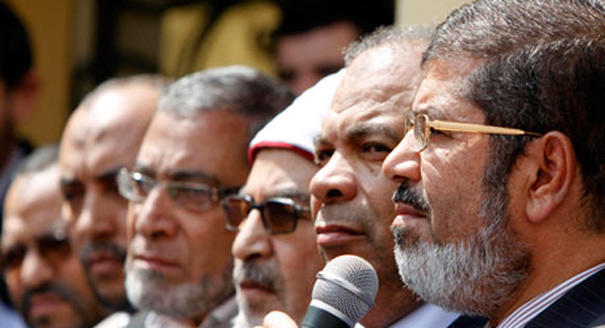
The Freedom and Justice Party was formed by the Muslim Brotherhood in May 2011 and is the dominant Islamist party in Egypt. Aware of the fears that surround its participation, the party defines itself as a “civil” party rather than an Islamic one and has formed the Democratic Alliance with a number of liberal and leftist parties.
Mohammed Morsi: President
Rafiq Habib: Vice president
Essam al-Arian: Vice president and spokesman
Saad al-Katatny: Secretary-General
The Egyptian Muslim Brotherhood underwent a long period of ideological transformation as Egypt returned to multiparty elections under President Anwar Sadat and then President Hosni Mubarak. Under the influence of younger, reform-minded leaders, the Brotherhood came to accept that democratic processes were compatible with Islam.
Beginning with the parliamentary elections of 1984, the Muslim Brotherhood even began presenting some candidates. Banned from forming a political party, it was forced to present its candidates either under the auspices of other parties or as independent candidates. The high point of the Muslim Brotherhood electoral participation came in 2005, when its members, running as independents, won 20 percent of the lower house seats. Strong repression by the government ensured that such success was never repeated.
After the 2011 uprising, the law on political parties was modified. Although the registration of political parties with a religious identity was still banned, the Muslim Brotherhood was able to register the Freedom and Justice Party, presenting it as a “civil” party.
Controversy continues to surround the party. Fear of an Islamist victory is rife in many sectors of Egyptian society. More specifically, an extremely controversial platform for a political party floated by the Muslim Brotherhood in 2007 alarmed many by proposing the creation of a clerical committee to review legislation for compliance with Islamic law and another to prohibit women and non-Muslims from running for president. Although the organization later repudiated the most extreme features of the platform, doubts still remain about the new party’s real intentions.
Carnegie does not take institutional positions on public policy issues; the views represented herein are those of the author(s) and do not necessarily reflect the views of Carnegie, its staff, or its trustees.
It’s about managing oil prices, bread prices, and strategic partnerships.



Amr Hamzawy, Karim Sadjadpour, Aaron David Miller, …
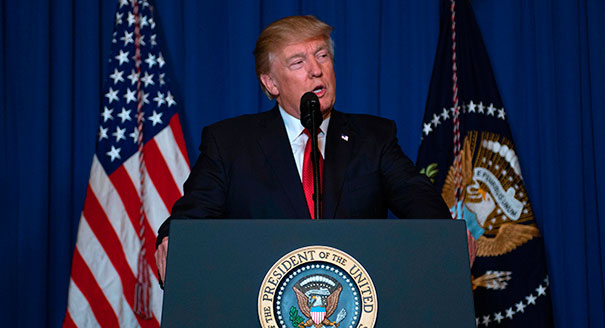
It remains to be seen whether recent foreign policy pivots by the Trump administration amount to a departure from its earlier views about America’s role in the world.

William J. Burns
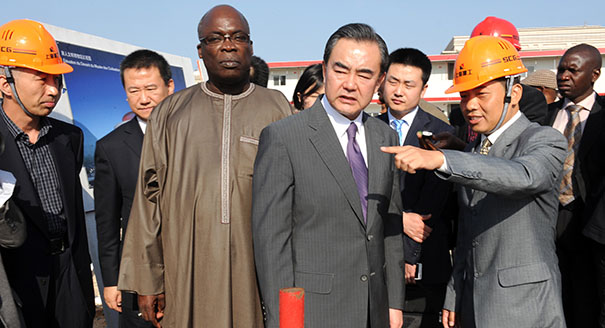
China’s relationship with Africa is becoming increasingly more complex as the country continues to invest and send workers across 54 countries on the continent.

Matt Ferchen
The world reacts to the election of Donald Trump and its potential implications.


Thomas Carothers, Lizza Bomassi, Amr Hamzawy, …
The Islamic State’s ideology is multifaceted and cannot be traced to one individual, movement, or period. Understanding it is crucial to defeating the group.
Hassan Hassan