

Other
Michael D. Swaine
{
  "authors": [
    "Michael D. Swaine"
  ],
  "type": "legacyinthemedia",
  "centerAffiliationAll": "dc",
  "centers": [
    "Carnegie Endowment for International Peace",
    "Carnegie China"
  ],
  "collections": [
    "China’s Foreign Relations",
    "U.S.-China Relations"
  ],
  "englishNewsletterAll": "asia",
  "nonEnglishNewsletterAll": "",
  "primaryCenter": "Carnegie China",
  "programAffiliation": "AP",
  "programs": [
    "Asia"
  ],
  "projects": [],
  "regions": [
    "East Asia",
    "China",
    "North America",
    "United States",
    "South Asia",
    "India",
    "Southeast Asia"
  ],
  "topics": [
    "Political Reform",
    "Security",
    "Military",
    "Foreign Policy",
    "Arms Control"
  ]
}
Source: Getty
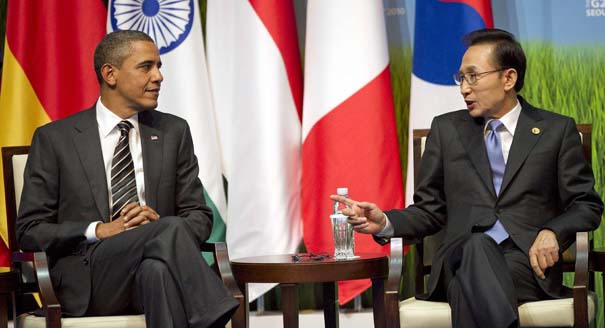
The execution of America’s strategic 'pivot' to Asia, and China's response, are combining to deepen mutual suspicions and potentially destabilize the entire area.
Source: National Interest

At that time, Washington moved decisively away from viewing China ominously as a rising "strategic competitor" (to quote George W. Bush) and toward significant levels of Sino-U.S. cooperation in combating terrorism and dealing with a growing array of common problems, from climate change to global economic instability. This shift brought Washington’s approach back into line with an earlier, long-standing U.S. policy of fostering greater Sino-American engagement while conducting low-key military hedging against the possibility of a future hostile China.
With President Obama and Secretary Clinton's recent trips to the South and Western Pacific, expanding U.S. involvement in multilateral economic and security-related fora, and a strengthening of Washington's traditional military alliances, the United States is now signaling an intention to move back toward the pre-9/11 strategic focus on a rising China. That focus places a premium on explicitly balancing against and constraining Chinese power and influence across the region.
This piece was originally published at the National Interest. Click here to continue reading.

Former Senior Fellow, Asia Program
Swaine was a senior fellow at the Carnegie Endowment for International Peace and one of the most prominent American analysts in Chinese security studies.
Recent Work
Michael D. Swaine
Michael D. Swaine
Carnegie does not take institutional positions on public policy issues; the views represented herein are those of the author(s) and do not necessarily reflect the views of Carnegie, its staff, or its trustees.

The Plaza Accord was not an externally imposed punishment of Japan but part of a broader restructuring that Japanese economists and policymakers themselves recognized was necessary. Its effects were undermined, however, when Tokyo responded to the resulting slowdown with policies that exacerbated investment, credit expansion, and the very imbalances the adjustment was intended to resolve.

Michael Pettis

The nuclear relationship between China and the United States is increasingly shaped by widening perception gaps rather than deliberate strategic design.

Tong Zhao
China’s banking crisis in the 2000s was resolved by transferring the costs to households through financial repression—a decision that recapitalized the banks while exacerbating the structural imbalances that continue to shape the Chinese economy today.
Michael Pettis

Chinese biotech companies have been on the receiving end of U.S. economic coercion. Yet their responses have differed significantly because firm and state interests are not uniformly aligned. For Washington, treating all Chinese tech firms the same, irrespective of their actual interests, risks pushing them farther into Beijing’s corner.

Xue Gong

China’s latest energy plan explicitly calls for integrating data centers into the electricity system, particularly connecting them to green energy. It appears Beijing wants to use compute as a source of domestic demand to absorb renewables excess capacity.

Damien Ma