

In The Media
David Rothkopf
{
  "authors": [
    "David Rothkopf"
  ],
  "type": "legacyinthemedia",
  "centerAffiliationAll": "",
  "centers": [
    "Carnegie Endowment for International Peace"
  ],
  "collections": [],
  "englishNewsletterAll": "",
  "nonEnglishNewsletterAll": "",
  "primaryCenter": "Carnegie Endowment for International Peace",
  "programAffiliation": "",
  "programs": [],
  "projects": [],
  "regions": [
    "North America",
    "United States"
  ],
  "topics": [
    "Political Reform",
    "Foreign Policy"
  ]
}
Source: Getty
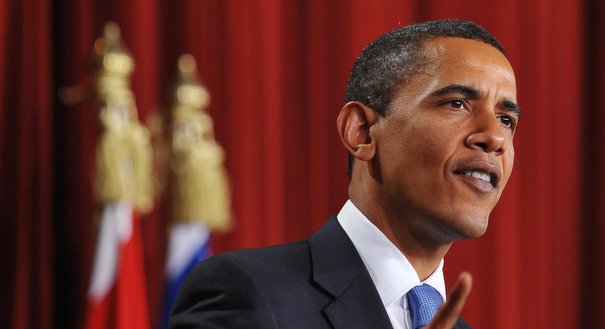
As President Obama prepared to deliver his remarks to the United Nations General Assembly, the world that had been so supportive had turned less receptive.
Source: CNN

Back then, he seized the moment with great speeches that offered a vision for a new era in American leadership. In Cairo, he spoke of new relations with the Islamic world. In Prague, he spoke of eliminating nuclear weapons. He embraced the G-20 as a mechanism of coordinating the response to the global economic crisis. He didn't bully. He charmed.
Indeed, Obama is probably the first person ever to be awarded the Nobel Peace Prize largely for his charm. Or, alternatively, he may be the first person ever to have won the Nobel Peace Prize for the simple achievement of not having been the guy who had the job before him. (This can be an important achievement. Former U.S. Commerce Secretary Pete Peterson once said one of the secrets to job success is picking the right predecessor.)
It was a great start. But the problem with great speeches of the kind Obama delivered then is that they contain promises, and if those promises are not kept future speeches not only ring hollow, they are reminders of what has not been fulfilled. As President Obama prepared to deliver his remarks Tuesday to the U.N. General Assembly, the world that had been so supportive had turned less receptive.
The echoes of his Cairo speech seemed very faint indeed as neither Obama nor Mohammed Morsy, Egypt's new president, seemed to know how to characterize the U.S. relationship with that country, once an important ally in the region. Further, the hope for a new relationship with Islam seemed deeply damaged in the wake of recent anti-American protests and the killings in Benghazi, Libya.
The Prague speech's promise of a world without nuclear weapons was predicated on the idea that the world's two most important nuclear powers, the United States and Russia, would move to a more constructive relationship. That has not happened. The relationship is deeply strained. And the threat of proliferation of nuclear weapons to Iran was a central subject of the president's remarks. He said such a threat could not be contained and therefore the United States would not tolerate it arising. But clearly, the question mark associated with past unkept promises hung in the air over that firmly delivered assertion.
Obama was awarded the Nobel Peace Prize on the assumption that he would be the president who got the United States out of the wars in the greater Middle East that had cause so much dissent during the Bush presidency. But Obama subsequently chose to increase the U.S. troop presence in Afghanistan. He serially violated national borders with special operations missions, drones and cyber-attacks. He changed U.S. doctrine but seemed to continue to embrace a "we'll do what we choose" American exceptionalism. The notion that the Middle East is itself somehow more peaceful today than it was when he received that prize is ludicrous.
The United States has turned away from the G-20 as the primary mechanism of global economic cooperation. Indeed, the president has turned away from the United Nations for campaign purposes, stopping only for a speech and campaign press appearances, not to meet with international leaders.
It would be wrong to suggest that President Obama is solely responsible for these developments. He could no more control the Arab street than he could the behind-the-scenes machinations of a tin-pot thug like Vladimir Putin. He has racked up some considerable foreign policy achievements as well. America is out of Iraq. Bin Laden is dead. So too is Ghadafi.
The U.S. economy is slowly turning a corner. And the president has been blessed with an adversary in this campaign who responds to every potential crisis for the president with a bigger self-inflicted crisis for his own campaign. Indeed, it sometimes seems that the GOP would be better running with no candidate at all than the one they have got.
Speaking to the United Nations, President Obama tried to evoke the strength and promise of that first year. His language was soaring and his themes were resonant. He evoked the kind of understanding for international perspectives that were signatures of that first year in office. Of the costs to the Middle East of intolerance. Of the strength of American values like free speech and government for, by and of the people.
It was apparent once again that this was a compassionate president and a man of good values. But for every strong assertion that echoed through the hall, the echoes of three years of past speeches added a question: Are good values enough? Can this president, any president, any man or woman, deliver the results that would have warranted that premature prize Barack Obama was awarded in 2009?
Was it not so much an award to a man as it was to an idea of the leadership we have ever since needed but have yet to find? Barack Obama right now has his sights clearly set on the challenge of winning the November election. But for him, that is a far smaller hurdle than what awaits if he wins: one last chance to live up to the hope that ushered him into office, one last chance to earn the prize he has already won.
Former Visiting Scholar
David Rothkopf was a visiting scholar at the Carnegie Endowment as well as the former CEO and editor in chief of the FP Group.
Recent Work
David Rothkopf
David Rothkopf
Carnegie does not take institutional positions on public policy issues; the views represented herein are those of the author(s) and do not necessarily reflect the views of Carnegie, its staff, or its trustees.

US unpredictability has allowed China to capitalize on its positioning as the “responsible great power”. Paradoxically, the more China wins the perception game, the more likely expectations will rise for Beijing to deliver not just words but to demonstrate with its deeds.

Chong Ja Ian

Hanoi and Beijing have long treated each other as distant cousins rather than comrades in arms. That might be changing as both sides draw closer to hedge against uncertainty and America’s erratic behavior.

Nguyễn Khắc Giang

Across Asia, China is better positioned to withstand energy shocks from the fallout of the Iran war. Its abundant coal capacity can ensure stability in the near term. Yet at the same time, the country’s energy transition away from coal will make it even less vulnerable during the next shock.

Damien Ma

Malaysia’s chairmanship sought to fend off short-term challenges while laying the groundwork for minimizing ASEAN’s longer-term exposure to external stresses.

Elina Noor

For Malaysia, the conjunction that works is “and” not “or” when it comes to the United States and China.
Elina Noor